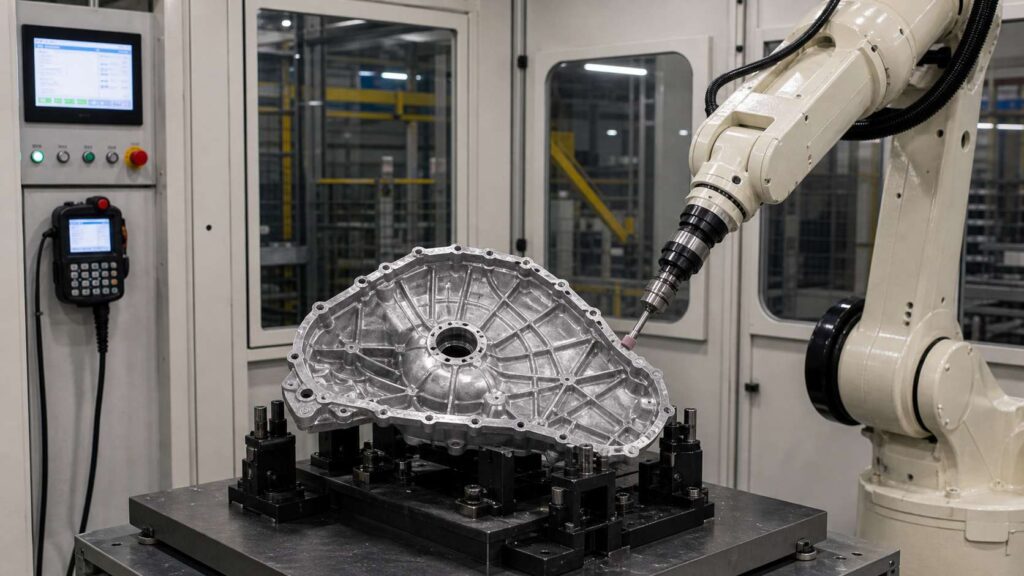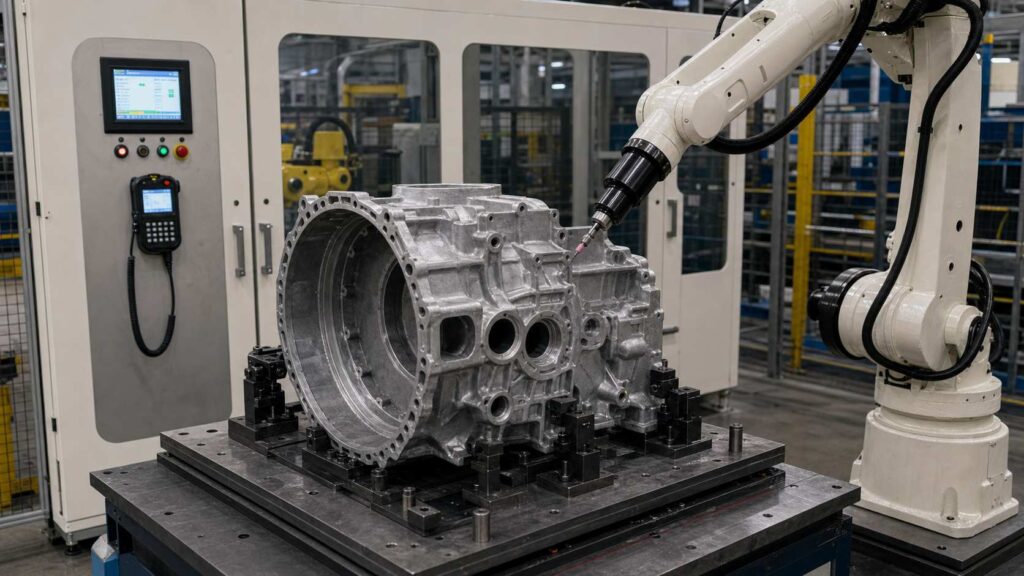
Large aluminum alloy engine gear housings are structural casting components used in automotive engine timing and gear transmission systems. Based on typical gear housing workpieces, this part includes a large cavity opening, gear chamber areas, shaft holes, mounting holes, sealing flanges, reinforced ribs, thick wall sections and irregular outer contours, making post-casting deburring and local grinding more complex than on simple aluminum castings.
This robotic deburring and grinding solution is designed for large aluminum alloy engine gear housings with typical dimensions around 400–750 mm in length, depending on the engine model. It helps remove burrs, flash, parting line residues, sharp edges and local gate marks from cavity openings, shaft holes, mounting holes, sealing flanges, rib transitions and outer contours while improving finishing consistency and reducing manual grinding workload.
What Is a Large Aluminum Alloy Engine Gear Housing?
A large aluminum alloy engine gear housing is a structural casting used to enclose and protect engine gear transmission systems. It is commonly mounted at the front or side of the engine block and houses timing gears, drive gears, bearing supports and related transmission components. Compared with an engine cylinder head or cylinder block, the gear housing focuses on gear chamber protection, shaft alignment and sealing rather than combustion or fluid passage functions.
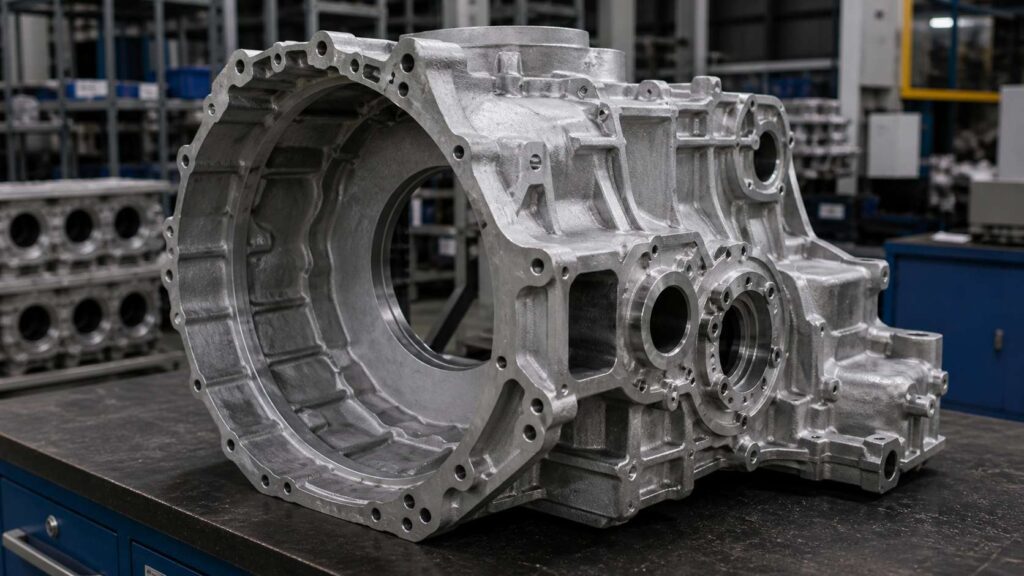
Based on typical sample structures, this workpiece has a large cavity opening for gear access, multiple shaft holes for gear shafts, bolt holes for mounting, continuous sealing flanges, reinforced ribs for structural strength, thick wall sections and local boss features. After casting, trimming and rough machining, burrs, flash, parting lines, gate residues or sharp edges may remain around cavity boundaries, shaft hole edges, mounting holes, flange edges, rib intersections and outer contours.
For this type of workpiece, the main finishing requirement is robotic deburring, controlled local grinding and edge cleanup rather than decorative polishing.
| Mặt hàng | Chi tiết |
|---|---|
| Tên chi tiết gia công | Large Aluminum Alloy Engine Gear Housing |
| Tên tiếng Trung | 大型铝合金发动机齿轮室 |
| Alternative Name | Timing Gear Housing / Engine Gear Cover |
| Kích thước tiêu chuẩn | Around 400–750 × 300–500 × 150–350 mm, depending on model |
| Chất liệu | Đúc hợp kim nhôm |
| Quy trình chính | Cắt gọt và mài bằng robot |
| Các quy trình được hỗ trợ | Cavity Edge Deburring, Shaft Hole Treatment, Flash Removal, Local Surface Cleanup |
| Các lĩnh vực xử lý chính | Large cavity opening, shaft holes, mounting holes, sealing flanges, reinforced ribs, thick wall sections, outer contours, gate-cut areas |
| Các khu vực được bảo vệ | Bearing holes, sealing surfaces, machined mounting faces, precision shaft holes, gear chamber functional surfaces |
| Bàn thắng quyết định | Remove burrs, flash, sharp edges and local residues while protecting precision gear-related functional surfaces |
Typical Finishing Challenges of Large Aluminum Alloy Engine Gear Housing
A large aluminum alloy engine gear housing is difficult to finish because it combines a large cavity structure with multiple precision holes, sealing flanges and reinforced ribs. Burrs may appear around cavity openings, shaft hole boundaries, mounting holes, flange edges, rib roots and thick wall transitions. These areas require different tool angles and different levels of material removal.
Manual deburring and grinding can be unstable because operators must reach into large cavity areas, work around multiple shaft holes and follow long sealing flange paths. Some burrs inside cavity corners or rib intersections may be missed, while exposed flange edges may be over-ground. Since the gear housing includes precision bearing holes and sealing surfaces, uncontrolled manual grinding may damage shaft hole surfaces, sealing faces or mounting interfaces.
| Vấn đề thường gặp | Lĩnh vực cụ thể | Tác động |
|---|---|---|
| Vết lóe khi đúc / Đường phân khuôn | Outer contour, sealing flange, cavity opening edges | Affects edge consistency and sealing preparation |
| Dư lượng cổng | Gate-cut areas on thick wall sections or boss areas | Requires controlled local grinding |
| Các góc nhọn | Cavity opening, shaft holes, mounting holes | Gây ra các rủi ro trong quá trình xử lý và lắp ráp |
| Các gờ thừa | Rib intersections, boss boundaries, local transitions | Causes unstable finishing quality and inspection issues |
| Điều chỉnh thủ công | Repeated holes, cavity edges and flange paths | Dẫn đến kết quả không nhất quán giữa các người vận hành |
| Các lĩnh vực chức năng nhạy cảm | Bearing holes, sealing surfaces, machined mounting faces | Risk of damage during manual deburring or grinding |
Robotic Deburring and Grinding Process for Large Aluminum Alloy Engine Gear Housing
A robotic deburring and grinding cell for large aluminum alloy engine gear housings should be designed around part stability, cavity accessibility, controlled material removal and protected-surface management. The process must remove burrs, flash and local residues from the housing body, cavity edges, holes and flanges while avoiding contact with bearing holes, sealing surfaces and machined mounting faces.
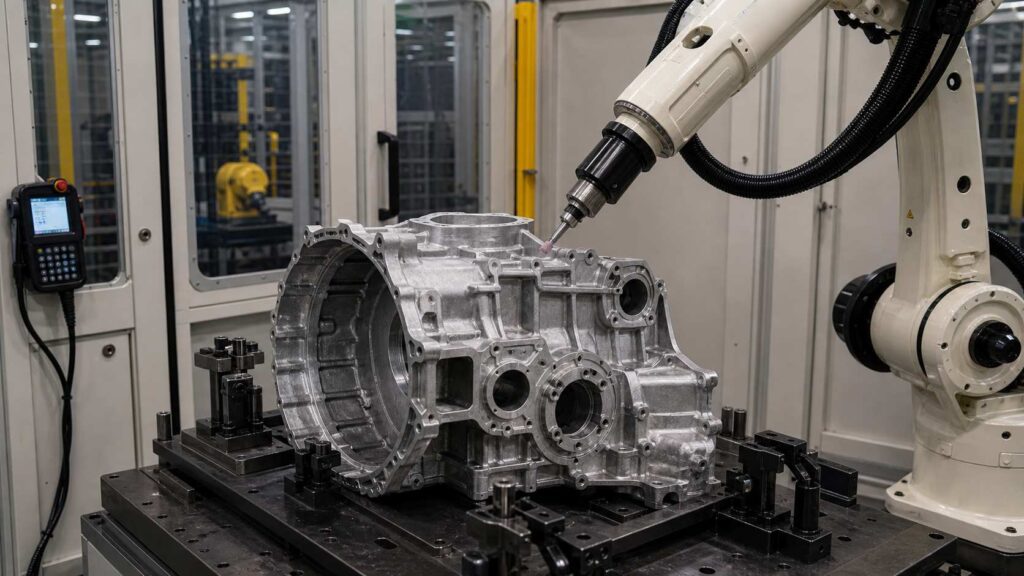
For large engine gear housings with typical dimensions around 400–750 mm in length, the process usually includes loading, program selection, protected-area confirmation, outer contour grinding, cavity opening deburring, shaft hole treatment, sealing flange cleanup, rib transition finishing, inspection and unloading. Different tools can be used for different areas, including abrasive grinding tools, flexible deburring tools, chamfering tools and small finishing heads.
| Bước | Quy trình | Mục đích | Công cụ / Hệ thống |
|---|---|---|---|
| 1 | Tải và định vị | Secure the gear housing for stable multi-side access | Giá đỡ chuyên dụng |
| 2 | Lựa chọn chương trình | Match the correct housing model and robot path | Chương trình HMI / Robot |
| 3 | Xác nhận khu vực được bảo vệ | Define bearing, sealing and precision no-grind zones | Logic lịch thi đấu / Cài đặt chương trình |
| 4 | Outer Contour and Parting Line Grinding | Remove flash and residues from external casting edges | Dụng cụ mài mòn |
| 5 | Large Cavity Opening Deburring | Remove burrs and sharp edges from cavity boundaries | Dụng cụ mài góc linh hoạt |
| 6 | Shaft Hole Edge Treatment | Deburr shaft holes and bearing-related openings | Dụng cụ vát cạnh / Trục mài gờ |
| 7 | Sealing Flange Edge Cleanup | Clean burrs from continuous sealing flange edges | Dụng cụ mài góc linh hoạt |
| 8 | Rib and Boss Transition Finishing | Process rib roots, boss boundaries and local transitions | Đầu mài nhỏ / Dụng cụ tuân thủ |
| 9 | Kiểm tra chất lượng | Kiểm tra việc loại bỏ gờ và các khu vực chức năng được bảo vệ | Kiểm tra thủ công hoặc kiểm tra bằng mắt thường |
| 10 | Dỡ hàng và vệ sinh | Remove chips and transfer the gear housing | Thổi khí / Hút bụi |
Bước 1: Tải và định vị
The large aluminum alloy engine gear housing is loaded into a dedicated fixture that supports the casting from stable non-critical areas. Because the workpiece has a large cavity structure and multiple precision holes, fixture rigidity is important for stable robotic grinding and deburring.
The fixture should allow the robot to access the outer contour, cavity opening, shaft holes, sealing flange, ribs and mounting holes. Stable positioning also helps maintain safe clearance from protected bearing holes, sealing surfaces and machined mounting faces.
Bước 2: Lựa chọn chương trình
After the gear housing is fixed, the operator selects the correct robot program through the HMI. This is important because gear housing models may vary in cavity shape, shaft hole positions, flange layout, rib structure and mounting hole patterns.
The selected program defines the processing sequence, tool type, robot posture, feed rate, contact force and protected zones. Saved programs help maintain consistent deburring and grinding results across repeated production batches.
Bước 3: Xác nhận khu vực được bảo vệ
Before processing begins, the system confirms the protected areas of the gear housing. These usually include bearing holes, shaft hole surfaces, sealing faces, machined mounting surfaces, precision holes and gear chamber functional surfaces.
This step is critical because many burr-prone edges are close to precision features. The robot should remove burrs from edge boundaries and casting transitions while keeping abrasive tools away from surfaces that affect gear alignment, sealing and dimensional accuracy.
Step 4: Outer Contour and Parting Line Grinding
The robot processes the external casting edges where flash, parting line residues, trimming marks or local casting defects may remain. These areas may include side walls, outer flanges, corner transitions, mounting bosses and gate-cut sections.
An abrasive grinding tool can remove raised defects with controlled feed speed and contact pressure. For aluminum alloy gear housings, the process should avoid excessive pressure that may create deep tool marks or remove too much base material from the casting.
Step 5: Large Cavity Opening Deburring
The large cavity opening is a key feature of the gear housing. Burrs or sharp edges around cavity boundaries may appear after casting, trimming or rough machining, but the cavity surface itself must be protected.
A flexible deburring tool can clean the cavity edge with controlled pressure and a programmed path. The robot should treat only the edge boundary and avoid contact with precision gear chamber surfaces or machined functional areas.
Step 6: Shaft Hole Edge Treatment
Shaft holes are critical features that support gear shafts and bearings. Burrs around these hole edges can affect shaft insertion, bearing seating or assembly alignment.
A chamfering tool or deburring spindle can process each shaft hole with repeatable depth and angle. The robot repeats the same routine across hole groups, improving hole-edge consistency and reducing manual variation.
Step 7: Sealing Flange Edge Cleanup
The sealing flange is a continuous edge feature that requires consistent burr removal for proper gasket sealing. Light flash and sharp edges may remain around the flange after casting or trimming.
A flexible deburring tool can follow the flange perimeter and apply controlled contact pressure. The goal is to remove sharp edges and loose burrs while preserving the sealing surface and original flange geometry.
Step 8: Rib and Boss Transition Finishing
Reinforced ribs, raised bosses and local transitions may retain small burrs after casting. These areas are often difficult to reach manually because they require frequent tool angle changes.
A small grinding head or compliant deburring tool can be used for these local features. The robot can divide the rib and boss structure into several finishing zones and process each transition with stable posture, reducing residual burrs in hidden or recessed areas.
Bước 9: Kiểm tra chất lượng
After robotic deburring and grinding, operators inspect the outer contours, cavity opening, shaft holes, sealing flange, mounting holes, rib transitions and gate-cut areas. The inspection confirms that burrs and sharp edges have been removed and that protected surfaces remain undamaged.
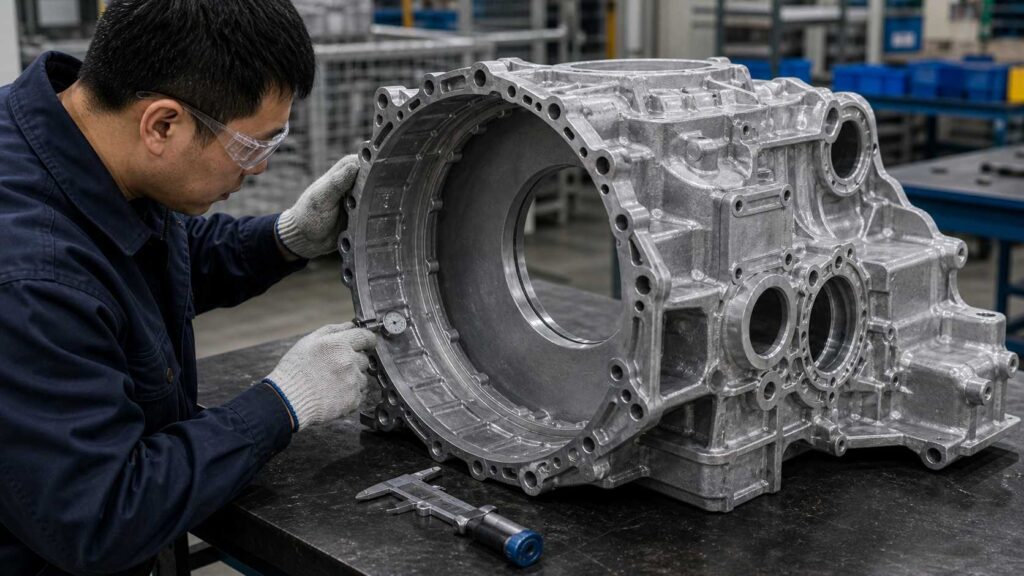
Depending on production requirements, inspection can include visual checks, manual touch checks, sample gauges or camera-based verification. Inspection feedback can also support tool wear compensation, local path optimization and maintenance planning.
Bước 10: Dỡ hàng và vệ sinh
After inspection, the gear housing is unloaded and transferred to the next production process. Aluminum chips and fine particles should be removed from cavity areas, shaft holes, sealing flanges and mounting holes.
An enclosed robotic cell with aluminum chip and dust collection is recommended for gear housing deburring and grinding. It helps improve cleanliness, reduce operator exposure and create a more controlled finishing environment than open manual grinding.
Những khó khăn trong gia công và các giải pháp
| Thử thách | Nguyên nhân | Giải pháp robot |
|---|---|---|
| Large Cavity Handling | Gear housing has large open cavity requiring multi-angle access | Dedicated fixture and stable robotic positioning |
| Cavity Edge Burrs | Large cavity boundaries require edge cleanup but chamber surfaces must be protected | Controlled deburring path with no-grind chamber zones |
| Shaft Hole Burrs | Multiple shaft holes retain burrs and require consistent treatment | Chamfering or deburring routine with repeatable depth |
| Sealing Flange Consistency | Continuous flange creates long edge paths near gasket areas | Programmed flange-edge deburring path |
| Rib and Boss Burrs | Reinforced features create hidden burr locations | Small tool access with divided local finishing zones |
| Bảo vệ bề mặt chức năng | Bearing holes and sealing faces must not be damaged | Protected-zone programming and accurate fixture reference |
Difficulty 1: Large Gear Housing Positioning and Cavity Access
A large engine gear housing is a three-dimensional casting with a large cavity opening and multiple external features. The robot must reach outer contours, cavity edges, shaft holes, sealing flanges and ribs without losing tool stability.
The solution is to use a dedicated gear housing fixture with stable support and repeatable positioning. This allows the robot to approach different processing areas with predictable posture while reducing vibration during grinding and deburring.
Difficulty 2: Cavity Opening Edge Deburring Without Chamber Damage
The large cavity opening may have burrs or sharp edges around the boundary, but the gear chamber surface itself is a precision functional area. Manual deburring can be risky if the tool slips or cuts into the chamber surface.
The solution is to use a controlled deburring path with defined no-grind zones. The robot removes burrs from the cavity edge while keeping the tool away from the precision chamber wall and related machined surfaces.
Difficulty 3: Multiple Shaft Hole Edge Treatment
Shaft holes are often distributed across different surfaces of the gear housing. These holes may retain burrs that are difficult to remove consistently by hand.
The solution is to use a chamfering tool or deburring spindle with local routines for each hole. The robot processes each shaft hole edge with repeatable angle and depth, reducing missed burrs and improving inspection consistency.
Difficulty 4: Sealing Flange Edge Consistency
The sealing flange is a continuous edge feature that requires uniform burr removal for proper gasket sealing. Manual operators may create inconsistent edge conditions along the long flange path.
The solution is to use a programmed flange-edge deburring path with a flexible tool. The robot follows the flange contour with controlled pressure, removing burrs while avoiding direct contact with the sealing face.
Difficulty 5: Protecting Bearing Holes and Mounting Interfaces
Gear housings include bearing holes, sealing faces, precision holes and machined mounting surfaces. These surfaces are close to burr-prone edges but must not be scratched or over-ground.
The solution is to define all precision features as protected zones in the robot program. The robot processes only the required burr locations and keeps abrasive tools away from functional interfaces that affect gear alignment and assembly accuracy.
Trường hợp sản xuất
Thông tin về khách hàng
An automotive aluminum casting manufacturer produces large engine gear housings for timing and gear transmission applications. Before automation, operators manually removed burrs, flash, local casting residues and sharp edges from outer contours, cavity openings, shaft holes, sealing flanges, ribs and mounting holes.
As production volume increased, manual deburring and grinding became difficult to standardize. Some small cavity corners and rib intersections were under-processed, while exposed flange edges could be over-ground by different operators. The customer wanted to improve finishing consistency, reduce manual workload and better protect precision gear-related surfaces.
Những thách thức kỹ thuật
The workpiece had a large cavity opening, multiple shaft holes, sealing flanges, mounting holes, bosses, ribs and substantial outer contours. Burrs were distributed across both exposed external edges and internal cavity boundaries, requiring different tools and robot postures.
The main technical challenge was balancing material removal and functional surface protection. Gate-cut areas and parting line residues required local grinding, while bearing holes, sealing faces and machined mounting surfaces needed to remain untouched.
Giải pháp
The proposed solution used a six-axis industrial robot, a dedicated gear housing support fixture and a multi-tool finishing system. The robot used an abrasive grinding tool for outer contour flash and local gate residues, a flexible deburring tool for cavity opening and sealing flange edges, a chamfering tool for shaft holes and mounting holes, and a small grinding head for rib and boss transitions.
Protected bearing holes, sealing faces, machined pads and precision holes were defined in the robot program. The fixture held the gear housing securely while allowing the robot to access multiple sides of the casting. An enclosed cell with aluminum chip and dust collection was used to control particles during robotic finishing.
| Mặt hàng | Cấu hình |
|---|---|
| Chi tiết gia công | Large Aluminum Alloy Engine Gear Housing |
| Tên tiếng Trung | 大型铝合金发动机齿轮室 |
| Kích thước tiêu chuẩn | Around 400–750 × 300–500 × 150–350 mm, depending on model |
| Quy trình chính | Cắt gọt và mài bằng robot |
| Quy trình có sự hỗ trợ | Cavity Edge Deburring, Shaft Hole Treatment, Flash Removal, Local Surface Cleanup |
| Robot | Robot công nghiệp sáu trục |
| Dụng cụ | Abrasive grinding tool, flexible deburring tool, chamfering tool, deburring spindle, compliant finishing tool |
| Lịch thi đấu | Dedicated Engine Gear Housing Support Fixture |
| Chiến lược bảo vệ | Protected bearing holes, sealing faces, machined surfaces and precision holes |
| Kiểm soát bụi | Enclosed Cell with Aluminum Chip and Dust Collection |
Kết quả triển khai
The robotic cell took over repetitive deburring and grinding work on outer contours, cavity opening, shaft holes, sealing flanges, mounting holes, rib transitions and local gate-cut areas. Operators mainly handled loading, unloading, inspection and tool maintenance, which reduced direct manual finishing intensity and made repeated batches more stable.
The controlled process also improved protection for precision gear-related surfaces. Instead of relying only on manual tool control, the robot followed saved paths with defined protected zones, reducing the risk of accidental contact near bearing holes, sealing faces and mounting surfaces.
| Khu vực kết quả | Sự cải thiện |
|---|---|
| Outer Contour Quality | More stable cleanup along casting edges and side-wall contours |
| Cavity Edge Deburring | Controlled burr removal around large cavity boundaries |
| Shaft Hole Treatment | Repeatable deburring around shaft and bearing holes |
| Sealing Flange Cleanup | Consistent edge condition along continuous flange path |
| Rib and Boss Finishing | Reduced missed burrs in rib roots and boss transitions |
| Gate / Parting Line Cleanup | Các lối đi riêng dành cho cặn đúc dày hơn |
| Bảo vệ bề mặt chức năng | Lower risk of damage to bearing holes and sealing faces |
| Giảm nhân công | Giảm bớt khối lượng công việc lặp đi lặp lại liên quan đến việc mài và loại bỏ gờ bằng tay |
| Sự ổn định trong sản xuất | Saved programs for repeated gear housing batches |
| Môi trường hội thảo | Cleaner finishing area with enclosed aluminum chip collection |
Phản hồi của khách hàng
The customer reported that the robotic deburring and grinding cell made repeated engine gear housing finishing more stable and reduced the manual effort required for cavity edge deburring, shaft hole treatment, sealing flange cleanup and local residue removal. Operators could focus more on loading, inspection and tool monitoring instead of continuous manual grinding around complex casting features.
Thông tin cần thiết cho đề xuất dự án mài bằng robot
To recommend a suitable robotic deburring and grinding cell for your large aluminum alloy engine gear housing, we usually need the part drawing, material grade, casting weight, photos of burrs, flash, cavity residues or gate-cut areas, required processing areas, protected bearing or sealing surfaces, current manual cycle time and annual production volume.
These details help our engineering team evaluate fixture design, robot reach, tool selection, chip collection layout and process feasibility. For large aluminum alloy engine gear housings, it is especially important to identify which cavity edges, shaft holes, flange boundaries and outer contours require burr removal, and which bearing holes, sealing faces and precision holes must be protected during robotic finishing.
Câu hỏi thường gặp
Q1: Is an engine gear housing the same as an engine cylinder head or cylinder block?
No. An engine gear housing is a transmission-related casting that encloses timing gears and drive gears. An engine cylinder head includes combustion chamber and port features, while a cylinder block is the main engine body with cylinder bores. All three are different components with different functions and deburring requirements.
Q2: Why is robotic deburring and grinding suitable for engine gear housings?
Robotic deburring and grinding are suitable because gear housings have large cavity openings, multiple shaft holes, continuous sealing flanges and reinforced ribs. A robot can follow programmed paths with controlled contact force, improving consistency compared with manual finishing.
Q3: What areas can the robot process on an engine gear housing?
The robot can process outer contours, cavity opening edges, shaft holes, sealing flanges, mounting holes, boss boundaries, rib transitions, parting line areas and local gate residues. The exact processing range should be confirmed based on the drawing and actual burr distribution.
Q4: Does this part require decorative polishing?
No. In most cases, engine gear housings do not require decorative polishing. The main requirement is deburring, local grinding, flash removal, cavity edge cleanup and edge rounding.
Q5: How are bearing holes and sealing surfaces protected during grinding?
Bearing holes, sealing faces and precision holes are protected through fixture positioning, robot path planning and no-grind zones. The robot processes only the required edge or residue area while keeping abrasive tools away from critical functional surfaces.
Q6: Can one robotic cell handle different gear housing models?
Yes. One robotic cell can often handle different aluminum alloy engine gear housing models if the fixture, robot reach and tooling are designed for part variation. Different robot programs can be saved for different cavity shapes, shaft hole patterns or part numbers.
Kết luận
Large aluminum alloy engine gear housings have large cavity openings, multiple shaft holes, sealing flanges, mounting holes, ribs and substantial outer contours, making manual deburring and grinding difficult to standardize. A robotic deburring and grinding solution helps manufacturers remove burrs, flash, sharp edges and local residues while improving consistency and protecting critical gear-related functional surfaces.
If your engine gear housing production still relies on manual cavity edge deburring, shaft hole treatment, sealing flange cleanup or local casting residue grinding, Liên hệ với chúng tôi để có được một giải pháp robot được thiết kế riêng. Bạn cũng có thể khám phá Ô tô & Xe điện các ứng dụng và Thiết bị để tìm hiểu thêm về các hệ thống hoàn thiện bằng robot của chúng tôi.