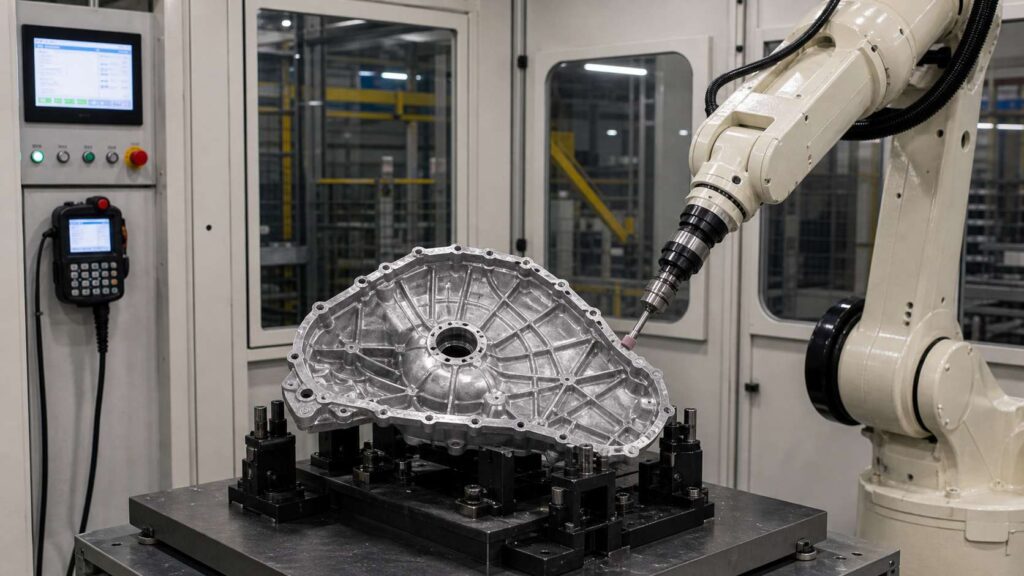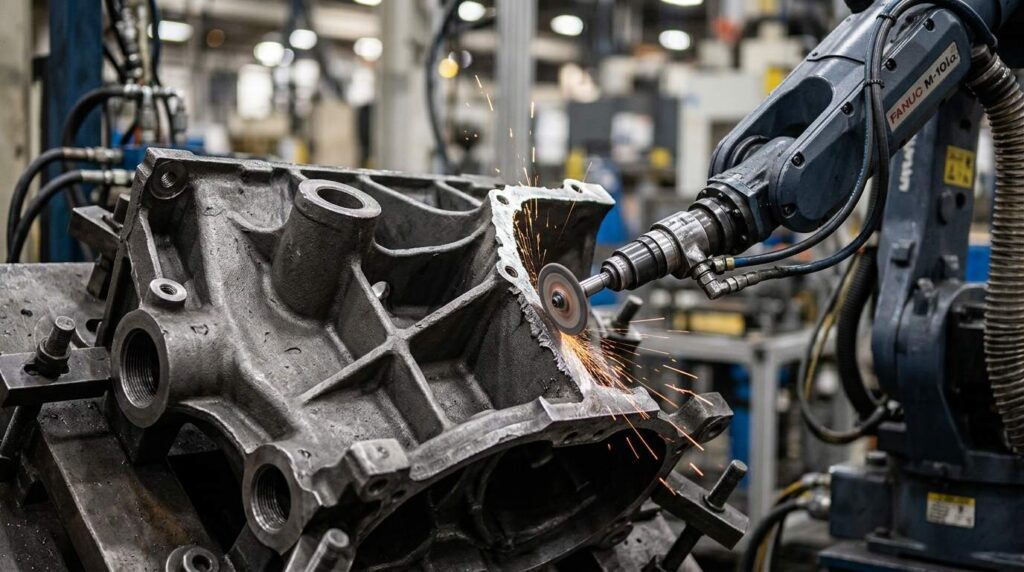
Balance shaft supports are large cast structural components used in automotive and commercial vehicle systems where balance shafts, rotating assemblies or related support structures must be positioned securely. In a typical design, this part has an irregular triangular support profile, a raised cylindrical section, multiple mounting surfaces, reinforced ribs, edge transitions and several localized bosses. During casting and rough machining, common finishing problems include casting flash, parting lines, burrs on mounting edges, local surface residues and sharp contour transitions.
Traditional manual grinding is labor-intensive and difficult to standardize, especially when operators need to process long outer contours, rib intersections, mounting faces, support bosses and local transition areas repeatedly. Different operators may use different grinding angles and pressure, which often leads to unstable finishing quality and over-grinding risks. This robotic grinding solution is designed for cast balance shaft support components in the large 700–800 mm class, focusing on large support contour grinding, casting flash removal, edge conditioning and local surface cleaning before coating, machining preparation, assembly or final inspection.
What is a Balance Shaft Support?
A balance shaft support is a structural cast component used to hold, position or reinforce balance-shaft-related assemblies within an automotive or powertrain system. Depending on the product design, it may serve as a support interface, mounting structure or reinforced bracket-like body connected to other engine, transmission or drivetrain parts.

A typical workpiece is a large, irregular cast support with a raised cylindrical feature, multiple mounting areas, rib-reinforced sections and complex contour boundaries. After casting, this type of component usually requires grinding and deburring to remove flash, smooth sharp transitions and prepare the part for machining, coating or assembly.
| Artículo | Detalles |
|---|---|
| Nombre de la pieza | Balance Shaft Support |
| Tamaño habitual | Varies by platform; large supports commonly 400–800 mm |
| Material | Hierro fundido / Acero fundido |
| Proceso principal | Rectificado robotizado |
| Procesos asistidos | Deburring, Flash Removal, Edge Rounding, Surface Cleaning |
| Principales áreas de procesamiento | Large outer contours, rib intersections, cylindrical support section, mounting faces, bosses, parting lines, visible cast surfaces |
| Gol de la victoria | Remove casting flash, burrs, sharp edges and local surface residues on a large structural support casting |
For this type of workpiece, the main requirement is not decorative polishing. The key task is to remove heavy casting flash, condition large support edges, clean local transitions and improve finishing consistency on a large structural part. For a part of this size, rectificado robotizado is the practical core process of the solution.
Typical Applications of Balance Shaft Supports
Balance shaft supports are typically used in automotive or heavy-duty mechanical systems where shaft-related structures need stable support and accurate positioning. Their geometry often combines load-bearing sections, mounting points and reinforced ribs, making them typical large structural castings.
| Ámbito de aplicación | Función típica |
|---|---|
| Automotive Powertrain Systems | Support shaft-related structures and mounting interfaces |
| Commercial Vehicle Assemblies | Provide reinforced structural support in heavy-duty systems |
| Engine and Drivetrain Components | Connect and position rotating or load-bearing parts |
| Heavy-Duty Vehicle Platforms | Used in large cast support structures with multiple interfaces |
| Transmission-Related Structures | Provide support and mounting geometry for adjacent assemblies |
| General Automotive Castings | Used as large irregular support castings requiring post-casting finishing |
For these applications, burrs, flash and sharp edges are not only appearance issues. They may affect handling safety, machining preparation, assembly fit and final coating quality. A controlled robotic grinding process helps manufacturers achieve more repeatable finishing quality on large support castings.
Pain Point Analysis of Balance Shaft Support Finishing
Balance shaft supports present several finishing challenges. The first challenge is the large and irregular structure. The workpiece contains long contour edges, rib intersections, local bosses and cylindrical support features that are difficult to process consistently by hand.
The second challenge is heavy casting flash and parting lines. Large structural castings often retain more obvious flash on contour boundaries and reinforced areas. If these defects are not removed properly, they can affect later machining, assembly or coating.
The third challenge is local transition cleanup. Rib junctions, raised sections and mounting transitions may contain burrs, rough edges or local residues after casting. These areas are often missed or processed unevenly in manual finishing.
The fourth challenge is labor intensity and workpiece handling. Because the part is relatively large, manual grinding requires repeated repositioning, heavy handling and frequent tool-angle changes. This increases fatigue and reduces consistency.
| Problema habitual | Área específica | Impacto |
|---|---|---|
| Flash de fundición | Outer contours, parting lines, rib boundaries | Affects assembly preparation and appearance |
| Rebabas | Mounting edges, bosses, local transitions | May interfere with machining or fit |
| Bordes afilados | Support boundaries, rib intersections, raised sections | Genera riesgos para la seguridad en la manipulación |
| Surface Residues | Visible cast surfaces and reinforced areas | Reduces coating and cleaning consistency |
| Variación manual | Large contour and local feature areas | Provoca una calidad de acabado inestable |
| Polvo de esmerilado | Operación de rectificado | Influye en el entorno del taller y en la comodidad del operario |
Compared with manual grinding, robotic grinding provides a more controlled and repeatable process. The robot can follow programmed paths across large contours and local structural features while maintaining stable contact and repeatable processing logic.
| Elemento de comparación | Rectificado manual | Rectificado robotizado |
|---|---|---|
| Large Contour Grinding | Depende de la habilidad del operador | Trayectoria programada repetible |
| Flash Removal | Inconsistent on long parting lines | More stable removal on repeated sections |
| Local Transition Cleanup | Easy to miss rib intersections and bosses | Targeted and repeatable processing |
| Intensidad de mano de obra | Gran volumen de trabajo manual | Reduce las tareas repetitivas de esmerilado |
| Coherencia del proceso | Difícil de estandarizar | Los programas se pueden guardar y reutilizar |
| Producción por lotes | Limitado por la capacidad de los trabajadores | Suitable for repeated support casting models |
For balance shaft support manufacturers, robotic grinding can transform heavy and repetitive finishing work into a more standardized process. It helps improve contour consistency, reduce missed flash and support stable batch production.
Robotic Grinding Process for Balance Shaft Supports
A robotic grinding cell for balance shaft supports can be configured according to workpiece size, material, flash condition, contour complexity and production volume. The system usually includes a six-axis industrial robot, heavy-duty fixture, abrasive grinding tool, flexible deburring tool, force-control or compliant mechanism, dust collection system and safety enclosure.
Because this workpiece is large and structurally irregular, robot path planning must focus on contour edges, rib transitions, raised cylindrical sections, mounting bosses and visible cast surfaces. The system must process these areas while protecting any critical machined or reference surfaces.
| Paso | Proceso | Propósito | Herramienta / Sistema |
|---|---|---|---|
| 1 | Carga y posicionamiento | Secure the balance shaft support accurately | Heavy-duty fixture |
| 2 | Selección de programas | Select the correct support model | Interfaz hombre-máquina / programa de robot |
| 3 | Large Contour Grinding | Remove flash and smooth major outer edges | Herramienta de rectificado abrasiva |
| 4 | Parting Line and Boss Cleanup | Remove flash and burrs from rib boundaries and bosses | Flexible deburring tool / rotary tool |
| 5 | Acabado de transición local | Smooth rib intersections, raised sections and support boundaries | Compliant grinding tool |
| 6 | Limpieza y acabado de superficies | Mejorar la limpieza y la uniformidad de la superficie local | Banda abrasiva o cabezal de esmerilado flexible |
| 7 | Control de calidad | Check flash removal and edge condition | Inspección manual o visual |
| 8 | Descarga y limpieza | Elimina el polvo y traslada la pieza | Limpieza con aire comprimido / aspiración |
Paso 1: Carga y colocación
The balance shaft support is placed into a heavy-duty fixture. The fixture should position the workpiece according to key reference points and provide stable access to large contour edges, rib intersections, mounting bosses and raised structural sections.
For repeated production, the fixture can be designed for stable clamping and efficient repositioning. If multiple support models are produced, model-specific fixtures or quick-change fixture solutions can be used.
Paso 2: Selección del programa
The operator selects the corresponding robot program according to the balance shaft support model. Each model can have different paths, tool parameters and protected zones depending on contour shape and flash location.
Para requisitos de automatización más exigentes, se pueden incorporar funciones de lectura de códigos de barras, reconocimiento de utillajes o posicionamiento visual para confirmar que se trata del modelo de pieza correcto.
Step 3: Large Contour Grinding
The robot first processes the major outer contour edges of the support casting. These areas often contain heavy casting flash, parting lines and sharp boundaries. The robot follows the programmed path and removes unwanted material with an abrasive grinding tool.
Stable tool contact is especially important for large castings. Force-controlled grinding helps maintain consistency and reduces the risk of over-grinding near reference surfaces.
Step 4: Parting Line and Boss Cleanup
After processing the main contours, the robot moves to rib boundaries, local bosses, cylindrical support features and parting line areas where flash often remains. These areas require more localized tool access than the main contour.
The system can use a flexible deburring tool, rotary tool or smaller grinding head to remove flash from these structural details. Proper path design helps ensure repeated burr and flash areas are treated consistently.
Step 5: Local Transition Finishing
Supports of this type include rib intersections, raised support sections and local contour transitions. These areas may retain sharp boundaries or rough casting residues after the main flash is removed.
The robot uses a compliant grinding tool to smooth transitions and local boundaries. The goal is controlled edge conditioning and cleanup rather than heavy material removal.
Paso 6: Limpieza y acabado de superficies
After contour grinding and local cleanup, the robot can process selected visible cast surfaces and support areas to improve surface cleanliness and local consistency. This step is especially useful before painting, coating or further machining preparation.
The process does not aim for mirror polishing. Instead, it removes residual surface defects, local flash traces and visible irregularities to create a cleaner finished surface.
Paso 7: Control de calidad
After grinding, the balance shaft support is inspected for flash removal, edge condition, surface cleanliness and over-grinding. Key inspection areas include large contour edges, bosses, rib intersections, cylindrical support sections and visible cast surfaces.

Inspection can be carried out manually, with gauges or with visual assistance depending on the plant’s quality standard.
Paso 8: Descarga y limpieza
The finished balance shaft support is removed from the fixture. Dust and grinding residues can be cleaned by air blowing, vacuum suction or brushing. The part can then move to coating, machining, assembly or the next production stage.
For larger production lines, the grinding cell can be integrated with conveyors, lifting support and centralized dust collection.
Dificultades en el mecanizado y sus soluciones
Balance shaft supports of this type are more demanding than simple brackets because they combine large irregular contours, reinforced ribs, local cylindrical features and multiple mounting interfaces. The robotic system must be designed for path accessibility, controlled edge finishing, fixture stability and functional surface protection.
| Reto | Causa | Solución robótica |
|---|---|---|
| Large Irregular Contours | Non-uniform edge paths and multiple structural turns | Use programmed multi-section contour grinding paths |
| Heavy Casting Flash | Long parting lines and reinforced sections retain flash | Use targeted flash-removal paths and abrasive tools |
| Rib and Boss Cleanup | Local structural intersections retain burrs and residues | Use flexible tools and local tool access |
| Protección funcional de superficies | Some mounting faces and machined areas must be preserved | Definir zonas protegidas y rutas optimizadas |
| Generación de polvo | Cast grinding creates fine particles | Utilice una cabina cerrada con sistema de extracción de polvo |
Difficulty 1: Processing Large Irregular Contours
This workpiece has multiple long contour paths, angled transitions and structural protrusions. Manual grinding of these areas is slow and difficult to standardize.
The solution is to divide the contour into multiple programmed path sections. A six-axis robot can maintain stable orientation and repeat the same sequence across batches.
Difficulty 2: Removing Heavy Flash on Structural Boundaries
Large cast support components often retain visible flash along parting lines, reinforced edges and contour transitions. Manual operators may remove these defects unevenly.
The solution is to use abrasive grinding tools with controlled force and dedicated flash-removal paths. This helps achieve more stable material removal on long repeated sections.
Difficulty 3: Cleaning Rib Intersections and Boss Areas
Rib intersections, raised cylindrical features and mounting bosses often require local finishing. These areas may contain burrs, residues or sharp transitions that are easy to miss manually.
The solution is to use flexible deburring tools or smaller grinding heads that can access these local structural features. The robot can approach these areas from predefined angles and repeat the same sequence for every part.
Difficulty 4: Protecting Functional Surfaces
Some support areas may be machined or dimension-critical, including mounting faces, hole seats or reference surfaces. These must not be damaged during grinding.
La solución consiste en definir zonas protegidas en el programa del robot y utilizar un sistema de sujeción preciso. Las trayectorias de las herramientas deben evitar las superficies críticas, y se puede aplicar una fuerza de contacto menor cerca de las zonas sensibles.
Dificultad 5: Control del polvo de esmerilado
Grinding large cast supports generates fine dust and particles. Manual grinding exposes workers directly to the dust source and creates a harsher environment.
La solución consiste en utilizar una célula de rectificado robotizada cerrada con un sistema de captación de polvo integrado. La aspiración local, las cubiertas protectoras y los sistemas de filtración contribuyen a mejorar la limpieza y la seguridad del operario.
Application Scenario
Production Context
An automotive casting manufacturer produces large balance shaft support castings for heavy-duty automotive and commercial vehicle applications. The workpieces have irregular outer contours, reinforced ribs, raised cylindrical features, multiple mounting surfaces and several local bosses. Before automation, workers manually removed casting flash, burrs and sharp edges after casting and rough machining.
With more castings per shift, manual finishing lagged behind, and the plant needed consistent contour edges, fewer missed flash points at rib transitions and less repetitive grinding work.
Retos técnicos
The balance shaft support had multiple flash-prone areas, including large contour edges, rib intersections, local bosses, cylindrical support features and parting line boundaries. Manual workers needed to constantly change tool angle and workpiece position, which caused unstable finishing quality.
Another challenge was protecting functional surfaces. Some areas had to remain dimensionally accurate after machining, so the robotic system needed to remove flash and burrs without affecting critical geometry. Dust control also had to improve, because open manual grinding on large castings spreads dust across the whole bay.
Solución
UBRIGHT SOLUTIONS designed a robotic grinding cell for cast balance shaft supports. The system used a six-axis industrial robot, dedicated heavy-duty fixture, abrasive grinding tool, flexible deburring tool and enclosed dust collection system.
The robot first processed the major contour edges and parting line areas, then removed flash and burrs from bosses, rib intersections and raised support features. Controlled transition-finishing paths were applied to local structural boundaries. Protected zones were defined in the program to avoid damage to critical machined features.
| Artículo | Configuración |
|---|---|
| Pieza de trabajo | Cast Balance Shaft Support |
| Tamaño habitual | Approx. 700–800 mm class casting |
| Proceso principal | Rectificado robotizado |
| Proceso asistido | Deburring, Flash Removal, Edge Rounding, Surface Cleaning |
| Robot | Robot industrial de seis ejes |
| Herramientas | Herramienta de esmerilado abrasivo, herramienta de desbarbado flexible |
| Calendario | Heavy-Duty Balance Shaft Support Fixture |
| Control del polvo | Cámara cerrada con sistema de recogida de polvo |
| Solicitud | Large Contour Grinding, Flash Removal, Local Structural Cleanup |
Outcome Overview
In a deployment of this type, finishing quality on large contour edges, rib transitions and local support features stabilizes. Outer contours, bosses and structural details all run from the saved program on every cycle.
The heaviest grinding work shifts from operators to the cell, and identical verified paths on every part are what standardize the process. Dust is captured inside the enclosure rather than released into the workshop.
| Área de resultados | Mejora |
|---|---|
| Contour Edge Consistency | More stable processing on irregular large outer edges |
| Flash Removal Quality | Fewer missed flash areas on rib boundaries and bosses |
| Acabado de transición local | More uniform cleanup on structural intersections |
| Reducción de la mano de obra | Reducción de la carga de trabajo derivada del esmerilado manual repetitivo |
| Estabilidad de la producción | Reusable robot programs for repeated support models |
| Control del polvo | Las celdas cerradas mejoran la limpieza del taller |
PREGUNTAS FRECUENTES
Q1: Why is robotic grinding suitable for balance shaft supports?
Robotic grinding is suitable for balance shaft supports because they have large irregular contours, reinforced ribs and multiple local structural features that require consistent finishing. The robot can follow programmed paths and process the same areas repeatedly, making it suitable for batch production.
Q2: What defects can robotic grinding remove from balance shaft supports?
The system can remove casting flash, parting lines, burrs, sharp edges and local surface residues. The most common processing areas include outer contours, rib intersections, bosses, raised cylindrical sections and visible cast surfaces.
Q3: Can the robot process local bosses and rib intersections?
Yes. With suitable path planning and flexible deburring tools, the robot can process local bosses, rib intersections and structural transition areas. The final accessibility depends on the geometry of the support and tool selection.
Q4: Does a balance shaft support need polishing?
In most cases, balance shaft supports do not require decorative mirror polishing. The main requirement is grinding, flash removal, deburring and surface cleaning before coating, machining or assembly.
Q5: How does the robot avoid damaging functional surfaces?
El programa del robot permite definir zonas protegidas y limitar el contacto de la herramienta en áreas de precisión. Una sujeción adecuada, un posicionamiento preciso y una fuerza de rectificado controlada contribuyen a proteger las superficies críticas y a mantener la consistencia dimensional.
Q6: Can one robotic grinding cell process different balance shaft support models?
Yes. A robotic grinding cell can process different support models if the fixtures and programs are designed properly. For similar product families, quick-change fixtures and saved programs can reduce changeover time.
Q7: What tools are used for balance shaft support robotic grinding?
Common tools include abrasive grinding wheels, belt tools, flexible deburring heads, rotary deburring tools and compliant grinding tools. The final tool selection depends on contour accessibility, flash size and finishing requirements.
Q8: Is dust collection necessary for balance shaft support grinding?
Yes. Dust collection is strongly recommended. Grinding cast supports produces fine particles, so the robotic cell should include an enclosure, suction ports, dust collection pipes and filtration equipment.
Conclusión
Balance shaft supports of this type are large irregular cast structural components that require reliable finishing on outer contours, rib intersections, bosses, raised support sections and visible cast surfaces. Casting flash, burrs, sharp edges and local surface residues can affect handling safety, machining preparation, coating quality and final inspection results if they are not removed properly.
A robotic grinding solution helps balance shaft support manufacturers improve large contour grinding, casting flash removal and local structural cleanup in batch production. With dedicated fixtures, controlled tool paths, flexible deburring tools and integrated dust extraction, robotic finishing is well suited to repeated production of cast support components. For the rotating shaft these supports carry, see also our crankshaft robotic grinding solution.
If your balance shaft support production still relies on manual contour grinding, flash removal or local structural cleanup, Contacte con nosotros for a customized robotic solution. More Automoción y VE finishing applications and the full Equipamiento lineup are available for review.