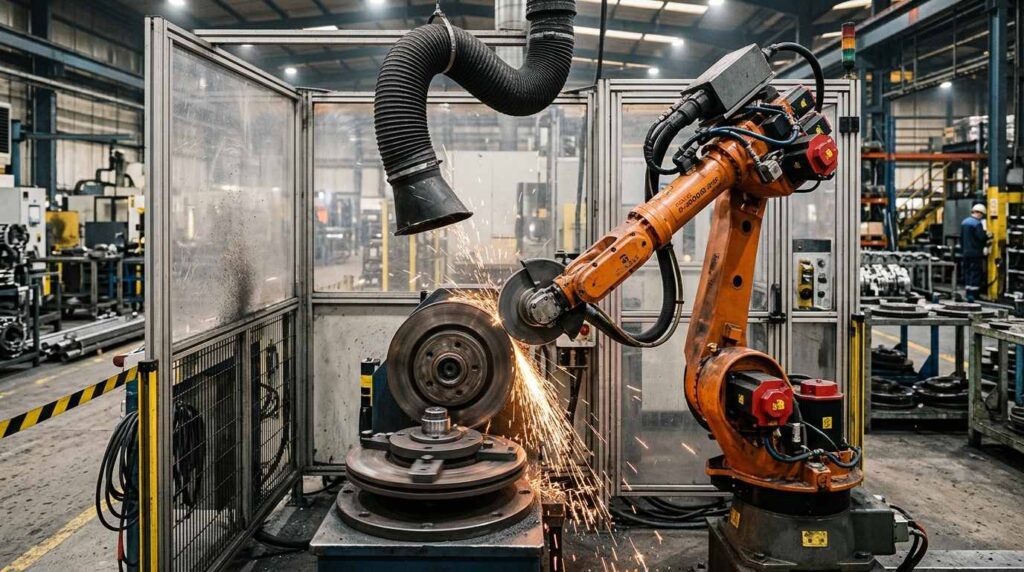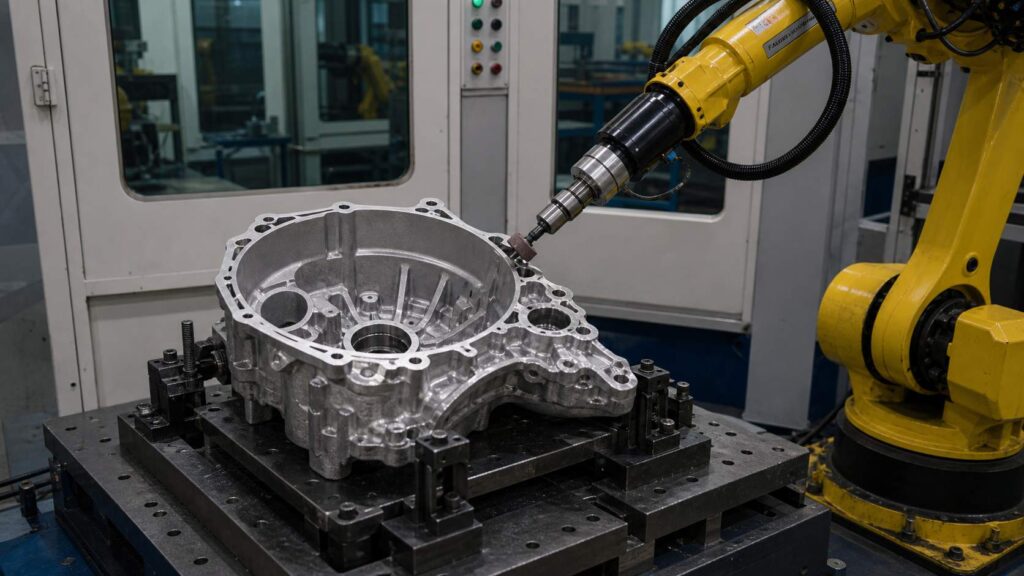
Aluminum alloy transmission bell housings are cast automotive components used in powertrain and transmission systems. This part has a large bell-shaped opening, central bore, reinforced rib structure, multiple mounting holes, irregular outer flanges and deep recessed cavity areas. These structural features make post-casting deburring and grinding more complex than simple aluminum casting parts.
This robotic deburring and grinding solution is designed for aluminum alloy transmission bell housings after casting, trimming or rough machining. It helps remove casting burrs, flash, parting lines, gate residues and sharp edges from the outer flange, bell opening, bore edge, mounting holes, rib transitions and recessed cavity edges. The goal is to improve finishing consistency, reduce manual grinding workload and protect functional surfaces during production.
What Is an Aluminum Alloy Transmission Bell Housing?
An aluminum alloy transmission bell housing is a cast structural component used to connect and support transmission-related assemblies in automotive drivetrain systems. It usually works around the engine-transmission interface or gearbox assembly area, providing support, protection and mounting functions.
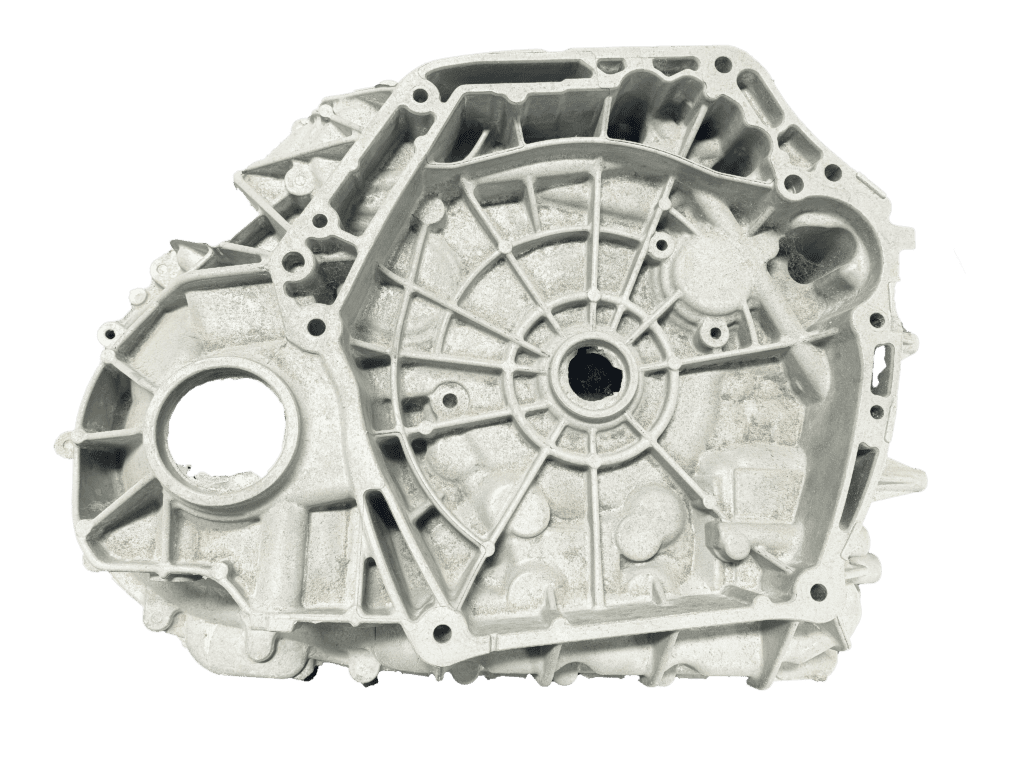
Typical castings show the standard bell housing features: a large circular opening, central shaft bore, dense reinforcing ribs, many bolt holes, raised bosses, angled flanges and inner cavity structures. After casting, burrs and flash may remain around the parting line, flange edge, hole openings, bore edges, rib roots and gate-cut areas.
For this type of workpiece, the finishing requirement is not decorative mirror polishing. The main process is robotic deburring, robotic grinding, edge rounding and local surface cleanup (for readers comparing process categories, our what is robotic deburring overview covers the basics). The robot must remove unwanted burrs and sharp edges while avoiding damage to mounting faces, sealing interfaces, locating holes and machined surfaces.
| 項目 | 詳細 |
|---|---|
| ワークピース名 | Aluminum Alloy Transmission Bell Housing |
| 典型的なサイズ | Around 350–500 mm length range, depending on actual model |
| 素材 | アルミニウム合金鋳造 |
| 主なプロセス | ロボットによるバリ取り・研削 |
| アシストプロセス | Edge Rounding, Local Surface Cleanup, Inner Cavity Finishing |
| 主要な処理分野 | Bell opening edge, central bore, mounting holes, outer flange, rib transitions, recessed cavity edges, gate-cut areas |
| 保護地域 | Mounting faces, sealing interfaces, precision holes, locating surfaces, machined fitting areas |
| ゴール | Remove burrs, flash, gate residues and sharp edges while improving finishing consistency |
Typical Finishing Challenges of Aluminum Alloy Transmission Bell Housing
An aluminum alloy transmission bell housing is difficult to finish because it combines large openings, irregular flanges, thin ribs, deep cavities and functional surfaces in one casting. The burr distribution is not limited to the outer contour. Burrs can also appear around inner ribs, bore edges, hole openings and recessed corners.
Manual deburring can be unstable because operators need to frequently change tool angles and grinding pressure. Some areas are easy to over-grind, while hidden corners inside the rib structure may be missed. Since aluminum alloy is softer than cast iron or steel, excessive grinding force may cause surface smearing, tool marks or unwanted material removal.
| よくある問題 | 特定地域 | インパクト |
|---|---|---|
| Casting Flash / Parting Lines | Outer contour, flange edge, cavity boundary | Affects edge consistency and appearance |
| Gate Residues | Gate-cut positions on outer body or flange base | Requires heavier local grinding |
| シャープなエッジ | Bell opening, central bore, mounting holes, flange edges | 取り扱いや組み立てのリスクが生じる |
| Residual Burrs | Rib roots, recessed cavity edges, bolt hole boundaries | Causes unstable finishing quality |
| マニュアル・バリエーション | Repeated hole edges, ribs and contour transitions | Leads to inconsistent quality between operators |
| 機微な機能領域 | Mounting faces, sealing interfaces, locating holes, machined surfaces | Risk of dimensional or surface damage |
Robotic Deburring and Grinding Process
A robotic deburring and grinding cell for aluminum alloy transmission bell housings should be designed around stable fixturing, multi-angle accessibility, controlled contact force and protected-surface management. The process must remove burrs, flash and gate residues while keeping functional surfaces safe; a fuller treatment of cell design is in our robotic grinding guide.

For this workpiece, a six-axis robot is usually suitable because the part has inner cavity areas, curved edges, multiple hole directions and irregular outer contours. Different tools can be used for different zones, such as abrasive grinding tools for flash removal, flexible deburring tools for edge treatment, small grinding heads for rib areas and chamfering tools for hole openings.
| ステップ | プロセス | 目的 | ツール/システム |
|---|---|---|---|
| 1 | ローディングとポジショニング | Secure the bell housing for stable processing | 専用フィクスチャー |
| 2 | プログラム選択 | Match the correct workpiece model and robot path | HMI / ロボットプログラム |
| 3 | 保護区域の確認 | Define no-grind zones for precision surfaces | Robot program / Fixture logic |
| 4 | Outer Flange and Contour Grinding | Remove flash and parting lines from the outer profile | 研磨工具 |
| 5 | Bell Opening and Bore Edge Deburring | Remove burrs and sharp edges around circular openings | フレキシブルなバリ取りツール |
| 6 | Rib and Inner Cavity Finishing | Process rib roots, recessed corners and cavity transitions | Small grinding head / Compliant tool |
| 7 | Gate Residue Removal | Remove thicker remaining gate material | Stock-removal grinding tool |
| 8 | Hole Opening Edge Treatment | Deburr mounting holes and boss openings | Chamfering tool / Deburring spindle |
| 9 | 品質検査 | Check burr removal and protected surface condition | 手動または目視検査 |
| 10 | 荷降ろしと清掃 | Remove aluminum chips and dust | Air blow / Vacuum cleaning |
ステップ1:積み込みと位置決め
The aluminum alloy transmission bell housing is placed into a dedicated fixture. The fixture should support the casting from stable, non-critical areas and prevent vibration during grinding. Because the workpiece has a large opening, irregular outer contour and reinforced ribs, fixture rigidity is important for repeatable tool contact.
Stable positioning helps the robot accurately process the bell opening, bore edge, flange contour and hole edges. If the workpiece moves during grinding, the robot may under-process burrs or accidentally touch protected functional surfaces.
ステップ2:プログラムの選択
Once the housing is clamped, the operator loads the correct recipe at the HMI. This matters when one line runs several bell housing variants with different hole positions, rib layouts or flange shapes.
The selected program defines the processing sequence, tool path, tool angle, contact force, feed rate and protected zones. Saved programs help maintain consistent finishing quality across different shifts and production batches.
Step 3: Protected Area Confirmation
Before grinding starts, the system should confirm which areas must not be touched by the grinding tool. For a transmission bell housing, protected areas usually include mounting faces, sealing interfaces, locating holes, bearing bores, machined surfaces and precision fitting areas.
This step is especially important because burr-prone edges are often close to functional surfaces. The robot should remove burrs from the edge boundary while avoiding contact with surfaces that affect assembly accuracy.
Step 4: Outer Flange and Contour Grinding
The robot processes the outer flange and irregular contour areas where casting flash, parting lines and trimming marks are commonly found. These areas usually require continuous contour-following movement instead of simple straight-line grinding.
For aluminum alloy castings, grinding pressure should be controlled carefully. The tool should remove only flash or raised defects without cutting deeply into the base material. A programmed contour path allows the robot to follow the complex housing shape and maintain more consistent edge quality than manual grinding.
Step 5: Bell Opening and Bore Edge Deburring
The large bell opening and central bore are key deburring areas. Burrs around these circular edges may affect handling, assembly preparation or downstream machining. However, excessive grinding may change the edge geometry or damage nearby functional surfaces.
A flexible deburring tool can follow the circular edge and apply controlled contact pressure. The goal is to remove sharp burrs and create a safer, more consistent edge condition without enlarging the bore or changing the original structure.
Step 6: Rib and Inner Cavity Finishing
The rib network and recessed cavity sections are among the most difficult areas to process manually. Burrs may remain at rib roots, inner wall transitions, corner intersections and narrow recessed edges. Operators often need to change tool angles repeatedly, which can lead to missed burrs or inconsistent results.
Rib networks like this are usually finished with a small-diameter grinding head or a compliant tool that tolerates casting variation. The robot can divide the cavity into several finishing zones and process each rib transition with a repeatable tool posture. This improves consistency and reduces residual burrs in hidden areas.
Step 7: Gate Residue Removal
Gate-cut areas may contain thicker residual material than normal flash or edge burrs. These areas require stronger local grinding and should usually be handled as a separate process step.
The robot can use a dedicated stock-removal tool with slower feed rate and higher controlled force. By separating gate residue removal from general deburring, the process can avoid unnecessary grinding on already clean surfaces.
Step 8: Hole Opening Edge Treatment
Transmission bell housings usually have many mounting holes, threaded bosses and auxiliary openings. Burrs around these holes can affect assembly, bolt seating or part handling.
The robot can use a chamfering tool or flexible deburring spindle to treat each hole opening. Since the holes may be located at different angles, the robot path should approach each hole from the correct direction to achieve stable edge treatment.
Step 9: Quality Inspection
After robotic deburring and grinding, operators inspect the outer flange, bell opening, central bore, mounting holes, rib transitions, cavity edges and gate-cut areas. The aim is to verify clean edges throughout the part and confirm that no tool contact marked the protected faces.

Depending on the line, this can be a visual and tactile check, a sampled gauge check, or a camera system that flags missed edges automatically.
Step 10: Unloading and Cleaning
After inspection, the workpiece is unloaded and transferred to the next process. Aluminum dust, chips and fine particles should be removed from the inner cavity, rib areas and hole edges.
An enclosed robotic cell with dust extraction is recommended for aluminum alloy grinding. It helps reduce dust exposure, keeps the workstation cleaner and improves the overall working environment compared with open manual grinding.
Machining Difficulties and Robotic Solutions
| チャレンジ | 原因 | ロボットソリューション |
|---|---|---|
| Irregular Outer Contour | Complex casting profile creates uneven edge paths | Programmed contour-following grinding path |
| Large Opening Edge Burrs | Bell opening and central bore retain sharp casting or trimming edges | Flexible robotic deburring path with controlled pressure |
| Rib and Cavity Burrs | Thin ribs and recessed areas create hidden burr locations | Small tool access and local finishing routines |
| Gate Residue Removal | Gate-cut areas contain thicker residual material | Dedicated stock-removal tool and localized grinding path |
| Functional Surface Protection | Mounting, sealing and locating areas must not be damaged | No-grind zones and protected robot paths |
| Aluminum Material Sensitivity | Aluminum alloy is soft and easier to over-grind | Optimized abrasive tool, feed rate and compliance control |
Difficulty 1: Irregular Outer Flange and Casting Contour
The transmission bell housing has an uneven outer contour with flange edges, corner transitions, local protrusions and mounting areas. These zones often contain casting flash or parting line marks, but the geometry is not suitable for simple straight-line grinding.
The solution is to use a programmed robotic contour path with a suitable abrasive grinding tool. The robot follows the housing perimeter consistently, reducing manual variation and avoiding unnecessary material removal from the aluminum casting.
Difficulty 2: Bell Opening and Bore Edge Control
The large circular bell opening and central bore are important features on this workpiece. Burrs or sharp edges around these openings can affect assembly and handling, but excessive grinding may damage the edge geometry.
The solution is to use a flexible deburring tool with controlled contact force and circular path programming. This allows the robot to clean the opening boundary while protecting the bore shape and nearby functional interfaces.
Difficulty 3: Rib Roots and Recessed Cavity Burrs
These housings carry many reinforced ribs and recessed cavity areas. Burrs may remain at rib roots, wall transitions and narrow corners where manual operators may easily miss small defects.
The solution is to divide the cavity and rib areas into local finishing zones. A small grinding head or compliant deburring tool can process these transitions with repeatable tool posture, improving consistency in difficult-to-reach areas.
Difficulty 4: Protecting Mounting Faces and Precision Interfaces
Transmission bell housings include mounting holes, sealing surfaces, locating features and machined fitting areas. These surfaces must be protected because over-grinding may affect assembly accuracy.
The solution is to define protected zones in the robot program and fixture layout. The robot removes burrs from nearby edges but keeps the abrasive tool away from critical functional surfaces.
Application Scenario
Production Context
A bell housing combines nearly every finishing problem an aluminum casting can offer: an irregular outer flange, one very large circular opening, a central bore, dozens of bolt holes at different angles, and a rib network recessed into the cavity. On a manual line that means frequent tool changes, constant repositioning of the part, and an edge map that changes from operator to operator.
At transmission-component volumes that combination is hard to keep consistent, and the hidden rib areas are the first place where quality drifts, which is what usually pushes this part family toward a robotic cell.
Process Pain Points
The flange and outer contour respond well to ordinary grinding practice, but the same tool and angle cannot carry through to the rest of the part. Hole edges need per-hole approach paths, the bore and bell opening need constant-pressure circular passes, and the rib roots need a small tool working inside the cavity. Done by hand, one operator is effectively running four different processes on a single casting.
Because the alloy is soft, force control matters everywhere: too much pressure smears the surface or bites into the base material, and the functional faces for mounting, sealing and locating sit close to the burr zones throughout the part.
Typical Cell Configuration
A practical cell for this workpiece uses one six-axis industrial robot and a tool set matched to zones: a stronger abrasive tool for outer contour flash and gate residues, a flexible deburring tool for the bell opening and hole edges, a chamfering spindle for the bolt holes, and a smaller grinding head for rib roots and recessed cavity transitions. The fixture supports the housing from non-critical zones.
Every functional face is registered in the program as a no-grind area, and the cell runs enclosed with extraction for aluminum grinding dust.
What the Cell Changes
Once the zones are programmed, the robot visits every hole with the same approach, follows the bore and bell opening at constant pressure, and works the rib roots in a fixed sequence. Consistency stops depending on who is on shift, and the operator role narrows to loading, inspection and tool changes.
The enclosure also contains the aluminum dust that open manual grinding would otherwise spread through the work area.
| 結果エリア | 改善 |
|---|---|
| Contour Quality | More stable cleanup on the outer flange and irregular casting contour |
| Burr Removal | Better consistency around bell opening, bore edge and mounting holes |
| Rib Area Finishing | Reduced missed burrs in rib roots and recessed cavity transitions |
| Gate Residue Cleanup | Dedicated paths for repeated gate-cut areas |
| Surface Protection | Lower risk of damage to mounting, sealing and locating surfaces |
| 労働力削減 | Reduced repetitive manual deburring and grinding workload |
| 生産の安定性 | Saved robot programs for repeated bell housing batches |
| Workshop Environment | Cleaner finishing area with enclosed aluminum dust collection |
Information Needed for a Robotic Grinding Proposal
To recommend a suitable robotic deburring and grinding cell for an aluminum alloy transmission bell housing, the following information is usually required:
| Required Information | 目的 |
|---|---|
| 2D / 3D drawing | Evaluate dimensions, geometry and robot reach |
| Material grade | Select proper abrasive tool and process parameters |
| Casting process | Confirm die casting, gravity casting or sand casting characteristics |
| Workpiece weight | Design fixture and loading method |
| Photos of burrs and flash | Identify actual processing areas |
| Gate-cut positions | Define local stock-removal process |
| Protected surfaces | Avoid damage to functional interfaces |
| Current manual cycle time | Estimate automation efficiency |
| Annual production volume | Evaluate cell configuration and investment feasibility |
| Required finishing standard | Confirm deburring, edge rounding or surface cleanup level |
よくあるご質問
Q1: Is a bell housing the same part as a flywheel housing?
They are related but distinct castings at the same engine-transmission interface, and the two names are often used loosely. The bell housing encloses the clutch or torque converter with its large circular opening, central bore, reinforced ribs, mounting holes and irregular flanges; the flywheel housing bolts to the rear of the engine block around the flywheel. We cover the neighboring part separately in our flywheel housing robotic grinding solution.
Q2: Why is robotic deburring suitable for this workpiece?
Robotic deburring is suitable because the bell housing has many repeated edges, holes, ribs and contour transitions. A robot can follow programmed paths and apply more consistent tool contact than manual operators, especially for repeated production batches.
Q3: What areas can the robot process on a transmission bell housing?
The robot can process the outer flange, large bell opening, central bore, mounting holes, rib transitions, recessed cavity edges, gate-cut areas and local flash positions. The exact processing areas should be confirmed based on the casting drawing and burr distribution.
Q4: Does this part require polishing?
In most cases, no. The purpose of the process is to remove burrs, flash and sharp edges while keeping functional surfaces intact, which is a technical finish rather than a cosmetic one.
Q5: How are protected surfaces controlled during grinding?
Protected surfaces are controlled through fixture positioning, robot path planning and no-grind zones in the program. Mounting faces, sealing interfaces, locating holes and machined bores are excluded from grinding paths to reduce the risk of surface or dimensional damage.
Q6: Can one robotic cell handle similar bell housing models?
Yes. One robotic cell can often handle similar transmission bell housing models if the fixture, robot reach and tooling are designed for model variation. Each part number runs from its own stored program, so changeover is a fixture and program call rather than re-teaching.
結論
Aluminum alloy transmission bell housings have large openings, central bores, irregular flanges, mounting holes, reinforced ribs and recessed cavities, making manual deburring and grinding difficult to standardize. A robotic deburring and grinding solution helps manufacturers remove burrs, flash, gate residues and sharp edges while improving finishing consistency and protecting key functional areas.
If your transmission bell housing production still relies on manual deburring, flange grinding, bore edge cleanup or cavity burr removal, お問い合わせ for a customized robotic solution. To see how these cells are applied across other drivetrain castings, visit 自動車・EV applications or browse the 設備 range.