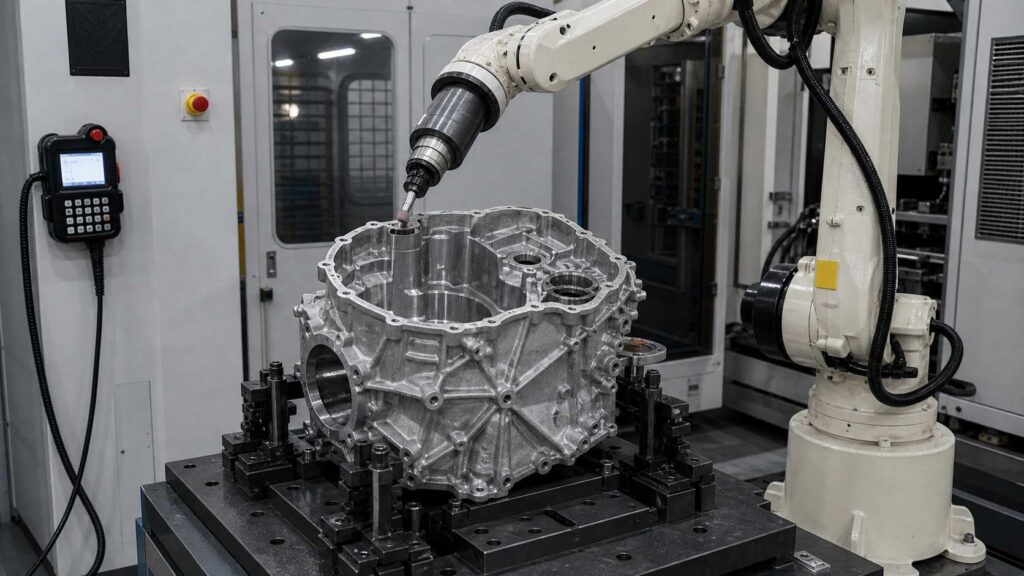
Truck wheel hubs are heavy-duty wheel-end components used in commercial vehicles, trucks, trailers, buses and other high-load vehicle platforms. They connect the wheel assembly, bearing system, brake components and axle structure, and usually feature a thick cylindrical body, large central bore, circular flange, bolt holes, bearing seat areas and multiple transition edges. During casting and machining, common finishing problems include casting flash, parting lines, sharp hole edges, bolt hole burrs, rough cast surfaces and uneven circular edges.
Traditional manual grinding is time-consuming and inconsistent, especially when operators need to process the outer circumference, flange edges, bolt holes, central bore, bearing seat transitions and local cast surfaces repeatedly. Different operators may apply different pressure and tool angles, resulting in unstable finishing quality and over-grinding risks. This robotic grinding solution is designed for cast iron truck wheel hubs typically in the φ300–450 mm diameter class, focusing on outer circumference grinding, bolt hole deburring, edge smoothing and cast surface uniformity improvement before coating, assembly or final inspection.
What is a Truck Wheel Hub?
A truck wheel hub is a core wheel-end component used in commercial vehicle axle systems. It supports the wheel assembly and provides mounting positions for wheel bolts, bearings, brake drums, brake discs or other related components. Compared with passenger car wheel hubs, truck wheel hubs are usually larger, heavier and designed for higher load capacity, making them more suitable for cast iron, ductile iron or other cast metal structures.

Truck wheel hubs are typically produced through casting, machining and finishing. Casting provides the basic heavy-duty structure, while machining creates accurate bearing seats, central bores, bolt holes and mounting surfaces. However, after casting and machining, the workpiece still requires finishing operations to remove flash, burrs, sharp edges and local surface irregularities.
The finishing quality of a truck wheel hub affects assembly consistency, coating adhesion, handling safety and final inspection. Burrs around bolt holes may interfere with wheel bolt installation. Sharp edges around the flange or outer circumference may create safety risks during handling. Rough cast surfaces and parting lines may affect coating quality or product appearance. Therefore, robotic grinding is a suitable solution for stabilizing quality and reducing heavy manual finishing work.
| 項目 | 詳細 |
|---|---|
| ワークピース名 | Truck Wheel Hub |
| 典型的なサイズ | φ300–450 mm diameter class, varies by axle rating |
| 素材 | Cast Iron / Ductile Iron (forged steel for some axle ratings) |
| 主なプロセス | ロボット研削 |
| アシストプロセス | Bolt Hole Deburring, Edge Rounding, Surface Finishing |
| 主な加工エリア | Outer circumference, flange edges, bolt holes, central bore, bearing seat transitions, parting lines, cast surfaces |
| ゴール | Remove casting flash, bolt hole burrs, sharp edges and surface irregularities |
For this type of workpiece, the main requirement is not decorative polishing. The key task is to remove casting and machining defects, smooth functional edges, clean bolt hole burrs and improve the uniformity of coated or visible cast surfaces. Robotic grinding therefore serves as the core process of this solution.
Typical Applications of Truck Wheel Hubs
Truck wheel hubs are used in heavy-duty wheel-end systems where wheels must be mounted, supported and positioned reliably under high load conditions. Depending on the vehicle type, the hub may work together with axle shafts, bearings, brake drums, brake discs, wheel bolts and suspension components.
For commercial vehicle manufacturers and axle component suppliers, truck wheel hubs are not only structural parts but also important assembly interfaces. Their edge condition, bolt hole quality and cast surface consistency can influence assembly efficiency, coating quality, product safety and final acceptance.
| アプリケーションエリア | 代表的な機能 |
|---|---|
| 大型トラック | Support wheel-end assembly and transfer road load |
| 商用車 | Connect wheel, bearing, brake and axle components |
| トレーラー | Provide durable wheel mounting and load-bearing support |
| Buses | Used in wheel-end systems for frequent operation |
| 特殊車両 | Applied in high-load chassis and axle structures |
| Axle Component Manufacturing | Used as a critical cast and machined wheel-end part |
For these applications, burrs, sharp edges and uneven cast surfaces are not only appearance issues. They may affect wheel bolt installation, bearing assembly, coating adhesion, handling safety and final inspection. A controlled robotic grinding process helps manufacturers achieve more repeatable finishing quality in batch production.
Pain Point Analysis of Truck Wheel Hub Finishing
Truck wheel hubs have several typical finishing challenges. The first challenge is the heavy circular structure. The outer circumference, flange edges and central bore transitions require smooth and consistent grinding. Manual grinding around large circular edges is difficult to keep uniform because the operator must constantly adjust tool angle, contact pressure and working posture.
The second challenge is bolt hole deburring. Truck wheel hubs usually have multiple bolt holes around the flange. These holes may have burrs after casting, drilling or machining. If the burrs are not removed properly, they may affect wheel bolt installation, coating coverage or final inspection.
The third challenge is cast surface consistency. Cast iron truck wheel hubs may have rough cast surfaces, parting lines, local flash and surface irregularities. Manual grinding can remove these defects, but the result depends heavily on operator experience. Inconsistent manual grinding may cause under-processing in some areas and excessive material removal in others.
The fourth challenge is dust and labor intensity. Grinding cast iron produces dust, particles and noise. Truck wheel hubs are relatively heavy, and operators need to repeatedly process large circular surfaces and multiple hole areas. This increases labor intensity, reduces production stability and makes the working environment difficult to manage.
| よくある問題 | 特定地域 | インパクト |
|---|---|---|
| キャスティング・フラッシュ | Outer circumference, flange edge, parting lines | Affects coating, appearance and handling |
| Bolt Hole Burrs | Bolt holes and mounting holes | May interfere with wheel bolt installation |
| シャープなエッジ | Flange edge, outer contour, machined transitions | 安全な取り扱いのリスクを生む |
| Uneven Cast Surface | Visible cast surfaces and cylindrical body | Reduces coating and surface consistency |
| マニュアル・バリエーション | Circular edges, hole areas and local surfaces | Causes unstable finishing quality |
| 鋳鉄ダスト | 研磨作業 | 作業場の環境と作業者の快適性に影響 |
Compared with manual grinding, ロボット研削 provides a more controlled and repeatable process. The robot follows fixed paths, processes bolt hole positions in sequence and can be integrated with dust extraction equipment.
| 比較項目 | 手動研磨 | ロボット研削 |
|---|---|---|
| Outer Circumference Grinding | オペレーターの技量による | Repeatable circular grinding path |
| Bolt Hole Deburring | Easy to miss individual holes | Programmed processing for each hole |
| 労働強度 | High manual workload | Reduces heavy grinding tasks |
| Process Consistency | Difficult to standardize | Robot programs can be saved and reused |
| 粉塵暴露 | Operators work close to dust | 除塵装置付き密閉セル |
| バッチ生産 | Limited by worker capacity | Suitable for repeated truck wheel hub models |
For manufacturers of cast iron truck wheel hubs, robotic grinding can turn a repetitive manual operation into a more standardized finishing process. It helps improve circular edge consistency, reduce missed burrs and create a cleaner production environment.
Robotic Grinding Process for Truck Wheel Hubs
A robotic grinding cell for truck wheel hubs can be designed according to product size, material, burr condition, production volume and finishing requirements. The system usually includes a six-axis industrial robot, heavy-duty fixture, rotary positioning device, abrasive grinding tool, flexible deburring tool, force-control or compliant mechanism, dust collection system and safety enclosure.
Because truck wheel hubs are round, heavy and have multiple processing areas, a rotary positioner is especially useful. The robot can process the outer circumference, flange edges, bolt holes, central bore transitions and selected cast surfaces while the workpiece is held securely and accurately. For higher flexibility, different robot programs can be created for different wheel hub models.
| ステップ | プロセス | 目的 | ツール/システム |
|---|---|---|---|
| 1 | ローディングとポジショニング | Secure the truck wheel hub accurately | Heavy-duty fixture / rotary positioner |
| 2 | プログラム選択 | Select the correct truck wheel hub model | HMI / robot program |
| 3 | Outer Circumference Grinding | Remove flash and smooth circular edges | Abrasive grinding wheel or belt |
| 4 | Flange Edge Grinding | Clean sharp edges and parting lines | Grinding tool with force control |
| 5 | Bolt Hole Deburring | Remove burrs around bolt holes and central bore | Rotary deburring tool / flexible brush |
| 6 | Cast Surface Finishing | Improve surface uniformity on cast areas | Abrasive belt or flexible grinding head |
| 7 | 品質検査 | バリ取りとエッジの滑らかさをチェック | 手動または目視検査 |
| 8 | 荷降ろしと清掃 | 埃を取り除き、部品を移す | エアブロー/バキュームクリーニング |
ステップ1:積み込みと位置決め
The truck wheel hub is placed into a heavy-duty fixture. The fixture should position the central bore, flange surface or reference points accurately. For circular and heavy parts, stable centering is important because the robot path must match the round contour of the workpiece.
If production volume is high, the system can use a rotary positioner, indexing table, lifting device or automatic loading system. This allows the robot to process different surfaces more efficiently while reducing manual handling and non-processing time.
ステップ2:プログラムの選択
The operator selects the corresponding robot program according to the truck wheel hub model. If the production line handles different hub sizes, each model can have a saved program with different paths, tool parameters and processing sequences.
For higher automation requirements, barcode scanning, fixture recognition or vision positioning can be added to confirm the product model and prevent wrong program selection.
Step 3: Outer Circumference Grinding
The robot first processes the outer circumference of the truck wheel hub. This area may contain casting flash, parting lines, sharp edges or rough surface defects. The robot follows the circular contour and removes unwanted material with an abrasive grinding tool.
For circular grinding, path stability is very important. A compliant grinding head or force-controlled system can help maintain stable contact pressure and compensate for small casting variations.
Step 4: Flange Edge Grinding
The flange area often includes functional edges, transition surfaces and parting line areas. Burrs or sharp edges around the flange may affect handling, coating or assembly.
The robot processes the flange edge using a controlled grinding path. The goal is to smooth sharp edges and remove residual flash without changing critical assembly dimensions. If the flange has machined surfaces, the grinding path should avoid damaging precision areas.
Step 5: Bolt Hole Deburring
Truck wheel hubs usually have multiple bolt holes and a central bore. These locations are common burr areas after machining. If burrs remain around the holes, they may affect wheel bolt installation, coating quality or final inspection.
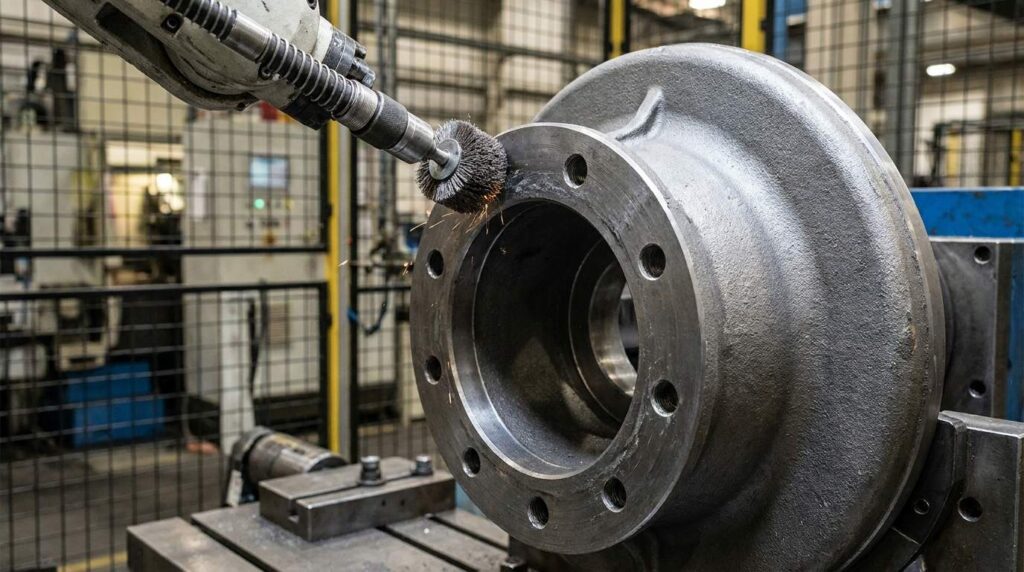
The robot can use a rotary deburring tool, abrasive brush or flexible chamfering tool to process bolt hole edges and central bore edges. The tool can approach each hole in a fixed sequence, ensuring that all hole positions are treated consistently.
Step 6: Cast Surface Finishing
After edge burrs and hole burrs are removed, the robot can process selected cast surfaces to improve overall surface uniformity. This step is especially useful before painting, powder coating or anti-corrosion treatment.
The process does not aim for mirror polishing. Instead, it removes rough cast marks, local irregularities and visible surface defects, creating a more consistent surface for the next process.
ステップ7:品質検査
After grinding, the truck wheel hub is inspected for burr removal, edge smoothness, cast surface consistency and over-grinding. Key inspection areas include the outer circumference, flange edges, bolt holes, central bore, bearing seat transitions and parting line areas.
Inspection can be done manually, with gauges or with visual assistance depending on production requirements. For truck wheel hub components, inspection standards should be clearly defined before automation.
ステップ8:荷下ろしと清掃
The finished truck wheel hub is removed from the fixture. Dust and grinding residues can be cleaned by air blowing, vacuum suction or brushing. The part can then move to coating, assembly, packaging or the next production stage.
For larger production lines, the robotic cell can be integrated with automatic loading, unloading, conveyor systems and centralized dust collection.
機械加工の困難と解決策
Truck wheel hubs are more demanding than simple round castings because they are heavy, circular and contain multiple functional areas. The robotic system must be designed to handle outer circumference grinding accuracy, bolt hole deburring consistency, fixture stability, functional surface protection and dust control.
| チャレンジ | 原因 | ロボットソリューション |
|---|---|---|
| Outer Circumference Consistency | Large circular contour requires stable tool contact | Use programmed circular paths and force control |
| Bolt Hole Burrs | Multiple bolt holes create repeated burr areas | Process each hole with rotary deburring tools |
| Heavy Workpiece Positioning | Large cast hub requires stable support | Use heavy-duty fixture and rotary positioner |
| Functional Surface Protection | Bearing seats and mounting faces may be dimension-critical | Define protected zones and optimized paths |
| ダストジェネレーション | 鋳鉄粉砕は微粒子を作る | Use enclosed cell with dust extraction |
Difficulty 1: Maintaining Uniform Outer Circumference Grinding
The outer circumference of a truck wheel hub requires consistent processing. Manual workers may grind some areas more heavily than others, resulting in uneven edge appearance and unstable surface quality.
The solution is to use a programmed circular path with stable tool pressure. The robot can follow the outer contour repeatedly, while a force-controlled or compliant grinding tool helps maintain consistent contact. If a rotary positioner is used, robot motion and workpiece rotation can be coordinated for smoother processing.
Difficulty 2: Deburring Multiple Bolt Holes
Truck wheel hubs usually contain several bolt holes and a central bore. Each hole may have burrs after machining or casting. Manual deburring is repetitive and easy to miss, especially when the number of holes is high.
The solution is to create a hole-by-hole deburring program. The robot moves to each bolt hole in sequence and uses a rotary deburring tool, abrasive brush or flexible chamfering tool to remove burrs. This improves consistency and reduces the risk of missed holes.
Difficulty 3: Positioning a Heavy Circular Casting
Truck wheel hubs are heavier than many small automotive parts. If the fixture does not hold the workpiece securely, vibration or positioning errors may occur during grinding.
The solution is to use a dedicated heavy-duty fixture with accurate centering and stable support. A rotary positioner can also help expose different processing areas to the robot while keeping the workpiece stable.
Difficulty 4: Protecting Functional Machined Surfaces
Some truck wheel hub surfaces may be precision machined, such as bearing seats, mounting faces, central bore surfaces or brake-related contact areas. These areas must be protected during grinding.
The solution is to define clear processing and non-processing zones in the robot program. The fixture should position the hub accurately, and the tool path should avoid precision surfaces. For sensitive areas, softer abrasive tools or lower contact force can be used.
Difficulty 5: Controlling Cast Iron Dust
Grinding cast iron truck wheel hubs produces fine particles and dust. Manual grinding exposes workers directly to the dust source and makes the working environment difficult to manage.
The solution is to use an enclosed robotic grinding cell with integrated dust extraction. Local suction ports, protective covers and filtration equipment can help remove grinding dust from the work area and improve workshop cleanliness.
Application Scenario
Production Context
A commercial vehicle casting manufacturer produces cast iron truck wheel hubs for heavy-duty trucks, trailers and axle assembly applications. The workpieces have thick cylindrical bodies, circular outer edges, flange surfaces, bolt holes and central bores. Before automation, workers manually removed casting flash, hole burrs and sharp edges after casting and machining.
Rising output turned manual finishing into the pacing step of the line, and consistent outer circumference quality, complete bolt hole deburring and lower grinding workload became the priorities.
技術的課題
The truck wheel hub had multiple burr-prone areas, including the outer circumference, flange edge, bolt holes, central bore and parting line areas. Manual workers needed to constantly change tool angles when grinding around the circular contour and hole edges. This caused unstable finishing quality and inconsistent surface appearance.
Another challenge was workpiece handling and positioning. The hub was heavy and required stable support during grinding. Some machined areas also had to remain clean and dimensionally accurate. The robotic system needed to remove burrs and flash without damaging critical assembly surfaces. Cast iron dust was also a concern, and a cleaner, more controlled grinding process was the target.
ソリューション
UBRIGHT SOLUTIONS designed a robotic grinding cell for cast iron truck wheel hubs. The system used a six-axis industrial robot, dedicated heavy-duty wheel hub fixture, rotary positioning device, abrasive grinding tool, flexible deburring tool and enclosed dust collection system.
The robot first processed the outer circumference and flange edges, then deburred the bolt holes and central bore. A controlled grinding strategy was used to maintain stable contact pressure and avoid over-grinding. Protected areas were defined in the robot program to prevent damage to precision machined surfaces.
| 項目 | 構成 |
|---|---|
| ワークピース | Cast Iron Truck Wheel Hub |
| 典型的なサイズ | Approx. φ400 mm class casting |
| 主なプロセス | ロボット研削 |
| アシストプロセス | Bolt Hole Deburring, Edge Rounding, Surface Finishing |
| ロボット | 産業用6軸ロボット |
| 工具 | 研磨工具、フレキシブルバリ取り工具 |
| 備品 | Heavy-Duty Wheel Hub Fixture with Rotary Positioning |
| ダストコントロール | 集塵機付密閉セル |
| 申し込み | Outer Circumference Grinding, Bolt Hole Deburring, Flash Removal |
Outcome Overview
In a deployment of this type, the cell delivers more stable finishing quality on circular edges and bolt hole areas. The robot repeatedly processes the outer circumference, flange edges and bolt holes according to the saved program.
Heavy manual grinding work drops noticeably, and process standardization improves because every part runs the same verified program. The enclosure also contains cast iron dust and keeps the finishing area cleaner.
| 結果エリア | 改善 |
|---|---|
| Outer Circumference Consistency | More uniform circular edge and flange finishing |
| Bolt Hole Deburring Quality | Fewer missed burrs around bolt holes and central bore |
| 労働力削減 | 手作業による重研削作業の軽減 |
| 生産の安定性 | Reusable robot programs for repeated truck wheel hub models |
| Functional Surface Protection | Defined tool paths helped avoid precision areas |
| ダストコントロール | 密閉されたセルが作業場の清潔さを向上 |
よくあるご質問
Q1: Why is robotic grinding suitable for truck wheel hubs?
Robotic grinding is suitable for truck wheel hubs because they have large circular edges, flange areas and multiple bolt hole edges that require consistent finishing. The robot can follow programmed paths and process the same areas repeatedly, making it suitable for batch production.
Q2: What defects can robotic grinding remove from truck wheel hubs?
The system can remove casting flash, parting lines, sharp edges, bolt hole burrs, rough cast marks and local surface irregularities. The most common processing areas include the outer circumference, flange edges, bolt holes, central bore and visible cast surfaces.
Q3: Can the robot deburr bolt holes and the central bore?
Yes. The robot can use rotary deburring tools, abrasive brushes or flexible chamfering tools to remove burrs around bolt holes and the central bore. The system can process each hole according to a programmed sequence to reduce missed burrs.
Q4: Are truck wheel hubs usually cast iron parts?
Truck wheel hubs can be made from cast iron, ductile iron, cast steel, forged steel or other metal materials depending on vehicle type, load requirement and manufacturing process. For heavy-duty commercial vehicle applications, cast iron or ductile iron hub castings are common options because they provide strength, rigidity and good castability.
Q5: Does a truck wheel hub need polishing?
In most cases, cast iron truck wheel hubs do not require mirror polishing. The main requirement is grinding, deburring and surface preparation before coating or assembly. If a customer has higher appearance requirements, additional fine finishing can be added.
Q6: How does the robotic system avoid damaging machined surfaces?
The robot program can define protected zones and limit tool contact in precision areas. Proper fixturing, accurate positioning, optimized paths and controlled grinding pressure help prevent damage to bearing seats, mounting faces or other critical surfaces.
Q7: Can one robotic grinding cell process different truck wheel hub models?
Yes. A robotic grinding cell can process different truck wheel hub models if the fixture and programs are designed properly. For similar product families, quick-change fixtures and saved robot programs can reduce changeover time.
Q8: What tools are used for truck wheel hub robotic grinding?
Common tools include abrasive grinding wheels, abrasive belt tools, rotary deburring tools, flexible brushes, chamfering tools and compliant grinding heads. The final tool selection depends on burr size, material, surface requirement and production efficiency target.
Q9: Is dust collection necessary for cast iron truck wheel hub grinding?
Yes. Dust collection is strongly recommended. Cast iron grinding produces fine particles, so the robotic cell should include an enclosure, suction ports, dust collection pipes and filtration equipment to improve the working environment and protect equipment.
結論
Truck wheel hubs are heavy-duty circular cast components that require reliable finishing on outer circumferences, flange edges, bolt holes, central bores and visible cast surfaces. Casting flash, bolt hole burrs, sharp edges, parting lines and uneven cast surfaces can affect coating quality, handling safety, assembly consistency and final inspection results if they are not removed properly.
A robotic grinding solution helps truck wheel hub manufacturers improve outer circumference grinding, bolt hole deburring and cast surface uniformity in batch production. With dedicated heavy-duty fixtures, rotary positioning, controlled tool paths and integrated dust extraction, robotic finishing is well suited to repeated production of cast iron truck wheel hubs. For brake-side castings, see also our brake caliper robotic grinding solution.
If your truck wheel hub production still relies on manual circular edge grinding, bolt hole deburring or cast surface finishing, お問い合わせ for a customized robotic solution. Browse the Automotive Parts application pages and the complete 設備 catalog for more wheel-end and chassis finishing systems.