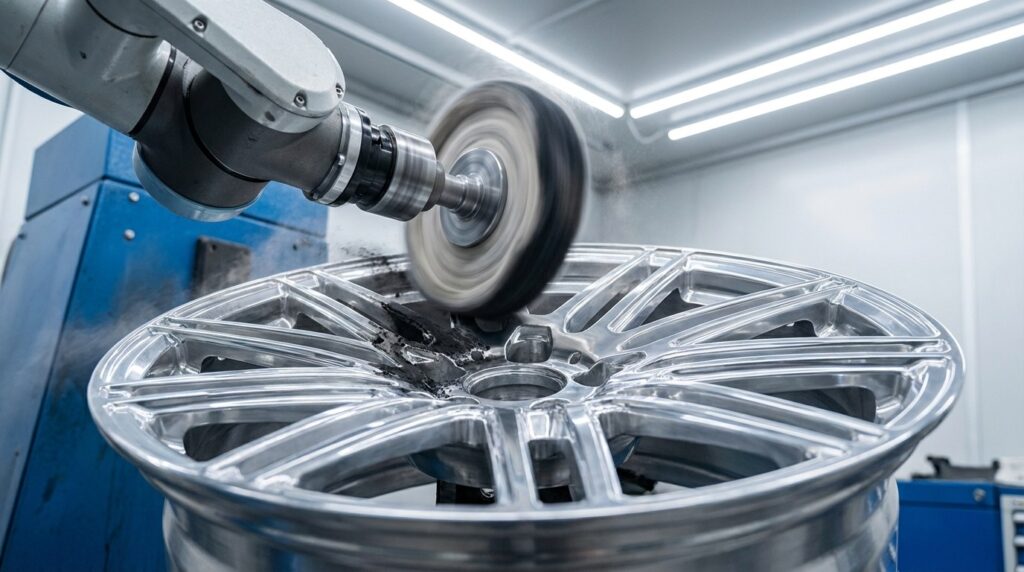
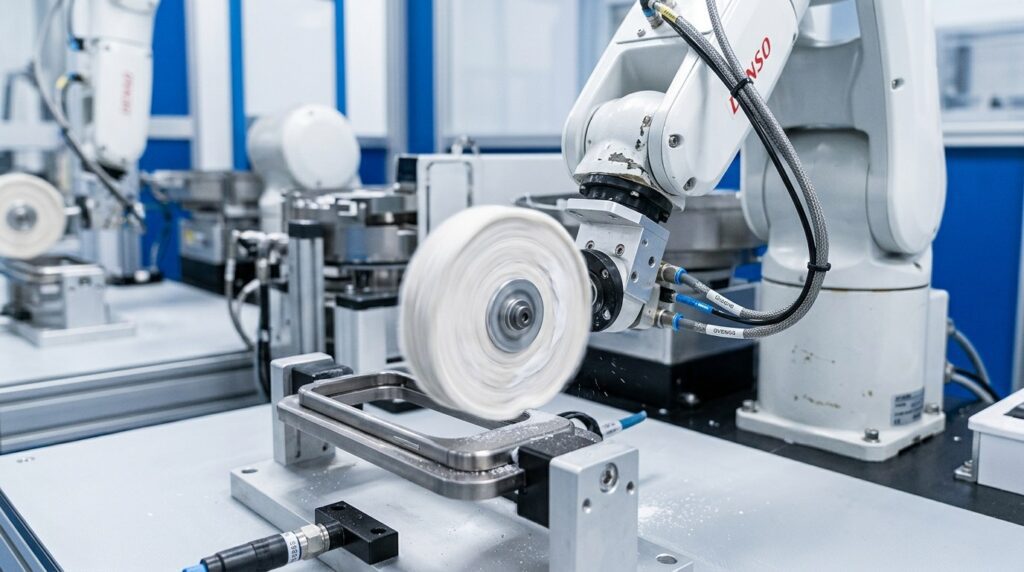
Trong lĩnh vực sản xuất đồ nội thất văn phòng cao cấp và Kim loại nói chung hardware, the 5-Star Chair Base is the core structural component that supports human weight and showcases the chair’s premium feel. Whether pursuing a minimalist brushed texture or a high-gloss mirror effect, its five radiating prongs must read as visually identical.
Đối mặt với những chi tiết đúc áp lực có kích thước khổng lồ và trọng lượng lớn, đòi hỏi phải mài ở nhiều mặt, lao động thủ công truyền thống từ lâu đã không còn đủ khả năng đáp ứng. Việc áp dụng một hệ thống tự động — trong đó một robot công nghiệp 6 trục chịu tải nặng kẹp vào lỗ trung tâm và di chuyển chi tiết đến các máy mài băng mài công suất cao lắp đặt trên sàn, được gọi là đánh bóng bằng robot—đã trở thành giải pháp tối ưu giúp các nhà sản xuất thiết bị gốc (OEM) hàng đầu thế giới trong lĩnh vực nội thất văn phòng khắc phục tình trạng tắc nghẽn năng lực sản xuất và loại bỏ các sai sót do mệt mỏi khi làm việc thủ công.
Chân ghế 5 sao bằng nhôm là gì?
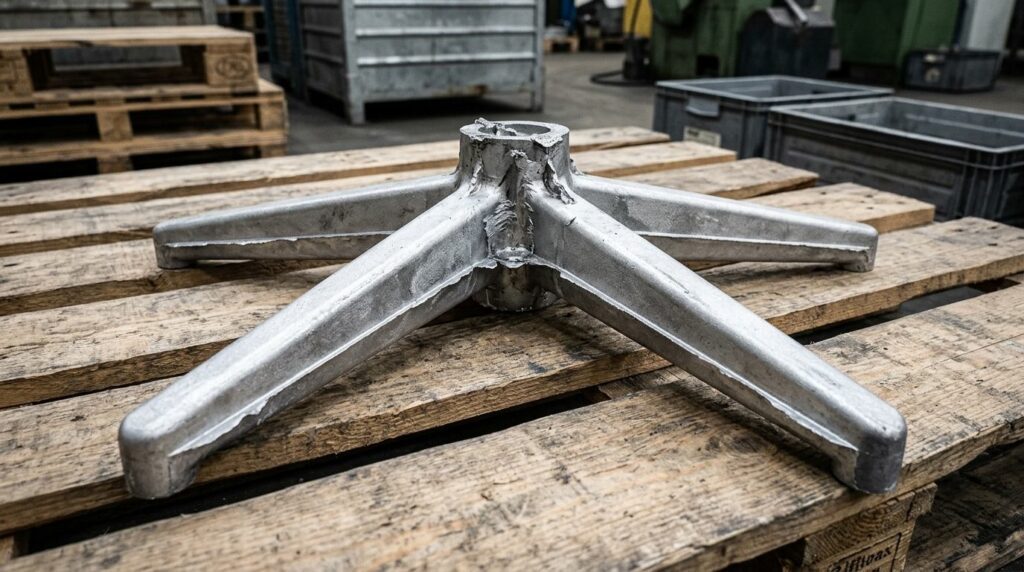
Chân ghế hình sao của các loại ghế văn phòng tầm trung đến cao cấp thường được đúc bằng máy đúc áp lực cao, sử dụng hợp kim nhôm có độ bền cao (như ADC12 hoặc A380). Ngay sau khi ra khỏi khuôn, phôi đúc thô thường có đường kính dao động từ 600mm đến 750mm. Bề mặt của nó còn thô ráp, có hiện tượng đóng lạnh do đúc áp lực, và các mép bên của cả năm chân đều bị bao phủ bởi các đường phân khuôn cực kỳ thô ráp và sắc nhọn cùng với cặn cửa rót.
Hai vấn đề song song của việc mài thủ công: Mệt mỏi và thiếu nhất quán
Do quy mô khổng lồ của căn cứ sao, việc mài thủ công phải đối mặt với những thách thức vô cùng khắc nghiệt:
- Kiệt sức thể chất nghiêm trọng: Một đế hình sao bằng nhôm nặng vài kilôgam. Công nhân phải cầm nó bằng cả hai tay, ấn chặt vào máy chà nhám đai và liên tục xoay bằng tay để mài cả năm cánh khác nhau. Công việc thể chất nặng nhọc và căng thẳng này khiến công nhân nhanh chóng mệt mỏi và tỷ lệ nghỉ việc rất cao.
- Các khuyết tật “không đối xứng” gây tử vong: Sức bền của con người sẽ suy giảm dần trong suốt ca làm việc. Một công nhân có thể dùng lực mạnh khi mài răng cưa thứ nhất nhưng lại dùng lực ít hơn đáng kể khi mài đến răng cưa thứ năm. Điều này dẫn trực tiếp đến việc độ bóng và kích thước vát góc R hoàn toàn không đồng đều trên năm răng cưa của cùng một chân ghế.
- Bụi nhôm dễ cháy nổ: Quá trình mài các bề mặt rộng bằng hợp kim nhôm tạo ra bụi nhôm có nồng độ rất cao. Điều này không chỉ gây tổn hại cho phổi của người lao động mà còn tiềm ẩn nguy cơ nổ nghiêm trọng trong các xưởng sản xuất kín, khiến đây trở thành đối tượng ưu tiên giám sát của các cơ quan quản lý an toàn.
Các thông số kỹ thuật cho hệ thống tự động hóa chân ghế nhôm
| Mặt hàng | Phạm vi tham số | Ghi chú |
| Chuẩn bị cho quá trình gating và loại bỏ phần thừa dày | Dây đai rộng SiC cắt cao | Loại bỏ nhanh chóng cặn thừa từ quá trình đúc áp lực, làm phẳng các đường viền bên |
| Kết hợp đường cong theo hướng tâm | Bánh xe nylon nổi / Dây đai mịn | Phù hợp với các đường cong thuôn nhọn của các chân, giúp xóa bỏ các vết in nổi dạng bậc thang |
| Đánh bóng mặt lớn và mặt bên | Lõi bằng sợi sisal mật độ cao / vải | Kết hợp với công nghệ đánh bóng tự động để làm nổi bật độ bóng cao tự nhiên của nhôm |
| Yêu cầu về tải trọng của robot | 160 kg – 210 kg | Do kích thước chi tiết rất lớn và lực đòn bẩy lớn nên bắt buộc phải sử dụng robot công suất cao |
| Lỗi không nhất quán về số chân cắm | ≤ 0,05 mm | Holds geometry and gloss of all 5 prongs to a matched finish |
Tại sao các hệ thống phần cứng quy mô lớn phải sử dụng kiến trúc “robot giữ chi tiết gia công”?
A star base is the classic “wide-span, heavy-body” workpiece, and it dictates its own layout: a heavy-payload robot drives a dedicated expanding gripper into the central gas-lift hole, locks it, and swings the whole casting against high-power floor-mounted belt machines and polishing centers. The center-hole grip turns an awkward casting into a predictable rotating workpiece.
For large-part grinding, this arrangement delivers where manual lines cannot:
- Indexed Posture Switching: One grip is all the setup the part gets. Rotating the 6th axis—or an external 7th—presents each of the five prongs to the stationary belt in turn, with the indexing precision of a rotary table. No human repositioning means no repositioning errors.
- Matched Prong Finishes: Constant feed and programmed trajectories give the 1st prong and the 5th prong the same pressure and dwell time. Symmetry across the product stops depending on how the worker felt at hour seven.
- Reaction-Force Stiffness: Grinding broad aluminum surfaces loads the arm heavily. A heavy-payload robot carries those cutting reactions without deflection or judder, which is why the surface texture stays smooth and wave-free.
Quy trình làm việc tự động trong quá trình mài và đánh bóng
| Bước | Operation | Tooling & Consumables | Mục đích |
| 01 | Tay cầm bên trong chịu lực cao | Robot + Trục nong khí nén | Mở rộng bên trong lỗ trung tâm để tạo ra một điểm khóa chắc chắn, xác định tọa độ 5 sao |
| 02 | Heavy Side Flash Removal | Băng tải thô công suất cao lắp đặt trên sàn | High-pressure passes flatten die-cast flash on the sides of all 5 prongs |
| 03 | Hòa trộn đồng nhất trên khuôn mặt | Máy đai tiếp xúc nổi rộng | Loại bỏ các vết do khuôn để lại, giúp 5 tấm panel cong có độ nhám bề mặt cơ bản đồng nhất |
| 04 | Đánh bóng gương độ bóng cao | Trung tâm lau xe bằng vải đa trạm Auto-Wax | Đánh bóng tốc độ cao cho các bề mặt cần có bề mặt nhôm bóng như gương |
| 05 | Bàn giao tự động khi dỡ hàng | Chuyển sang khâu đóng gói/vệ sinh | Thả kẹp, đặt chi tiết một cách nhẹ nhàng để tiến hành kiểm tra chất lượng tiếp theo |
Workholding and Datum Setup for Star Bases
Everything about star-base workholding follows from two facts: the part is heavy and wide, and it already contains a precision feature—the tapered gas-lift bore—at its center. The expanding mandrel grip exploits that bore for both holding and location, and the program establishes its angular zero on the centerline of prong one, so every subsequent indexing move is relative to a physical feature rather than a fixture guess.
- Mandrel locking: pneumatic or hydraulic expansion grips the bore wall over a length sized to the casting’s weight; grip pressure is set high enough to resist prong-tip cutting loads without distorting the bore.
- Overhang management: at 600-750 mm across, prong tips work at a long lever arm; the cell pairs robot stiffness with the shortest practical gripper to keep tip deflection out of the finish.
- Incoming variation: die-cast parting lines wander from shot to shot; the program banks on floating toolheads and generous lead-ins rather than expecting castings to repeat like machined parts.
Abrasives for Large Aluminum Castings
Aluminum die-castings are abrasive-system unkind: the metal smears, loads belts, and burns if the cut is allowed to glaze. The media ladder therefore runs from open-coat SiC belts that stay free-cutting through heavy flash removal, to floating nylon and fine belts that fair the prong curves, and finally to sisal and cloth wheels with auto-waxing for the mirror grades. Open-coat construction and disciplined belt changes matter more here than in steel work—aluminum does not forgive a loaded belt.
- Flash and gate residue: the coarse stage exists to remove bulk material fast; spending fine media on roughing is the fastest way to inflate consumable cost per base.
- Curved prong flanks: compliant wheels follow the tapering prong geometry so the surface is cut, not chased—stepped die-marks disappear without flattening the design intent.
- Dust strategy: every stage runs under extraction, wet where the fire risk assessment requires it, because aluminum fines are combustible; the cell’s dust handling is engineered as part of the process, not bolted on. Deburring fundamentals are covered in what is robotic deburring.
Cycle Structure and Consistency Verification
The cycle exploits indexing: prong by prong, side pass then top pass, the whole base machined around one grip. Loading and unloading overlap the grinding via a second station or an exchange table, so spindle time is nearly all cutting time. Lines running mixed models store per-family programs and gripper inserts, and changeovers between base families reduce to selecting the program and swapping the insert.
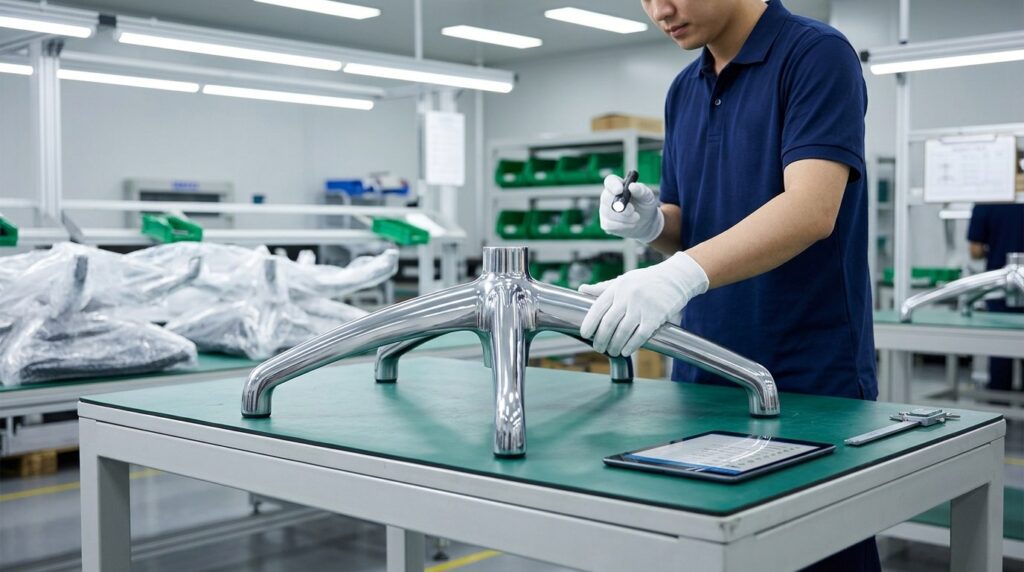
Consistency is checked the way customers see it: side-by-side prong comparison under consistent lighting, gloss sampling against the approved master, and dimensional spot checks on the bore and prong profiles. Because every part runs the same indexed program, a verified first part carries real weight—the rest of the batch is running the same physics. Wheel-machine selection for this class of work is covered in our wheel polishing machine guide; for a compact aluminum casting on the same platform, see our die-cast motor housing deburring solution.
Application Scenario: Large Die-Cast Star Bases
A hardware manufacturer in South China casting star bases for top-tier ergonomic chair brands is a typical case—eight heavy-payload cells now anchor its finishing line.
- Before: Recruitment had become the constraint—younger workers would not take heavy, high-dust aluminum grinding jobs. Manual grinding left the five prongs mismatched in gloss, brand rejections arrived regularly, and yield sat well below what the business needed.
- After: With 210 kg-class robots holding the workpieces, the line runs lights-out under fully enclosed negative-pressure dust extraction. The five prongs of every base come out visibly matched, first-pass cosmetic yield holds in the high nineties, cycle times shorten, and the capacity ceiling and dust hazard go with them.
Câu hỏi thường gặp về việc đánh bóng chân ghế bằng nhôm
Câu hỏi 1: Các đế hình sao có kích thước rất lớn, tạo ra một cánh tay đòn dài khi mài đầu của một chân đế. Liệu robot có thể kẹp chặt nó một cách ổn định không?
A: Yes. External clamping jaws are the wrong tool here. Instead, a high-strength pneumatic or hydraulic expanding mandrel enters the conical gas-lift hole in the center and expands outward, taking a positive lock on the bore interior. With a 160 kg-class robot, grinding pressure at the very tip of a prong still produces no chatter or shift. The same center-bore logic carries across design changeovers, as covered below.
Câu hỏi 2: Các nhà máy sản xuất đồ nội thất thường xuyên cập nhật thiết kế chân ghế hình sao (kiểu phẳng so với kiểu cong). Việc chuyển đổi dây chuyền robot có khó không?
A: It is straightforward. Because center-bore gripping suits the vast majority of star bases, a changeover is mostly a software event: the engineer imports the new CAD model, and 3D Offline Programming (OLP) plans the paths and indexing angles for all five prongs from it. No teach-pendant hours in a dusty workshop—which is what keeps high-mix furniture hardware production practical.
Kết luận
In high-end office furniture hardware, the matched finish of a 5-star base and its surface quality are baseline requirements, not aspirations. An automated architecture—a heavy-duty 6-axis robot gripping the center hole against high-power floor-mounted belt machines—takes workers out of the most punishing job on the floor and ends the asymmetry problem, while opening the capacity ceiling for furniture hardware suppliers.
Large aluminum castings punish every inconsistency a human brings to the job. When heavy grinding yields stop making sense, ask our team about a heavy-payload cell for your furniture hardware line: Liên hệ với chúng tôi.