
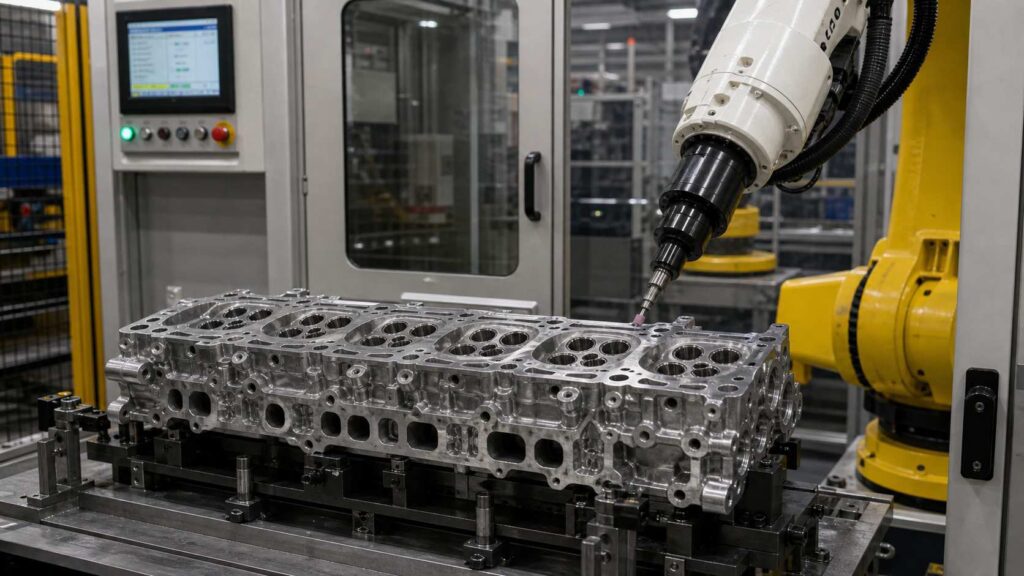
Aluminum alloy engine cylinder heads are complex automotive engine castings used to form combustion chamber areas, support valve-train components and connect intake, exhaust, cooling and lubrication passages. Across common cylinder head designs, the workpiece brings combustion chamber edges, intake and exhaust ports, water jacket openings, oil passages, spark plug or injector holes, bolt holes, machined surfaces and irregular casting contours, making post-casting deburring and local grinding more demanding than on simple aluminum components.
This robotic deburring and grinding solution is designed for aluminum alloy engine cylinder heads with typical dimensions around 350–650 mm in length, depending on the engine model. It helps remove burrs, flash, sharp edges, passage-edge residues and local gate marks from port openings, chamber boundaries, water and oil passage edges, bolt holes, outer contours and local cavity transitions while improving finishing consistency and protecting critical functional surfaces.
What Is an Aluminum Alloy Engine Cylinder Head?
An aluminum alloy engine cylinder head is a core engine casting mounted above the cylinder block, whose own finishing challenges are covered in our cylinder block deburring and grinding solution. It contains or supports combustion chamber features, intake and exhaust flow paths, valve-related areas, spark plug or injector locations, coolant passages, oil passages and multiple mounting interfaces.
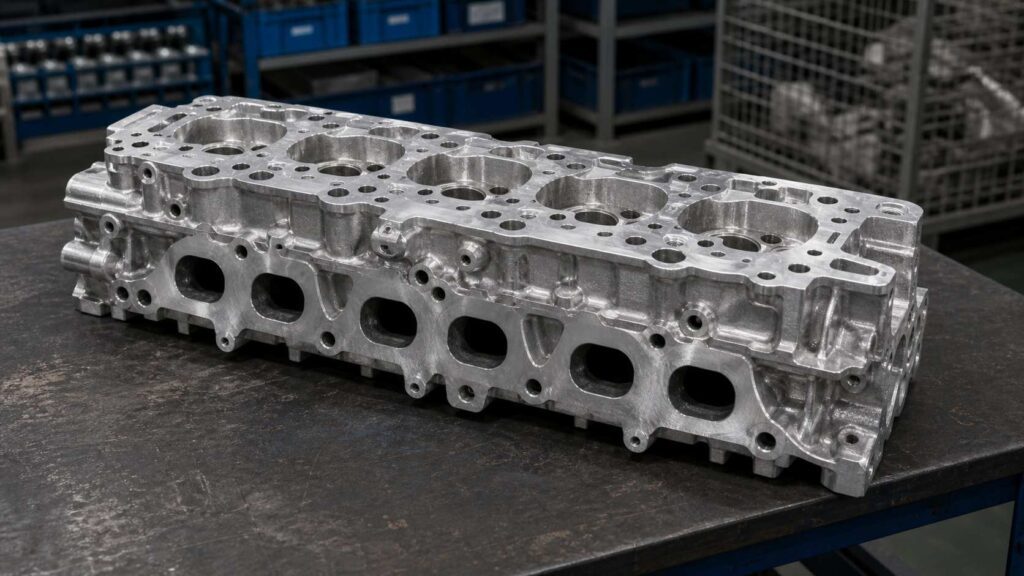
Even at a glance, an engine cylinder head is far more complex than a cylinder head cover. It has deep passages, functional hole groups, chamber-side boundaries, machined mounting faces, sealing surfaces, threaded or precision holes and dense internal transitions. After casting, trimming and rough machining, burrs, flash and sharp edges may remain around port openings, water jacket holes, oil passages, bolt holes, chamber edges and local casting transitions. For this type of workpiece, the main finishing requirement is robotic deburring, controlled local grinding and passage-edge cleanup rather than decorative polishing.
| Item | Details |
|---|---|
| Workpiece Name | Aluminum Alloy Engine Cylinder Head |
| Typical Size | Around 350–650 × 180–350 × 100–250 mm, depending on model |
| Material | Aluminum Alloy Casting |
| Main Process | Robotic Deburring and Grinding |
| Assisted Processes | Port Edge Deburring, Hole Edge Treatment, Local Surface Cleanup, Edge Rounding |
| Key Processing Areas | Intake ports, exhaust ports, combustion chamber edges, water jacket openings, oil passages, bolt holes, outer contours, local gate-cut areas |
| Protected Areas | Combustion chamber surfaces, valve seats, valve guide holes, sealing faces, machined reference surfaces, precision holes |
| Finishing Goal | Remove burrs, flash, sharp edges and local residues while protecting critical engine functional surfaces |
Typical Finishing Challenges of Aluminum Alloy Engine Cylinder Head
An aluminum alloy engine cylinder head is difficult to finish because burrs may appear around many functional features rather than only along external edges. Port openings, water jacket holes, oil passages, bolt holes and chamber boundaries all require controlled edge cleanup, but nearby precision surfaces must remain protected.
Manual deburring is unstable because operators need to reach into different openings and adjust tool angle frequently; choosing the right equipment category, as outlined in our deburring machine types guide, is the first step away from that variability. Some port edges or internal passage boundaries may be under-processed, while chamber-side or sealing-adjacent areas may be damaged if too much force is applied. Since cylinder heads directly affect engine assembly and performance, the robotic process must balance burr removal, surface protection and repeatability.
| Common Problem | Specific Area | Impact |
|---|---|---|
| Port Edge Burrs | Intake and exhaust port openings | May affect assembly preparation and flow-edge quality |
| Water / Oil Passage Burrs | Coolant openings, oil passage edges | Causes unstable cleanup quality and inspection risk |
| Sharp Edges | Bolt holes, outer contours, local openings | Creates handling and assembly risks |
| Local Casting Flash | Outer contour, parting line areas, gate-cut sections | Requires controlled local grinding |
| Manual Variation | Multiple ports, holes and chamber-side boundaries | Leads to inconsistent results between operators |
| Sensitive Functional Areas | Chamber faces, valve seats, guide holes, sealing surfaces, precision holes | Risk of damage during manual grinding |
Robotic Deburring and Grinding Process for Aluminum Alloy Engine Cylinder Head
A robotic deburring and grinding cell for aluminum alloy engine cylinder heads should be designed around multi-feature access, controlled material removal, tool compliance and functional-surface protection, with 6-axis deburring equipment as the typical motion platform for reaching every port and passage. The process must remove burrs and local residues from ports, holes, passages and contours while avoiding damage to combustion chamber surfaces, valve seats, guide holes, sealing faces and machined references.

For engine cylinder heads with typical dimensions around 350–650 mm in length, the process usually includes loading, program selection, protected-area confirmation, outer contour grinding, port edge deburring, water and oil passage cleanup, bolt hole treatment, chamber-adjacent edge control, inspection and unloading. Different tools may be used for different areas, including flexible deburring tools, chamfering tools, small grinding heads and controlled abrasive tools.
| Step | Process | Purpose | Tool / System |
|---|---|---|---|
| 1 | Loading and Positioning | Secure the cylinder head for multi-side access | Dedicated fixture |
| 2 | Program Selection | Match the correct cylinder head model and path | HMI / Robot program |
| 3 | Protected Area Confirmation | Define chamber, valve, sealing and precision no-grind zones | Fixture logic / Program setting |
| 4 | Outer Contour and Parting Line Grinding | Remove flash and residues from external casting edges | Abrasive grinding tool |
| 5 | Intake and Exhaust Port Edge Deburring | Remove burrs from port openings and transition edges | Flexible deburring tool |
| 6 | Water and Oil Passage Edge Cleanup | Clean small passage openings and local edges | Small deburring tool / Deburring spindle |
| 7 | Bolt Hole and Mounting Edge Treatment | Deburr bolt holes and mounting-related edges | Chamfering tool |
| 8 | Chamber-Adjacent Edge Control | Clean edges near combustion chamber without damaging functional surfaces | Controlled path / No-grind zones |
| 9 | Quality Inspection | Check burr removal and protected functional areas | Manual or visual inspection |
| 10 | Unloading and Cleaning | Remove chips and transfer the cylinder head | Air blow / Vacuum cleaning |
Step 1: Loading and Positioning
The aluminum alloy engine cylinder head is loaded into a dedicated fixture that supports the casting from stable and non-critical areas. Because the cylinder head contains multiple functional surfaces and openings, fixture accuracy directly affects robot path reliability.
The fixture should allow the robot to access outer contours, port openings, bolt holes and passage edges while maintaining safe clearance from protected surfaces. Stable positioning also reduces vibration during local grinding and helps keep burr removal consistent.
Step 2: Program Selection
After the cylinder head is fixed, the operator selects the correct robot program through the HMI. This is important because cylinder head models may vary in port layout, bolt pattern, passage position and chamber-side structure.
Inside that program live the processing order, tool assignment, robot postures, feed rate, contact force and the list of protected zones. Calling the same program back for later batches is what keeps cylinder head finishing repeatable.
Step 3: Protected Area Confirmation
Before processing begins, the system confirms all protected areas. For an engine cylinder head, protected surfaces usually include combustion chamber surfaces, valve seats, valve guide holes, spark plug or injector interfaces, sealing faces, machined reference planes and precision holes.
This step is critical because many burrs are close to functional surfaces. The robot should remove edge defects without touching surfaces that affect combustion, sealing, valve assembly or dimensional accuracy.
Step 4: Outer Contour and Parting Line Grinding
The robot first processes external casting edges where light flash, parting line residues and trimming marks may remain. These areas may include outer contours, side edges, local bosses and gate-cut positions.
An abrasive grinding tool can remove raised defects with controlled feed and pressure. For aluminum alloy cylinder heads, the process should avoid deep grinding marks and unnecessary material removal, especially near machined surfaces.
Step 5: Intake and Exhaust Port Edge Deburring
Intake and exhaust port openings are important deburring areas on engine cylinder heads. Burrs around these port edges can affect assembly preparation and may create unstable edge quality near airflow passages.
A flexible deburring tool can follow the port opening profile with controlled contact pressure. The robot should clean the edge boundary without changing the intended port shape or touching protected machined areas.
Step 6: Water and Oil Passage Edge Cleanup
Water jacket openings and oil passage edges often contain small burrs or casting residues. These features may be smaller and more difficult to access than external edges.
A small deburring tool or deburring spindle can be used to clean these passage openings. The robot can process each passage edge with repeatable posture, reducing missed burrs and improving inspection consistency.
Step 7: Bolt Hole and Mounting Edge Treatment
Cylinder heads include many bolt holes, threaded holes and mounting-related openings. Burrs around these holes may affect assembly, bolt insertion or surface seating.
A chamfering tool can process each hole opening with consistent depth and angle. The robot repeats the same routine across hole groups, which improves edge uniformity compared with manual chamfering.
Step 8: Chamber-Adjacent Edge Control
The combustion chamber side is one of the most sensitive areas on an engine cylinder head. Burrs near chamber boundaries may need to be removed, but chamber surfaces, valve seats and related precision features must not be damaged.
The robot uses controlled approach paths, low contact force and no-grind zones to clean only the required edge boundary. This helps protect functional geometry while removing small burrs that may remain after casting or machining.
Step 9: Quality Inspection
After robotic deburring and grinding, operators inspect the port openings, water and oil passage edges, bolt holes, outer contours, chamber-adjacent boundaries and protected functional surfaces. The inspection confirms that burrs and sharp edges have been removed and that critical surfaces remain undamaged.
Depending on production requirements, inspection can include visual checks, manual touch checks, gauges or camera-based verification. Inspection feedback can also be used to optimize path compensation, tool life and local parameters.
Step 10: Unloading and Cleaning
After inspection, the cylinder head is unloaded and transferred to the next process. Aluminum chips and fine particles should be removed from ports, holes, passage openings and cavity areas.
An enclosed robotic cell with aluminum chip and dust collection is recommended. It helps improve cleanliness and reduces the operator’s direct exposure to repetitive manual deburring and grinding work.
Machining Difficulties and Solutions
| Challenge | Cause | Robotic Solution |
|---|---|---|
| Port Edge Burrs | Intake and exhaust openings create complex edge profiles | Flexible deburring along port boundaries |
| Passage Opening Burrs | Water and oil passages have small, repeated edges | Small tool access with local deburring routines |
| Chamber-Side Protection | Chamber surfaces and valve features must not be damaged | No-grind zones and controlled tool posture |
| Bolt Hole Variation | Multiple holes require consistent chamfering | Robotic chamfering routine with repeatable depth |
| Local Casting Residues | Parting lines or gate-cut areas require controlled grinding | Dedicated abrasive tool and local path |
| Functional Surface Sensitivity | Machined faces and precision holes are close to burr areas | Protected-zone programming and fixture accuracy |
Difficulty 1: Intake and Exhaust Port Edge Deburring
The intake and exhaust port openings have curved profiles and transition edges. Burrs around these areas can be difficult to remove uniformly by hand because the operator must maintain the correct tool angle around irregular openings.
The solution is to use a flexible deburring tool and programmed port-edge paths. The robot follows each port boundary with controlled pressure, improving consistency while reducing the risk of changing the port geometry.
Difficulty 2: Water and Oil Passage Cleanup
Water jacket and oil passage openings may be small, repeated and located on different surfaces of the cylinder head. Manual deburring can easily miss small burrs inside these openings.
The solution is to use a small deburring tool or spindle with local routines for each passage. The robot processes each opening with repeatable posture and controlled depth, improving burr removal consistency.
Difficulty 3: Combustion Chamber and Valve Area Protection
The combustion chamber side includes sensitive areas such as chamber surfaces, valve seats and nearby precision features. These areas must not be scratched or over-ground during burr removal.
The solution is to define chamber and valve-related features as no-grind zones. The robot only processes the required edge boundary and keeps abrasive tools away from protected functional surfaces.
Difficulty 4: Multiple Bolt Holes and Mounting Edges
Cylinder heads contain many bolt holes and mounting-related openings. Manual chamfering around these holes can vary in depth, angle and surface finish.
The solution is to use a robotic chamfering routine. The robot repeats the same approach angle, contact depth and tool speed at each hole, improving uniformity across the part.
Difficulty 5: Local Parting Line and Gate Residue Removal
Some external casting areas may contain flash, parting line residues or gate-cut marks. These defects require more material removal than normal light deburring.
The solution is to use a dedicated local grinding path with an abrasive tool. The robot removes thicker residues only where needed, avoiding unnecessary grinding near clean or protected areas.
Application Scenario
Scenario Background
Aluminum cylinder heads for passenger engines collect burrs, flash, passage-edge residues and sharp edges at port openings, water jacket holes, oil passages, bolt holes and outer contours, and clearing all of that by hand ties up skilled labor shift after shift.
Manual work of that kind is also hard to keep uniform: port and passage edges come out under-processed on some parts, and chamber-adjacent areas need constant care to avoid damage. Hence the move to robotic deburring and grinding for consistency, workload relief and lower damage risk.
Technical Challenges
A cylinder head combines complex port openings, many small passage edges, bolt holes, external casting contours and sensitive combustion-chamber-related areas, so its burr map is denser than on frame or cover castings.
Process control decides the outcome. Casting residues call for local grinding in some zones, while other zones need only light deburring a short distance from precision surfaces, and none of it may touch valve seats, sealing faces, machined references or chamber surfaces.
Solution
The configuration for this scenario is a six-axis industrial robot, a dedicated cylinder head fixture and a multi-tool finishing package: a flexible deburring tool on intake and exhaust port edges, a small deburring spindle in the water and oil passage openings, a chamfering tool over the bolt holes and an abrasive grinding tool for external flash or gate residues.
Combustion chamber surfaces, valve seats, guide holes, sealing faces, machined references and precision holes all sit in the program’s protected list. The fixture gives repeatable positioning and the enclosure captures aluminum chips and fine particles.
| Item | Configuration |
|---|---|
| Workpiece | Aluminum Alloy Engine Cylinder Head |
| Typical Size | Around 350–650 × 180–350 × 100–250 mm, depending on model |
| Main Process | Robotic Deburring and Grinding |
| Assisted Process | Port Edge Deburring, Hole Edge Treatment, Local Surface Cleanup |
| Robot | Six-Axis Industrial Robot |
| Tooling | Flexible deburring tool, small deburring spindle, chamfering tool, abrasive grinding tool |
| Fixture | Dedicated Engine Cylinder Head Support Fixture |
| Protection Strategy | Protected chamber surfaces, valve seats, sealing faces, machined references and precision holes |
| Dust Control | Enclosed Cell with Aluminum Chip and Dust Collection |
Implementation Results
The robotic cell took over repetitive deburring and local grinding work on port openings, passage edges, bolt holes, outer contours and local casting residue areas. Staff attention narrows to loading, unloading, inspection and tool maintenance, direct finishing effort disappears and batch-to-batch stability improves.
The controlled process also improved protection for sensitive functional surfaces. Instead of relying only on manual skill, the robot followed saved paths with defined no-grind zones, reducing the risk of accidental tool contact near chamber, valve and sealing areas.
| Result Area | Improvement |
|---|---|
| Port Edge Deburring | More stable cleanup around intake and exhaust openings |
| Passage Edge Cleanup | Better consistency around water and oil passage openings |
| Bolt Hole Treatment | Repeatable chamfering and burr removal around hole groups |
| Local Residue Grinding | Dedicated paths for parting line and gate-cut areas |
| Chamber Area Protection | Lower risk of damage to chamber and valve-related surfaces |
| Surface Protection | Machined faces and precision holes excluded from grinding paths |
| Labor Reduction | Reduced repetitive manual deburring and grinding workload |
| Production Stability | Saved programs for repeated cylinder head batches |
| Workshop Environment | Cleaner finishing area with enclosed aluminum chip collection |
Information Needed for a Robotic Grinding Proposal
To recommend a suitable robotic deburring and grinding cell for your aluminum alloy engine cylinder head, we usually need the part drawing, material grade, casting weight, photos of burrs, flash, passage residues or gate-cut areas, required processing areas, protected combustion chamber or sealing surfaces, current manual cycle time and annual production volume.
Our team reads these inputs against fixture design, robot reach, tool selection, chip collection layout and process feasibility. For aluminum alloy engine cylinder heads, it is especially important to identify which port, passage and hole edges require burr removal and which valve, chamber, sealing or precision surfaces must be protected during robotic finishing.
FAQ
Q1: Is an engine cylinder head different from an engine cylinder head cover?
Yes. An engine cylinder head is a core engine casting with combustion chamber, port, passage and valve-related features. An engine cylinder head cover is a cover component mounted above the cylinder head and mainly requires perimeter and sealing-edge deburring.
Q2: Why is robotic deburring and grinding suitable for engine cylinder heads?
Robotic deburring and grinding are suitable because cylinder heads have many repeated ports, holes, passages and casting edges. A robot can follow programmed paths with controlled contact force, improving consistency compared with manual operation.
Q3: What areas can the robot process on an engine cylinder head?
The robot can process intake and exhaust port edges, water jacket openings, oil passage edges, bolt holes, outer contours, parting line areas and local gate residues. The exact processing areas should be confirmed based on the drawing and actual burr distribution.
Q4: Does this part require decorative polishing?
Decorative polishing is not on the requirement list for engine cylinder heads. The work is deburring, local grinding, edge cleanup and protection of functional surfaces.
Q5: How are combustion chamber and valve-related areas protected?
Protected areas are controlled through fixture positioning, robot path planning and no-grind zones. Combustion chamber surfaces, valve seats, valve guide holes, sealing faces and precision holes are excluded from grinding paths.
Q6: Can one robotic cell handle different cylinder head models?
Yes. One robotic cell can often handle different aluminum alloy engine cylinder head models if the fixture, robot reach and tool system are designed for part variation. Different robot programs can be saved for different models or part numbers.
Conclusion
Aluminum alloy engine cylinder heads have intake and exhaust ports, water and oil passages, bolt holes, combustion chamber boundaries and sensitive machined interfaces, making manual deburring and grinding difficult to standardize. A robotic deburring and grinding solution helps manufacturers remove burrs, flash, sharp edges and local residues while improving consistency and protecting critical engine functional surfaces.
If your engine cylinder head production still relies on manual port deburring, passage cleanup or local casting residue grinding, Contact Us for a customized robotic solution. You may also find the Automotive & EV application pages and the Equipment catalog useful for comparing configurations.

