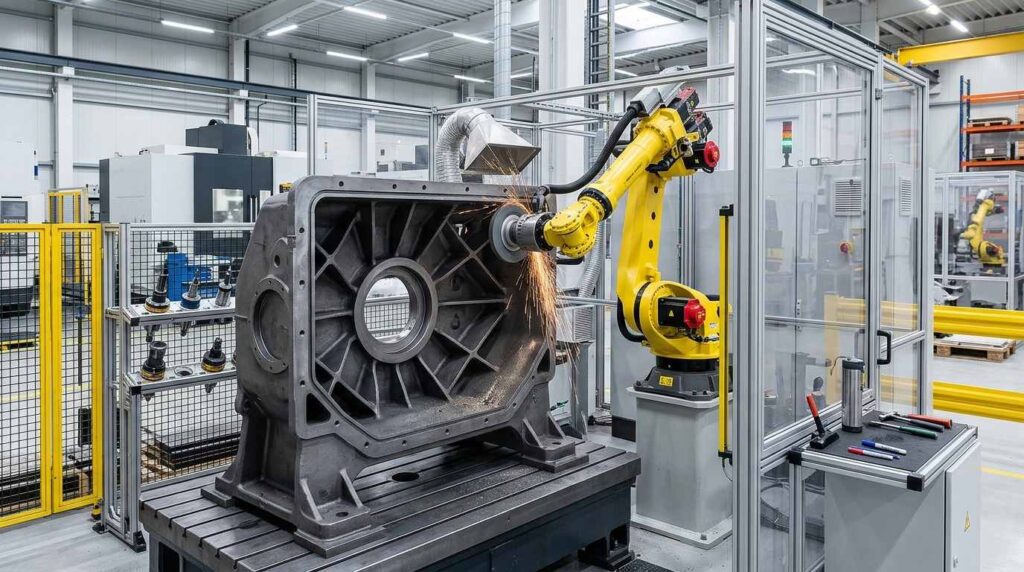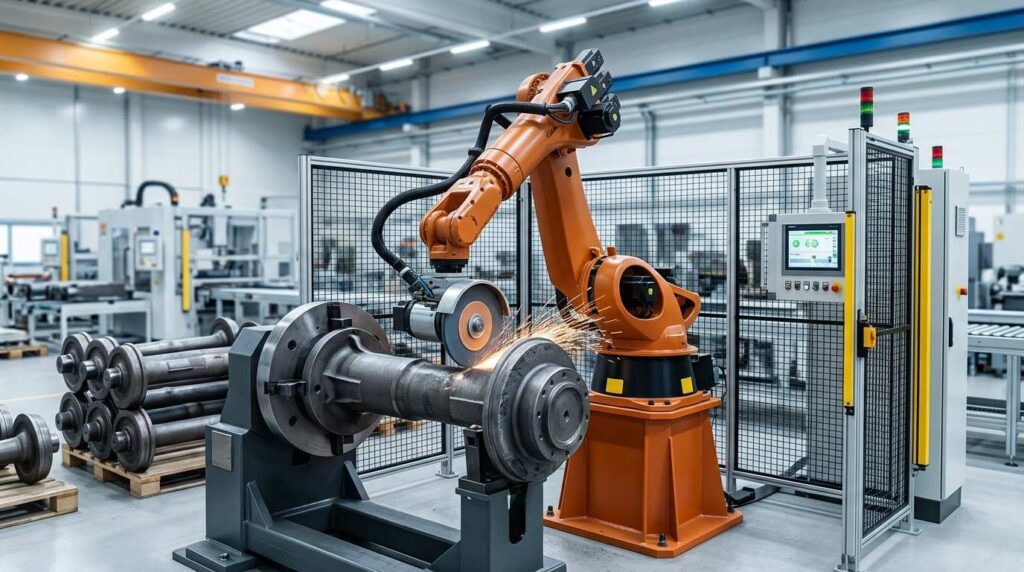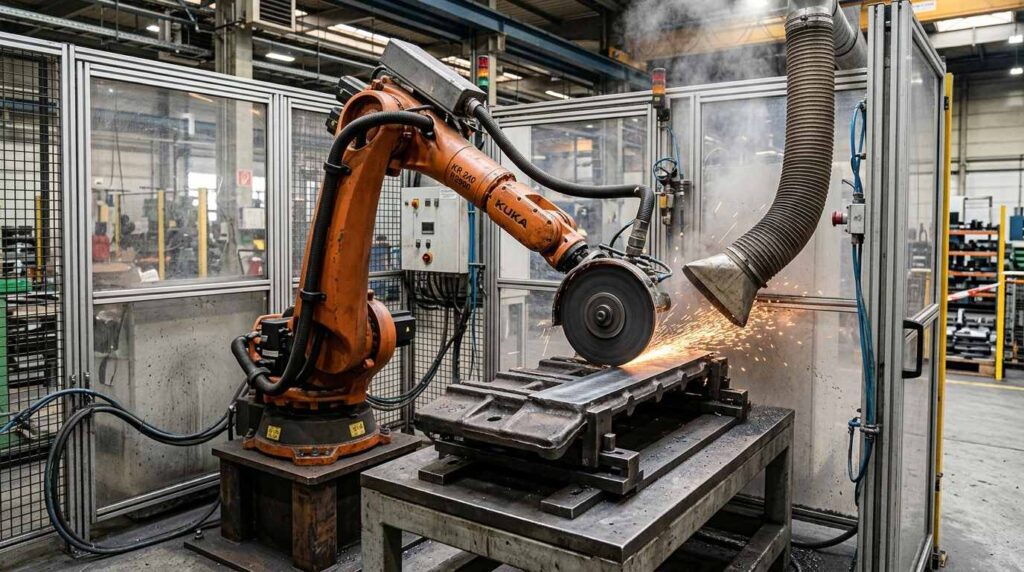
Track pads are cast iron support components used in rail-related systems, heavy-duty equipment, industrial guide structures and machinery base assemblies. As a typical medium-to-large cast iron workpiece, a track pad usually has a flat body, raised structural sections, mounting areas, outer edges and local transitions that require reliable post-casting finishing.
During casting, track pads may develop flash, burrs, parting lines, sharp edges and uneven surface areas. These defects are commonly found along the outer contour, flat surfaces, mounting transitions and edge zones. If they are not removed properly, they may affect installation quality, coating adhesion, handling safety and downstream assembly consistency.
Traditional manual grinding requires workers to remove casting flash, grind flat surfaces and chamfer edges one by one. For repeated track pad production, this process becomes labor-intensive and difficult to keep consistent. A robotic grinding solution provides a more stable and repeatable method for finishing cast iron track pads, especially when manufacturers need consistent surface preparation and edge quality in batch production.
This solution is designed for cast iron track pads with typical dimensions around 620 × 280 × 100 mm based on your sample reference. It focuses on robotic grinding, casting flash removal, flat surface grinding, edge chamfering and surface preparation before coating, assembly or shipment.
What is a Track Pad?
A track pad is a support or contact component used in systems where load distribution, positioning, vibration resistance or wear support is required. Depending on the application, it may be used in railway track support systems, industrial guide rail structures, heavy equipment track assemblies, material handling equipment or machinery foundation systems.
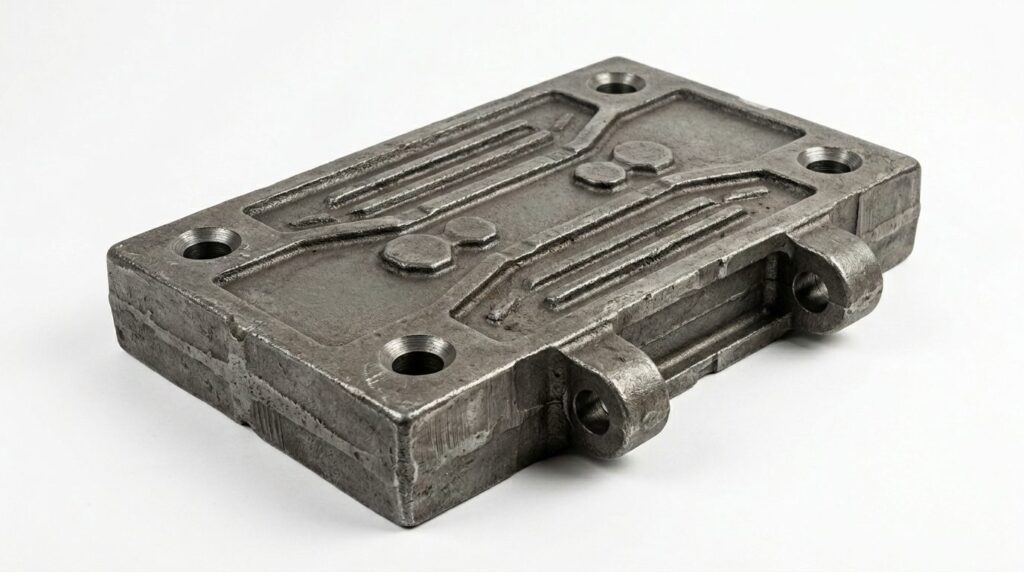
Cast iron is often used for this type of workpiece because it provides good compressive strength, wear resistance, vibration damping and casting efficiency. The part may include flat contact areas, side walls, mounting features, raised ribs and edge transitions. These features create several finishing zones after casting.
Although the workpiece appears relatively simple, track pad finishing is not just basic cleaning. Flat surfaces may require grinding to remove casting irregularities, outer edges may need chamfering for safety and assembly, and parting line flash must be removed before coating or installation.
| 項目 | 詳細 |
|---|---|
| ワークピース名 | Track Pad |
| 中国名 | 轨道垫板 |
| 典型的なサイズ | 620 × 280 × 100 mm |
| 素材 | 鋳鉄 |
| 主なプロセス | ロボット研削 |
| アシストプロセス | Deburring, Edge Chamfering, Surface Finishing |
| 主な加工エリア | Flat surfaces, outer edges, parting lines, mounting transitions |
| ゴール | Remove casting flash, grind flat areas and chamfer sharp edges |
For track pads, the main target is not mirror polishing. The key requirement is to remove casting defects, improve flat surface consistency, chamfer sharp edges and prepare the part for coating or assembly. Therefore, robotic grinding is a suitable core process for this type of cast iron workpiece.
Typical Applications of Track Pads
Track pads are functional industrial components. They are usually used in applications where support, contact, load distribution or positioning stability is required.
| アプリケーションエリア | 典型的な使用例 |
|---|---|
| Railway Track Systems | Support or positioning component in track-related assemblies |
| Heavy Equipment | Track or support pad for machinery structures |
| Industrial Guide Rails | Support surface or guide-related cast component |
| Material Handling Systems | Load-bearing or sliding support component |
| Machinery Base Assemblies | Contact pad or support plate for equipment structures |
| Engineering Equipment | Wear-resistant or support-related cast iron part |
In these applications, burrs, flash and sharp edges can affect installation, handling, surface coating and long-term reliability. A consistent grinding process helps ensure that each track pad meets the expected finishing standard before delivery.
Pain Point Analysis of Track Pad Finishing
The first challenge is casting flash removal. Track pads often have flash along the outer edges, parting line areas and local transitions. If the flash is thick or uneven, manual workers must spend considerable time removing it.
The second challenge is flat surface grinding. A track pad may contain broad flat surfaces that need cleaning or surface preparation before coating or assembly. Manual grinding on a flat area can easily create uneven marks if the grinding pressure is not stable.
The third challenge is edge chamfering. Sharp edges around the outer contour or mounting areas can create handling risks and may interfere with installation. Manual chamfering depends heavily on worker skill and may vary from part to part.
The fourth challenge is batch consistency. Track pads are often produced as repeated cast parts. When every part requires similar edge treatment and surface preparation, manual finishing becomes repetitive and difficult to standardize.
| よくある問題 | 特定地域 | インパクト |
|---|---|---|
| キャスティング・フラッシュ | Outer contour and parting line areas | Affects appearance, coating and installation |
| Uneven Flat Surface | Main contact or visible flat areas | 表面処理の一貫性を低減 |
| シャープなエッジ | Outer edges and local transitions | 取り扱いや組み立てのリスクが生じる |
| 地元のバリ | Mounting areas and geometry changes | May affect installation or coating quality |
| マニュアル・バリエーション | Flat grinding and edge chamfering zones | Causes inconsistent finishing quality |
| 鋳鉄ダスト | 研磨作業 | 作業場の清潔さと作業者の快適性に影響 |
Compared with manual grinding, robotic grinding can provide more stable processing of flat surfaces and more repeatable edge chamfering. This is especially useful for track pad production where the workpiece shape and finishing path are repeated.
| 比較項目 | 手動研磨 | ロボット研削 |
|---|---|---|
| フラッシュ除去 | Depends on worker force and experience | Repeatable tool path and stable removal |
| Flat Surface Grinding | Easy to create uneven marks | Controlled grinding path and pressure |
| Edge Chamfering | Chamfer size may vary | Consistent edge treatment |
| 労働強度 | Repetitive and physically demanding | Reduces manual grinding workload |
| バッチ生産 | Difficult to standardize fully | プログラムの保存と再利用が可能 |
| 粉塵暴露 | 粉塵の近くで作業するオペレーター | Can be integrated with dust extraction |
For track pad manufacturers, robotic grinding helps turn a repetitive finishing process into a more controlled and scalable production step.
Robotic Grinding Process for Track Pads
A robotic grinding cell for track pads can be configured according to workpiece size, casting flash thickness, required surface quality and production volume. The system usually includes a six-axis robot, dedicated fixture, abrasive grinding tool, chamfering tool, optional force-control device, dust extraction system and safety enclosure.
The process focuses on removing casting flash, grinding flat surfaces, chamfering edges and preparing the workpiece for coating or assembly.
| ステップ | プロセス | 目的 | ツール/システム |
|---|---|---|---|
| 1 | ローディングとポジショニング | Secure the track pad accurately | 専用フィクスチャー |
| 2 | プログラム選択 | 正しい研削経路を選択する | HMI / ロボットプログラム |
| 3 | Casting Flash Removal | Remove flash from parting lines and outer contour | 研磨工具 |
| 4 | Flat Surface Grinding | Improve surface consistency on flat areas | 砥石または研磨ベルト |
| 5 | Edge Chamfering | Smooth and chamfer sharp edges | Chamfering tool or compliant grinder |
| 6 | Local Transition Finishing | Process corners and mounting transitions | 小型研磨ヘッド |
| 7 | 品質検査 | Check flash removal, flatness appearance and edge quality | 手動または目視検査 |
| 8 | 荷降ろしと清掃 | 埃を取り除き、部品を移す | エアブロー/バキュームクリーニング |
ステップ1:積み込みと位置決め
The track pad is placed into a dedicated fixture. The fixture must support the flat body and keep the workpiece stable during grinding. Since the part has a broad contact surface and local raised areas, fixture design should ensure both stability and tool accessibility.
For repeated production, the fixture can include quick positioning blocks to reduce loading time and improve consistency.
ステップ2:プログラムの選択
The operator selects the corresponding robot program according to the track pad model. If several similar track pad sizes are produced, separate programs can be saved and selected through the HMI.
For higher automation, barcode scanning or fixture recognition can be added to reduce program selection errors.
Step 3: Casting Flash Removal
The robot first removes casting flash from the outer contour, parting line areas and local transitions. These areas usually require the most material removal during the finishing process.
An abrasive grinding tool is used to remove unwanted flash while maintaining stable tool contact. For heavier flash, the process may use multiple grinding passes.
Step 4: Flat Surface Grinding
After flash removal, the robot processes selected flat surfaces. The goal is to remove rough casting marks, local high spots and surface irregularities.
Flat surface grinding must be controlled carefully to avoid uneven grinding marks. A compliant grinding tool or force-controlled system can help maintain stable pressure across the surface.
Step 5: Edge Chamfering
The robot then chamfers sharp outer edges and selected local edges. This improves handling safety and reduces the risk of coating defects on sharp corners.
Consistent edge chamfering is one of the key advantages of robotic grinding. The robot can follow the same path on every part, creating more uniform edge quality than manual processing.
Step 6: Local Transition Finishing
Corners, mounting transitions and raised structural features may require additional local finishing. These areas can be difficult to process evenly by hand because the tool angle changes frequently.
The robot can use a smaller grinding head or localized finishing tool to smooth these areas and remove remaining burrs.
ステップ7:品質検査
After grinding, the track pad is inspected for flash removal, flat surface consistency, edge chamfer quality and local burr removal. Key inspection areas include the outer contour, main flat surface, parting line areas and mounting transitions.
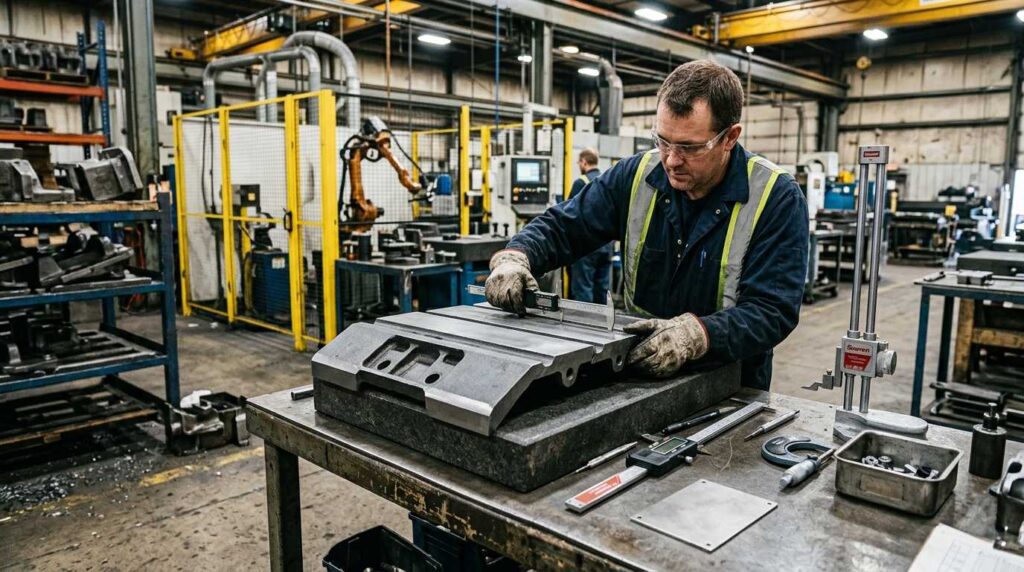
Inspection can be performed manually or with visual assistance depending on the production requirements.
ステップ8:荷下ろしと清掃
The finished track pad is removed from the fixture. Dust and grinding residue can be cleaned by air blowing, brushing or vacuum suction. The workpiece can then move to coating, assembly, packaging or the next production process.
機械加工の困難と解決策
Track pads are challenging because they combine flat surface grinding, contour flash removal and edge chamfering in one workpiece. A good robotic solution must maintain surface consistency while also handling local burrs and edge defects.
| チャレンジ | 原因 | ロボットソリューション |
|---|---|---|
| Heavy Casting Flash | Parting lines and outer edges retain excess material | Programmed grinding path with suitable abrasive tool |
| Flat Surface Consistency | Broad surfaces are sensitive to uneven pressure | Force-controlled or compliant grinding |
| Edge Chamfer Variation | Manual chamfering depends on operator skill | Repeatable robotic chamfering path |
| Local Burrs at Transitions | Corners and raised features accumulate burrs | Small tool and localized finishing path |
| ダストジェネレーション | 鋳鉄粉砕は微粒子を作る | 除塵装置付き密閉セル |
Difficulty 1: Casting Flash May Be Thick and Uneven
Track pads may have thick flash along parting lines or outer edges. Manual workers often need to apply high force, which can create inconsistent results and increase fatigue.
The solution is to use a robotic grinding path designed for flash removal. The robot can apply a consistent processing strategy and repeat the same path for every part. For thicker flash, staged grinding can be used.
Difficulty 2: Flat Surfaces Require Stable Grinding Pressure
Broad flat surfaces can show uneven grinding marks if the tool pressure changes. Manual grinding may leave inconsistent patterns or local over-ground areas.
The solution is to use compliant grinding or force-controlled tools. This helps maintain stable contact pressure and improves surface consistency across the flat area.
Difficulty 3: Edge Chamfering Must Be Consistent
Sharp edges need to be chamfered for safety, coating and assembly. Manual chamfering can vary in width and appearance from one operator to another.
The solution is to use a programmed robotic chamfering path. The robot follows the same edge trajectory and creates more consistent edge treatment across repeated parts.
Difficulty 4: Corners and Mounting Transitions Are Easy to Miss
Local corners, raised features and mounting transition areas may retain small burrs after the main grinding process. These areas are easy to miss during manual finishing.
The solution is to use a smaller tool and define local finishing points in the robot program. This ensures that important transition areas are processed consistently.
Difficulty 5: Dust Control Is Important for Cast Iron Grinding
Grinding cast iron track pads generates dust and particles. If the process is manual and open, it can affect the working environment and equipment cleanliness.
The solution is to integrate the robotic grinding cell with dust extraction. Enclosures, suction ports and filtration systems can help improve workshop conditions.
製造ケース
顧客背景
An industrial casting manufacturer produces cast iron track pads for rail-related assemblies and heavy-duty machinery applications. The parts require casting flash removal, flat surface grinding and edge chamfering before coating and shipment.
Before automation, the customer relied on manual grinding. As production volume increased, manual finishing became a bottleneck, especially for flat surface consistency and edge chamfer repeatability.
技術的課題
The track pad had broad flat areas, thick outer edges and several local transitions where casting flash and burrs remained after casting. Manual grinding quality varied between operators, and edge chamfering was not always consistent.
The customer needed a more stable finishing method that could remove flash, grind flat surfaces and chamfer edges while reducing manual labor and dust exposure.
ソリューション
UBRIGHT SOLUTIONS designed a robotic grinding cell for cast iron track pads. The system used a six-axis industrial robot, dedicated track pad fixture, abrasive grinding tool, chamfering tool and dust extraction system.
The robot first removed casting flash from the outer contour and parting line areas. It then ground selected flat surfaces and finished the edges with a controlled chamfering path. Local transition areas were processed with a smaller tool to remove remaining burrs.
| 項目 | 構成 |
|---|---|
| ワークピース | Cast Iron Track Pad |
| 典型的なサイズ | 620 × 280 × 100 mm |
| 主なプロセス | ロボット研削 |
| アシストプロセス | Edge Chamfering and Deburring |
| ロボット | 産業用6軸ロボット |
| 工具 | Abrasive Grinding Tool, Chamfering Tool |
| 備品 | Dedicated Track Pad Fixture |
| ダストコントロール | 除塵機能付きロボットセル |
| 申し込み | Flash removal, flat grinding, edge chamfering |
実施結果
After implementation, the customer achieved more consistent flash removal, flatter surface appearance and more uniform edge chamfering. The robotic system reduced manual grinding workload and made the finishing process easier to standardize for repeated production.
The dust extraction system improved the working environment, while saved robot programs allowed the customer to reuse validated grinding paths for recurring track pad models.
| 結果エリア | 改善 |
|---|---|
| フラッシュ除去 | More stable removal along outer edges and parting lines |
| Flat Surface Quality | More consistent surface grinding results |
| Edge Chamfering | More uniform chamfer quality on repeated parts |
| 労働力削減 | 手作業による重研削作業の軽減 |
| Process Stability | Reusable robot programs for track pad production |
| ダストコントロール | 抽出システムによるクリーンな研削環境 |
お客様の声
“The robotic grinding system helped us improve flat surface consistency and edge chamfer quality on our cast iron track pads while reducing repetitive manual grinding work.”
よくあるご質問
Q1: Why is robotic grinding suitable for track pads?
Robotic grinding is suitable because track pads often require repeated flash removal, flat surface grinding and edge chamfering. The robot can follow stable paths and process the same areas consistently in batch production.
Q2: What areas of a track pad are typically processed?
Common processing areas include outer edges, parting lines, flat surfaces, local transitions, mounting-related areas and sharp corners that require deburring or chamfering.
Q3: Can robotic grinding improve flat surface consistency?
Yes. With suitable grinding tools and controlled tool pressure, robotic grinding can improve surface consistency on selected flat areas and reduce variation caused by manual grinding.
Q4: Can the robot chamfer track pad edges?
Yes. Edge chamfering can be programmed into the robotic process. The robot follows a defined edge path, helping create more consistent chamfer quality across repeated parts.
Q5: Does the robot process the entire track pad surface?
Not necessarily. The robot usually processes defined target areas such as flash zones, flat surfaces, outer edges and local transitions. The exact scope depends on the customer’s finishing requirements.
Q6: Can one robotic cell process different track pad models?
Yes. Different models can be processed if the system uses suitable fixtures and saved robot programs. Quick-change fixtures can also be used for similar product families.
Q7: Is polishing required for cast iron track pads?
In most cases, no. Track pads usually require grinding, deburring and edge chamfering rather than decorative polishing. The goal is functional finishing and surface preparation.
Q8: Can the system include dust extraction?
Yes. Dust extraction is strongly recommended for cast iron grinding. The robotic cell can include local suction, enclosure protection and filtration equipment.
結論
Track pads are cast iron components that require reliable finishing on casting flash areas, flat surfaces and sharp edges. Flash, burrs, uneven surfaces and unchamfered edges can affect coating quality, installation consistency and handling safety if they are not processed properly.
A robotic grinding solution helps track pad manufacturers improve flash removal, flat surface consistency and edge chamfer repeatability. With dedicated fixtures, controlled grinding paths and integrated dust extraction, robotic finishing is well suited to repeated production of cast iron track pads.
If your track pad production still relies on manual flash removal, flat grinding or edge chamfering, お問い合わせ をご覧ください。また 一般金属 アプリケーションと 設備 をクリックして、当社のロボット仕上げシステムの詳細をご覧ください。.