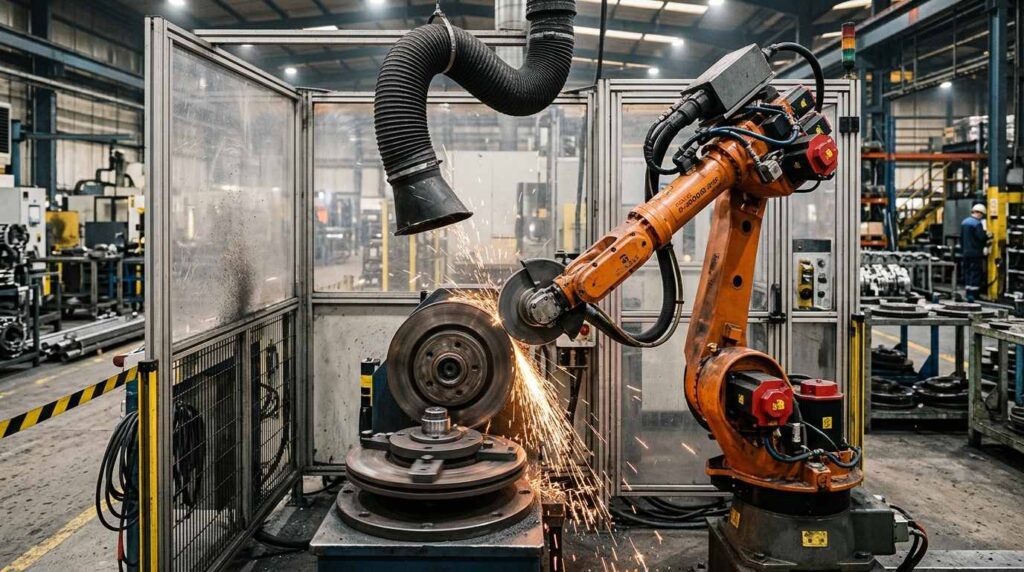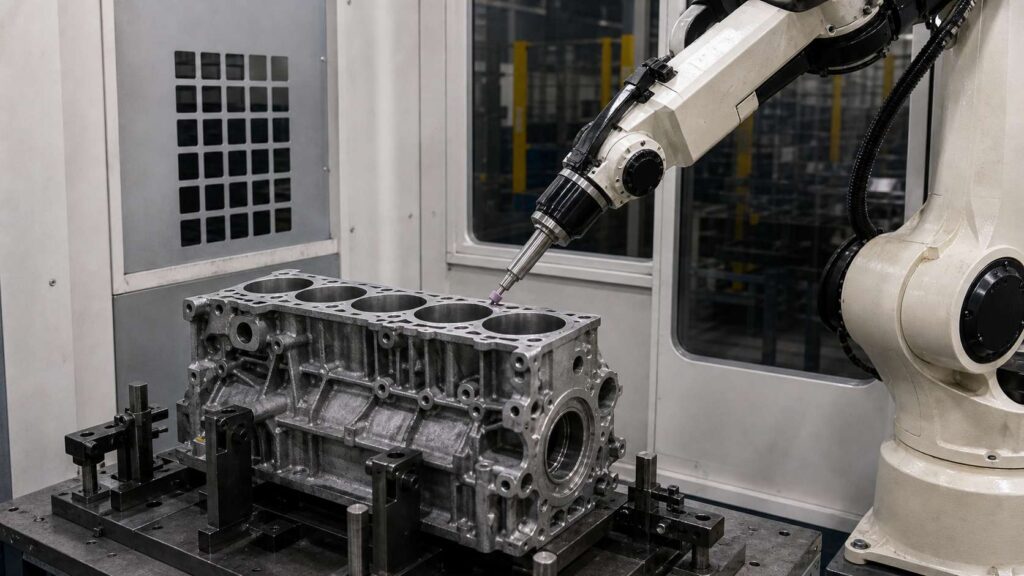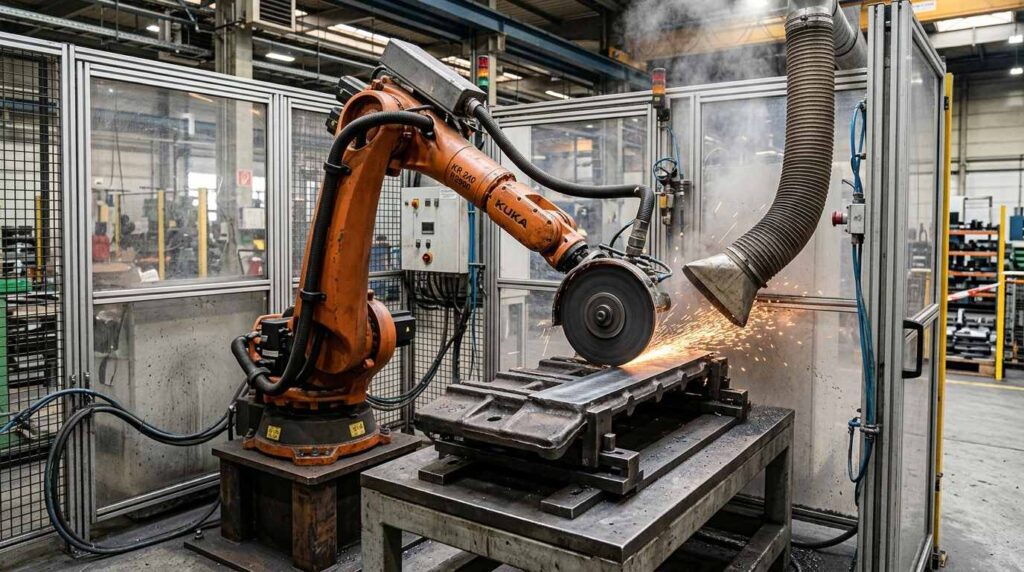
Track pads are cast iron support components used in rail-related systems, industrial guide structures and machinery base assemblies. As a typical medium-to-large cast iron workpiece, a track pad usually has a flat body, raised structural sections, mounting areas, outer edges and local transitions that require reliable post-casting finishing.
During casting, track pads may develop flash, burrs, parting lines, sharp edges and uneven surface areas. These defects are commonly found along the outer contour, flat surfaces, mounting transitions and edge zones. If they are not removed properly, they may affect installation quality, coating adhesion, handling safety and downstream assembly consistency.
Traditional manual grinding requires workers to remove casting flash, grind flat surfaces and chamfer edges one by one. For repeated track pad production, this process becomes labor-intensive and difficult to keep consistent. A robotic grinding solution provides a more stable and repeatable method for finishing cast iron track pads, especially when manufacturers need consistent surface preparation and edge quality in batch production.
This solution is designed for cast iron track pads with typical dimensions around 620 × 280 × 100 mm. It focuses on robotic grinding, casting flash removal, flat surface grinding, edge chamfering and surface preparation before coating, assembly or shipment.
What is a Track Pad?
A track pad is a support or contact component used in systems where load distribution, positioning, vibration resistance or wear support is required. Depending on the application, it may be used in railway track support systems, industrial guide rail structures, material handling equipment or machinery foundation systems.
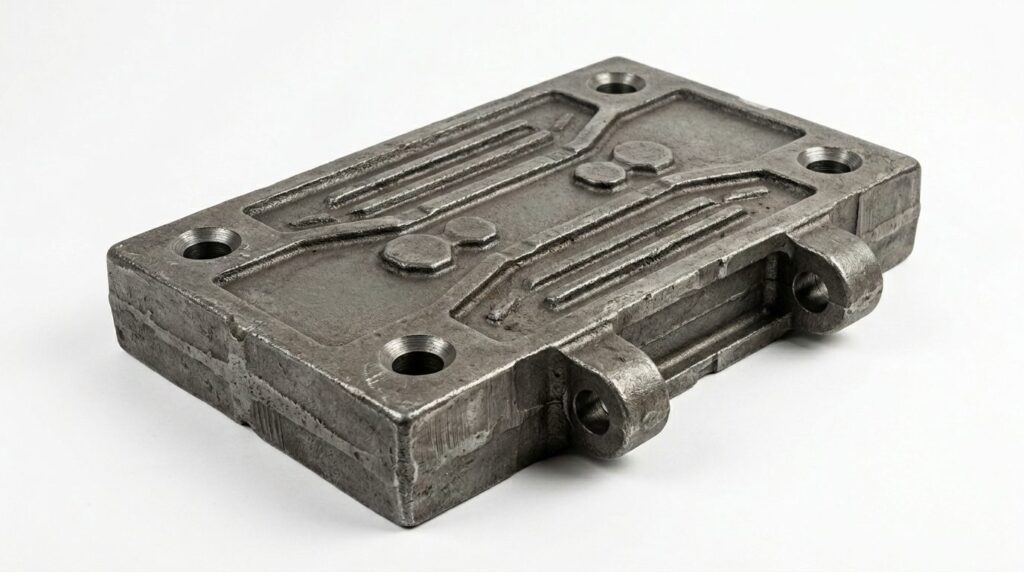
Cast iron is often used for this type of workpiece because it provides good compressive strength, wear resistance, vibration damping and casting efficiency. The part may include flat contact areas, side walls, mounting features, raised ribs and edge transitions. These features create several finishing zones after casting.
Although the workpiece appears relatively simple, track pad finishing is not just basic cleaning. Flat surfaces may require grinding to remove casting irregularities, outer edges may need chamfering for safety and assembly, and parting line flash must be removed before coating or installation.
| Mặt hàng | Chi tiết |
|---|---|
| Tên chi tiết gia công | Track Pad |
| Kích thước tiêu chuẩn | 620 × 280 × 100 mm |
| Chất liệu | Gang |
| Quy trình chính | Mài bằng robot |
| Các quy trình được hỗ trợ | Deburring, Edge Chamfering, Surface Finishing |
| Các khu vực xử lý chính | Flat surfaces, outer edges, parting lines, mounting transitions |
| Bàn thắng quyết định | Remove casting flash, grind flat areas and chamfer sharp edges |
A track pad gains nothing from a mirror finish. What counts is defect-free flats, chamfered edges and a coating-ready surface — grinding work, well suited to a robot on a repeated cast part like this.
Typical Applications of Track Pads
Track pads are functional industrial components. They are usually used in applications where support, contact, load distribution or positioning stability is required.
| Lĩnh vực ứng dụng | Cách sử dụng thông thường |
|---|---|
| Railway Track Systems | Support or positioning component in track-related assemblies |
| Industrial Guide Rails | Support surface or guide-related cast component |
| Material Handling Systems | Load-bearing or sliding support component |
| Machinery Base Assemblies | Contact pad or support plate for equipment structures |
| Engineering Equipment | Wear-resistant or support-related cast iron part |
In these applications, burrs, flash and sharp edges can affect installation, handling, surface coating and long-term reliability. A consistent grinding process helps ensure that each track pad meets the expected finishing standard before delivery.
Pain Point Analysis of Track Pad Finishing
The first challenge is casting flash removal. Track pads often have flash along the outer edges, parting line areas and local transitions. If the flash is thick or uneven, manual workers must spend considerable time removing it.
The second challenge is flat surface grinding. A track pad may contain broad flat surfaces that need cleaning or surface preparation before coating or assembly. Manual grinding on a flat area can easily create uneven marks if the grinding pressure is not stable.
The third challenge is edge chamfering. Sharp edges around the outer contour or mounting areas can create handling risks and may interfere with installation. Manual chamfering depends heavily on worker skill and may vary from part to part.
The fourth challenge is batch consistency. Track pads are often produced as repeated cast parts. When every part requires similar edge treatment and surface preparation, manual finishing becomes repetitive and difficult to standardize.
| Vấn đề thường gặp | Lĩnh vực cụ thể | Tác động |
|---|---|---|
| Ánh sáng chiếu sáng | Outer contour and parting line areas | Affects appearance, coating and installation |
| Uneven Flat Surface | Main contact or visible flat areas | Reduces surface preparation consistency |
| Các góc nhọn | Outer edges and local transitions | Gây ra các rủi ro trong quá trình xử lý và lắp ráp |
| Local Burrs | Mounting areas and geometry changes | May affect installation or coating quality |
| Điều chỉnh thủ công | Flat grinding and edge chamfering zones | Gây ra chất lượng hoàn thiện không đồng đều |
| Cast Iron Dust | Quá trình mài | Affects workshop cleanliness and operator comfort |
Compared with manual grinding, robotic grinding can provide more stable processing of flat surfaces and more repeatable edge chamfering. This is especially useful for track pad production where the workpiece shape and finishing path are repeated. For a broader look at how such cells are planned, see our robotic grinding guide.
| Mục so sánh | Mài thủ công | Mài bằng robot |
|---|---|---|
| Loại bỏ vết thâm | Depends on worker force and experience | Repeatable tool path and stable removal |
| Flat Surface Grinding | Easy to create uneven marks | Controlled grinding path and pressure |
| Edge Chamfering | Chamfer size may vary | Consistent edge treatment |
| Mức độ sử dụng lao động | Repetitive and physically demanding | Reduces manual grinding workload |
| Sản xuất hàng loạt | Rất khó để tiêu chuẩn hóa hoàn toàn | Các chương trình có thể được lưu lại và sử dụng lại |
| Dust Exposure | Operators work close to grinding dust | Can be integrated with dust extraction |
For track pad manufacturers, robotic grinding helps turn a repetitive finishing process into a more controlled and scalable production step.
Robotic Grinding Process for Track Pads
A robotic grinding cell for track pads can be configured according to workpiece size, casting flash thickness, required surface quality and production volume. The system usually includes a six-axis robot, dedicated fixture, abrasive grinding tool, chamfering tool, optional force-control device, dust extraction system and safety enclosure.
The process focuses on removing casting flash, grinding flat surfaces, chamfering edges and preparing the workpiece for coating or assembly.
| Bước | Quy trình | Mục đích | Công cụ / Hệ thống |
|---|---|---|---|
| 1 | Tải và định vị | Secure the track pad accurately | Giá đỡ chuyên dụng |
| 2 | Lựa chọn chương trình | Select the correct grinding path | Chương trình HMI / Robot |
| 3 | Casting Flash Removal | Remove flash from parting lines and outer contour | Dụng cụ mài mòn |
| 4 | Flat Surface Grinding | Improve surface consistency on flat areas | Grinding wheel or abrasive belt |
| 5 | Edge Chamfering | Smooth and chamfer sharp edges | Chamfering tool or compliant grinder |
| 6 | Local Transition Finishing | Process corners and mounting transitions | Đầu mài nhỏ |
| 7 | Kiểm tra chất lượng | Check flash removal, flatness appearance and edge quality | Kiểm tra thủ công hoặc kiểm tra bằng mắt thường |
| 8 | Dỡ hàng và vệ sinh | Lau bụi và chuyển bộ phận | Thổi khí / Hút bụi |
Bước 1: Tải và định vị
The track pad is placed into a dedicated fixture. The fixture must support the flat body and keep the workpiece stable during grinding. Since the part has a broad contact surface and local raised areas, fixture design should ensure both stability and tool accessibility.
For repeated production, the fixture can include quick positioning blocks to reduce loading time and improve consistency.
Bước 2: Lựa chọn chương trình
The operator selects the corresponding robot program according to the track pad model. If several similar track pad sizes are produced, separate programs can be saved and selected through the HMI.
For higher automation, barcode scanning or fixture recognition can be added to reduce program selection errors.
Step 3: Casting Flash Removal
The robot first removes casting flash from the outer contour, parting line areas and local transitions. These areas usually require the most material removal during the finishing process.
An abrasive grinding tool is used to remove unwanted flash while maintaining stable tool contact. For heavier flash, the process may use multiple grinding passes.
Step 4: Flat Surface Grinding
After flash removal, the robot processes selected flat surfaces. The goal is to remove rough casting marks, local high spots and surface irregularities.
Flat surface grinding must be controlled carefully to avoid uneven grinding marks. A compliant grinding tool or force-controlled system can help maintain stable pressure across the surface.
Step 5: Edge Chamfering
The robot then chamfers sharp outer edges and selected local edges. This improves handling safety and reduces the risk of coating defects on sharp corners.
Consistent edge chamfering is one of the key advantages of robotic grinding. The robot can follow the same path on every part, creating more uniform edge quality than manual processing.
Step 6: Local Transition Finishing
Corners, mounting transitions and raised structural features may require additional local finishing. These areas can be difficult to process evenly by hand because the tool angle changes frequently.
The robot can use a smaller grinding head or localized finishing tool to smooth these areas and remove remaining burrs.
Bước 7: Kiểm tra chất lượng
After grinding, the track pad is inspected for flash removal, flat surface consistency, edge chamfer quality and local burr removal. Key inspection areas include the outer contour, main flat surface, parting line areas and mounting transitions.
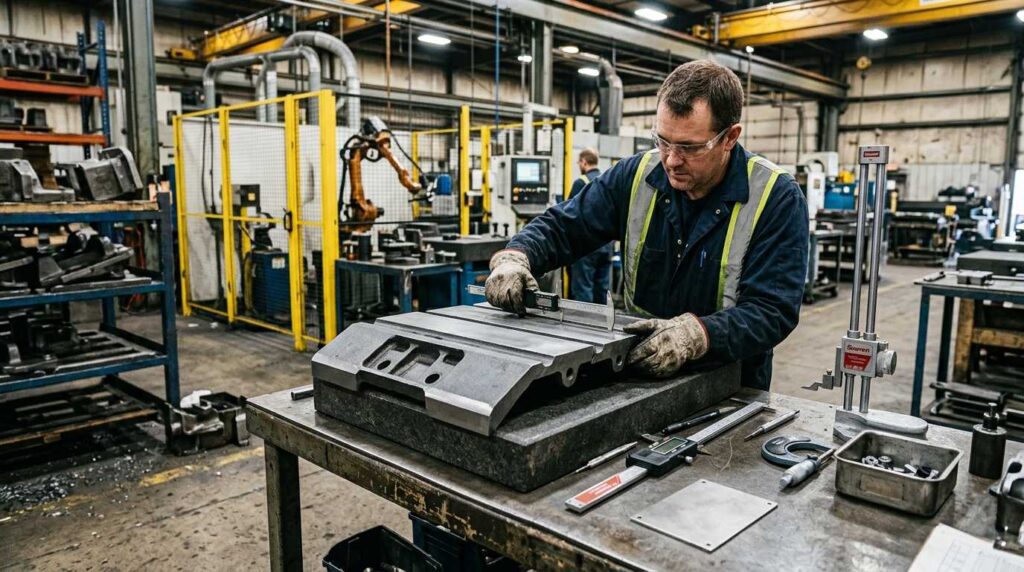
Inspection can be performed manually or with visual assistance depending on the production requirements.
Bước 8: Dỡ hàng và vệ sinh
The finished track pad is removed from the fixture. A final blow-down, brush or vacuum pass clears dust and residue. The workpiece can then move to coating, assembly, packaging or the next production process.
Những khó khăn trong gia công và các giải pháp
Track pads are challenging because they combine flat surface grinding, contour flash removal and edge chamfering in one workpiece. A good robotic solution must maintain surface consistency while also handling local burrs and edge defects.
| Thử thách | Nguyên nhân | Giải pháp robot |
|---|---|---|
| Heavy Casting Flash | Parting lines and outer edges retain excess material | Programmed grinding path with suitable abrasive tool |
| Flat Surface Consistency | Broad surfaces are sensitive to uneven pressure | Force-controlled or compliant grinding |
| Edge Chamfer Variation | Manual chamfering depends on operator skill | Repeatable robotic chamfering path |
| Local Burrs at Transitions | Corners and raised features accumulate burrs | Small tool and localized finishing path |
| Sự hình thành bụi | Cast iron grinding creates fine particles | Enclosed cell with dust extraction |
Difficulty 1: Casting Flash May Be Thick and Uneven
Track pads may have thick flash along parting lines or outer edges. Manual workers often need to apply high force, which can create inconsistent results and increase fatigue.
The solution is to use a robotic grinding path designed for flash removal. The robot can apply a consistent processing strategy and repeat the same path for every part. For thicker flash, staged grinding can be used.
Difficulty 2: Flat Surfaces Require Stable Grinding Pressure
Broad flat surfaces can show uneven grinding marks if the tool pressure changes. Manual grinding may leave inconsistent patterns or local over-ground areas.
The solution is to use compliant grinding or force-controlled tools. This helps maintain stable contact pressure and improves surface consistency across the flat area.
Difficulty 3: Edge Chamfering Must Be Consistent
Sharp edges need to be chamfered for safety, coating and assembly. Manual chamfering can vary in width and appearance from one operator to another.
The solution is to use a programmed robotic chamfering path. The robot follows the same edge trajectory and creates more consistent edge treatment across repeated parts.
Difficulty 4: Corners and Mounting Transitions Are Easy to Miss
Local corners, raised features and mounting transition areas may retain small burrs after the main grinding process. These areas are easy to miss during manual finishing.
The solution is to use a smaller tool and define local finishing points in the robot program. This ensures that important transition areas are processed consistently.
Difficulty 5: Dust Control Is Important for Cast Iron Grinding
Grinding cast iron track pads generates dust and particles. If the process is manual and open, it can affect the working environment and equipment cleanliness.
The solution is to integrate the robotic grinding cell with dust extraction. Enclosures, suction ports and filtration systems can help improve workshop conditions.
Application Scenario
Scenario Background
Picture an industrial casting plant supplying cast iron track pads to rail-related assemblies and heavy machinery builders. Every part needs flash removal, flat surface grinding and edge chamfering before coating and shipment.
Manual grinding can cover this scope at low volume, but scaling up output exposes its weak points — first on flat-surface consistency, then on chamfer repeatability.
Những thách thức kỹ thuật
Broad flats, thick outer edges and several local transitions hold casting flash and burrs after shakeout. Operator-to-operator variation shows up quickly here, and chamfer width is usually the first thing to drift.
The finishing method therefore has to remove flash, grind flats and chamfer edges stably, while pulling people out of the dust.
Giải pháp
One proven UBRIGHT SOLUTIONS layout for this work uses a six-axis industrial robot, a dedicated track pad fixture, an abrasive grinding tool, a chamfering tool and dust extraction.
Flash comes off the outer contour and parting lines first. Selected flats are ground next, the edges close out with a controlled chamfer path, and a smaller tool clears remaining burrs from local transitions.
| Mặt hàng | Cấu hình |
|---|---|
| Chi tiết gia công | Cast Iron Track Pad |
| Kích thước tiêu chuẩn | 620 × 280 × 100 mm |
| Quy trình chính | Mài bằng robot |
| Quy trình có sự hỗ trợ | Edge Chamfering and Deburring |
| Robot | Robot công nghiệp sáu trục |
| Dụng cụ | Abrasive Grinding Tool, Chamfering Tool |
| Lịch thi đấu | Dedicated Track Pad Fixture |
| Kiểm soát bụi | Robotic Cell with Dust Extraction |
| Ứng dụng | Flash removal, flat grinding, edge chamfering |
Expected Results
Expected results from this configuration: consistent flash removal, a flatter surface appearance and chamfers that look the same on every part. Manual grinding workload drops, and the finishing step becomes something the plant can standardize.
Dust extraction cleans up the working environment, and recurring track pad models reuse validated grinding paths from saved programs.
| Khu vực kết quả | Expected Improvement |
|---|---|
| Loại bỏ vết thâm | More stable removal along outer edges and parting lines |
| Flat Surface Quality | More consistent surface grinding results |
| Edge Chamfering | More uniform chamfer quality on repeated parts |
| Giảm nhân công | Reduced heavy manual grinding workload |
| Ổn định quy trình | Reusable robot programs for track pad production |
| Kiểm soát bụi | Cleaner grinding environment with extraction system |
Câu hỏi thường gặp
Q1: Why is robotic grinding suitable for track pads?
Robotic grinding is suitable because track pads often require repeated flash removal, flat surface grinding and edge chamfering. The robot can follow stable paths and process the same areas consistently in batch production.
Q2: What areas of a track pad are typically processed?
Common processing areas include outer edges, parting lines, flat surfaces, local transitions, mounting-related areas and sharp corners that require deburring or chamfering.
Q3: Can robotic grinding improve flat surface consistency?
Yes. With suitable grinding tools and controlled tool pressure, robotic grinding can improve surface consistency on selected flat areas and reduce variation caused by manual grinding.
Q4: Can the robot chamfer track pad edges?
Yes. Edge chamfering can be programmed into the robotic process. The robot follows a defined edge path, helping create more consistent chamfer quality across repeated parts.
Q5: Does the robot process the entire track pad surface?
Not necessarily. The robot usually processes defined target areas such as flash zones, flat surfaces, outer edges and local transitions. The exact scope depends on the customer’s finishing requirements.
Q6: Can one robotic cell process different track pad models?
Yes. Different models can be processed if the system uses suitable fixtures and saved robot programs. Quick-change fixtures can also be used for similar product families. To compare machine formats for this kind of work, see our deburring machine types guide.
Q7: Is polishing required for cast iron track pads?
In most cases, no. Track pads usually require grinding, deburring and edge chamfering rather than decorative polishing. The goal is functional finishing and surface preparation.
Q8: Can the system include dust extraction?
Yes. Dust extraction is strongly recommended for cast iron grinding. The robotic cell can include local suction, enclosure protection and filtration equipment.
Kết luận
Track pads are cast iron components that require reliable finishing on casting flash areas, flat surfaces and sharp edges. Flash, burrs, uneven surfaces and unchamfered edges can affect coating quality, installation consistency and handling safety if they are not processed properly.
A robotic grinding solution helps track pad manufacturers improve flash removal, flat surface consistency and edge chamfer repeatability. With dedicated fixtures, controlled grinding paths and integrated dust extraction, robotic finishing is well suited to repeated production of cast iron track pads. For another cast workpiece that pairs outer grinding with cavity work, see our gearbox housing grinding solution.
If your track pad production still relies on manual flash removal, flat grinding or edge chamfering, Liên hệ với chúng tôi for a customized robotic solution. Similar industrial casting projects appear under Kim loại nói chung, and machine platforms are listed in Thiết bị.