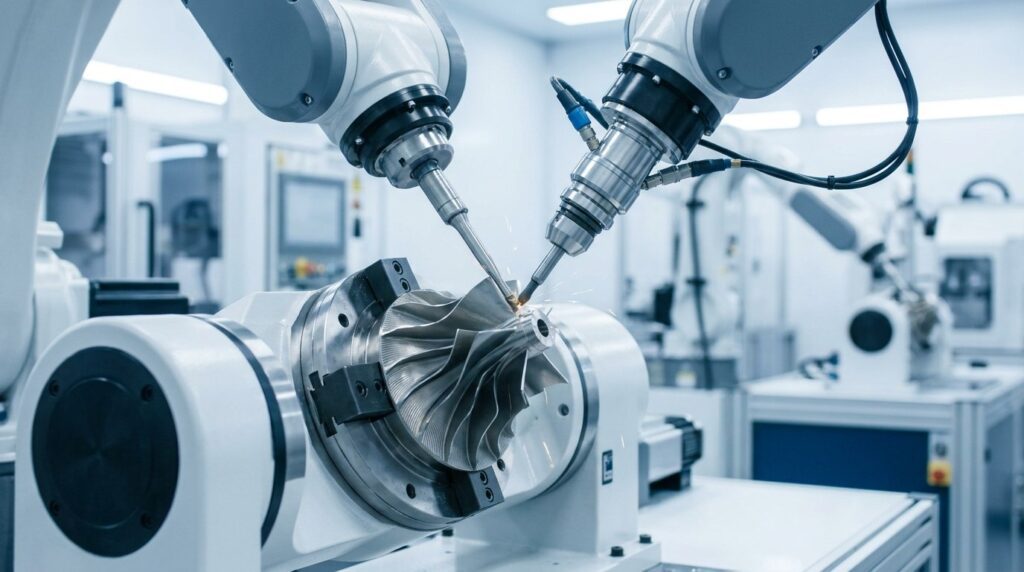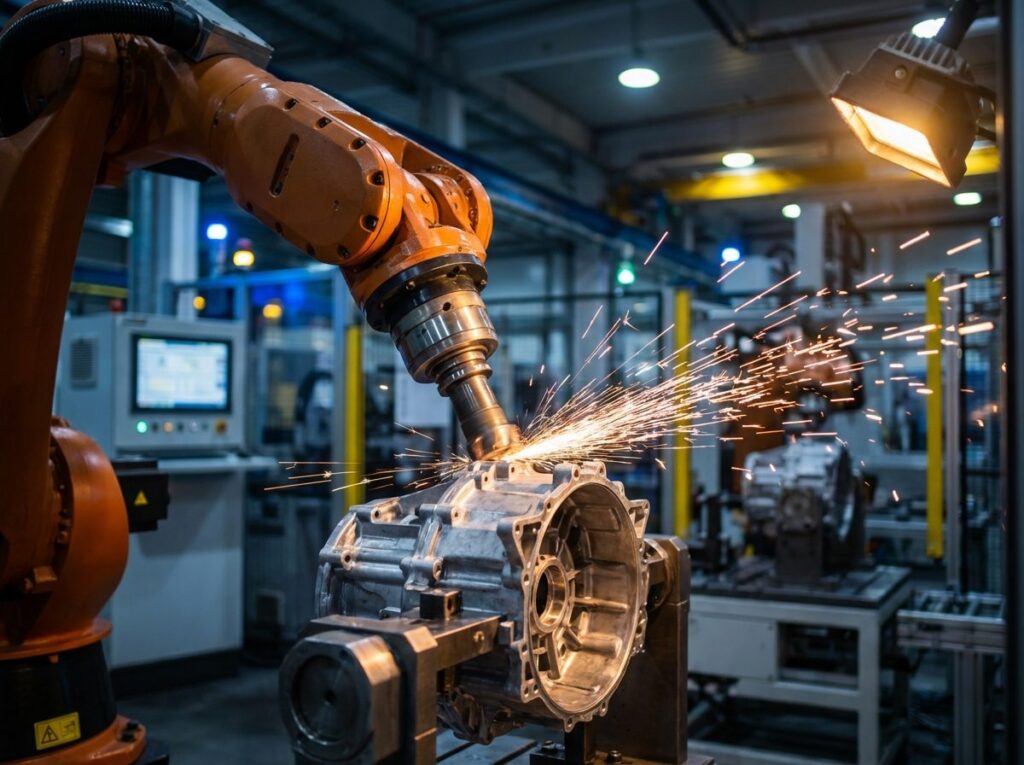
In the premium plumbing and hardware market, shower heads and hand-held units are core products that experience high-frequency tactile interaction with users. Whether featuring a teardrop-shaped rain shower body or an ergonomically designed hand-held unit, the soul of their appearance lies in continuous, full 3D free-form curves.
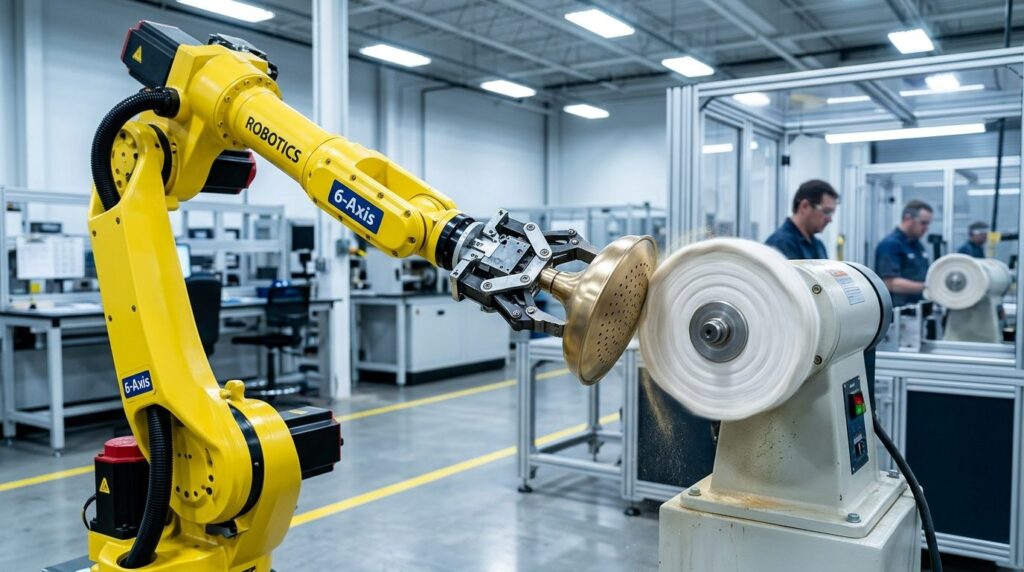
To maintain the dynamic curves envisioned by designers across millions of units and to ensure a premium mirror finish after electroplating, adopting an automated architecture—where a 6-axis industrial robot holds the workpiece against floor-mounted flexible abrasive belt machines, known as robotic polishing—has become the standard process for top-tier global plumbing OEMs to say goodbye to manual “flat spots” and achieve a leap in yield rates.
What are Shower Head Castings?
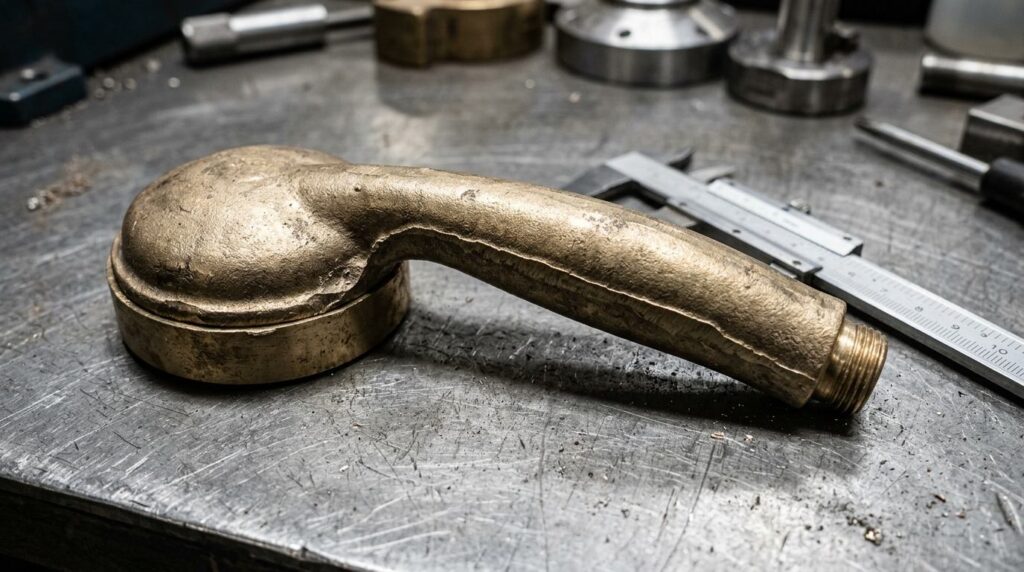
High-end shower head bodies are typically integrally formed from premium brass via hot forging or gravity casting. Some models also use stainless steel or zinc alloy die-casting. Fresh out of the mold, the raw casting surface is not only covered in rough oxidation scale but also features distinct parting lines along its extremely complex bionic contours.
The “Curve-Killing” Effect of Traditional Manual Polishing
The defining characteristic of a shower head is that “there are almost no pure flat surfaces anywhere.” This extreme roundness poses three fatal pain points for traditional manual polishing:
- Unavoidable “Flat Spot” Defects: When a worker rotates a shower head against a sanding belt by hand, wrist force cannot be absolutely uniform. Lingering even slightly too long on a rounded curve (like the bell-shaped body or cylindrical handle) grinds out a microscopic flat area. After electroplating, this flat spot causes a break in the reflection, instantly destroying the product’s premium feel.
- Collapsed Edges Around Water Nozzles: The faceplate of a shower head is densely packed with water nozzles. Uncontrolled manual grinding easily rounds off or collapses the edges of these holes, leading to uneven gaps when assembling silicone nozzles later, or even causing leaks.
- Severe Dust Hazards: The massive amount of metal dust generated by brass polishing is not only a high occupational health hazard but also places modern factories under severe environmental and safety compliance pressures.
Technical Parameters for Shower Head Automation
| Articolo | Intervallo dei parametri | Note |
| Parting Line Blending | Flexible Cloth-Backed Fine Belt | Rapidly removes flash without destroying original wall thickness |
| Bionic Curve Leveling | Floating Contact Wheel / Nylon | Conforms to teardrop or conical profiles for seamless transitions |
| Mirror Base Polishing | High-Density Cotton + Wax | Erases scratches and awakens clear metal luster for plating adhesion |
| Trajectory Continuity | Interpolation Precision ≤ 0.05 mm | Ensures zero stuttering as the robot glides over multi-curvature surfaces |
| Constant Force Control | ±1N (High-Freq Adaptive) | “Floating touch” mimics human hands, eradicating flat spots from over-cutting |
Why Must Shower Heads Use the “Robot-Holding-Workpiece” Architecture?
For workpieces like shower heads that are moderately sized (typically 8-12 inches long) but feature extremely complex geometries, the universally recognized optimal automated solution is: A 6-axis industrial robot on the left firmly gripping the shower handle or dedicated fixture (Workpiece), maneuvering it with extreme flexibility against multi-station polishing and belt centers secured to the floor on the right (Tool).
This “workpiece-to-tool” architecture perfectly solves the challenges of curved surface grinding:
- 360° Bionic Posture Rotation: The 6-axis robot possesses degrees of freedom surpassing the human wrist. It can hold the shower head and perform continuous “rotate, tilt, and roll” motions in front of a stationary belt. This ensures the abrasive perfectly glides through the concave curves of the handle and the convex arcs of the main body, achieving truly blind-spot-free polishing.
- Controllo attivo della forza Milli-Newton: When the robot presses the shower head against the polishing wheel, the force sensor at the wrist monitors contact force in real time. When encountering transition zones with drastic curvature changes, the system instantly auto-adjusts the downward pressure to ensure absolutely uniform material removal. This is the core black technology for eliminating “flat spots” and “collapsed edges.”
- One-Grip Full Process Integration: Holding the same shower head, the robot can sequentially move to coarse belts, fine belts, sisal, and cloth wheels at different floor stations, eliminating secondary clamping errors and significantly boosting cycle times.
Automated Grinding and Polishing Process Workflow
| Passaggio | Nome del processo | Equipment & Consumables | Purpose & Precision |
| 01 | Auto Loading & Location | Robot + Pneumatic Gripper | Precisely grabs raw casting from tray, locking the coordinate system |
| 02 | Profile Parting Line Prep | Floor-Mounted Floating Belt Machine | Rapidly traces complex 3D contours to shear off forging flash |
| 03 | Streamlined Curve Transition | Floating Fine-Grit Abrasive Belt | Conforms to rounded profiles with constant force, unifying the surface arc |
| 04 | High-Gloss Mirror Buffing | Auto-Wax Multi-Station Cloth Center | Graded buffing brings brass to a liquid-mirror finish, ready for plating |
| 05 | Auto Unloading Handover | Transfer to dedicated racks/conveyors | Avoids collisions, transferring directly to ultrasonic cleaning lines |
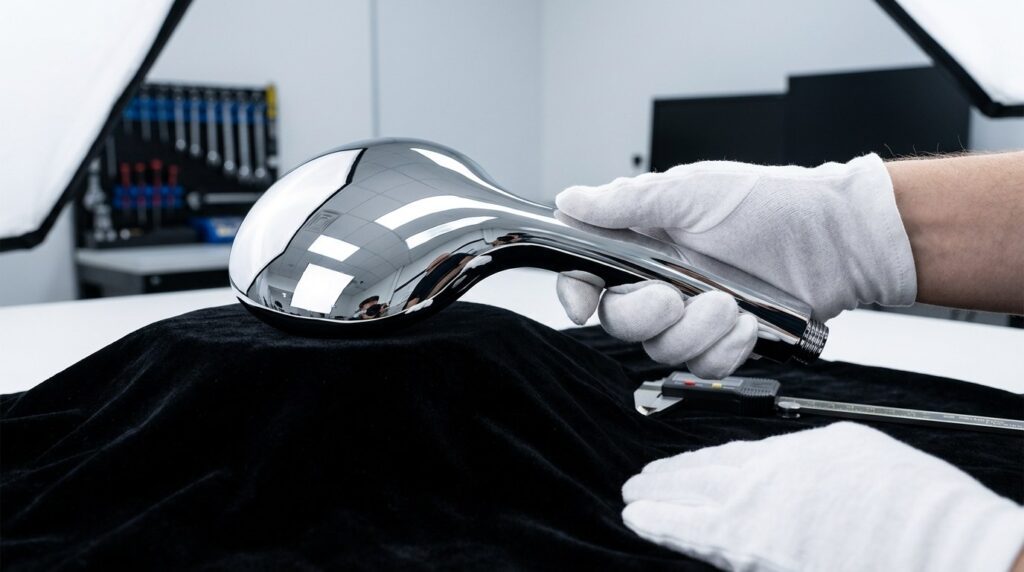
Case Study: OEM for a Top-Tier International Plumbing Brand
We deployed 12 robotic polishing cells for a South China OEM that manufactures shower heads for a premium German plumbing brand.
- Before Implementation: For a specific teardrop-shaped brass hand-held shower, the client required extremely high reflective continuity after plating. The manual polishing pass rate hovered around 70%. Rework caused frequent delivery delays, and the workshop’s dust environment drew warnings from safety regulators.
- After Implementation: By introducing the architecture of robots holding workpieces combined with active force control, the robots perfectly replicated the ideal 3D polishing paths. The curve transitions on the shower heads were extremely smooth, completely eradicating flat spots caused by manual grinding. The first-pass cosmetic yield soared to 96%, production efficiency increased by 40%, and the fully enclosed cells completely resolved the workshop’s dust pollution crisis.
Shower Head Polishing FAQ
Q1: Shower head designs iterate incredibly fast with a massive variety of styles. Is robotic programming time-consuming for changeovers?
A: Not at all. To address the high-frequency new product launches in the plumbing industry, we use advanced 3D Offline Programming (OLP) technology. Faced with a new shower head, engineers simply import the 3D CAD model. The software automatically analyzes the complex free-form surfaces and generates collision-free polishing trajectories with one click. Combined with quick-change grippers, debugging time to switch an automated line to a completely new style can typically be kept under 30 minutes. You can also see how this flexibility helps with thin-walled hole processing (#Q2).
Q2: The metal around the water nozzle area is usually quite thin. Will the robot warp the holes during polishing?
A: No. As detailed in our rapid changeover programming section (#Q1), our system possesses high-precision force and trajectory control. When processing the edges of the faceplate and densely packed hole areas, the robot automatically switches to a “micro-cutting” mode. It utilizes flexible polishing consumables with an extremely gentle, floating pressure, guaranteeing a bright surface finish without ever altering the metal’s wall thickness or distorting the delicate nozzle holes.
Conclusione
In the manufacturing of premium shower heads, perfect, flowing 3D curved reflections are the foundation of a plumbing brand’s premium pricing. Adopting an automated architecture featuring industrial robots flexibly holding workpieces against floor-mounted multi-station flexible belt machines completely breaks the bottlenecks of manual flat spots, collapsed edges, and severe dust hazards. It provides plumbing hardware OEMs with a stable, highly efficient, and extremely precise manufacturing moat.
If your factory is struggling with low yields on complex curve polishing or wishes to achieve green, dust-free manufacturing, please feel free to Contatto for a dedicated plumbing automation process assessment.