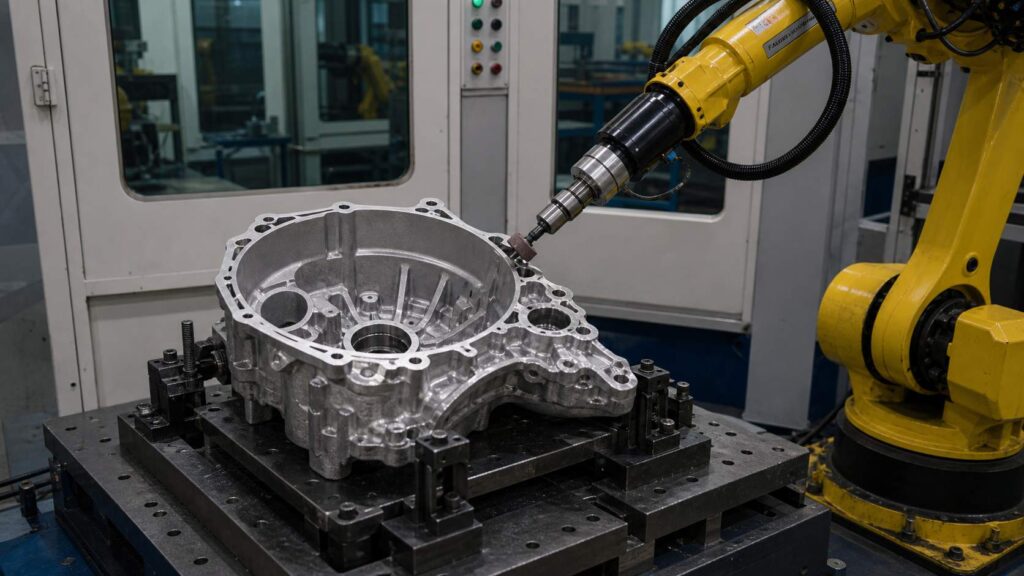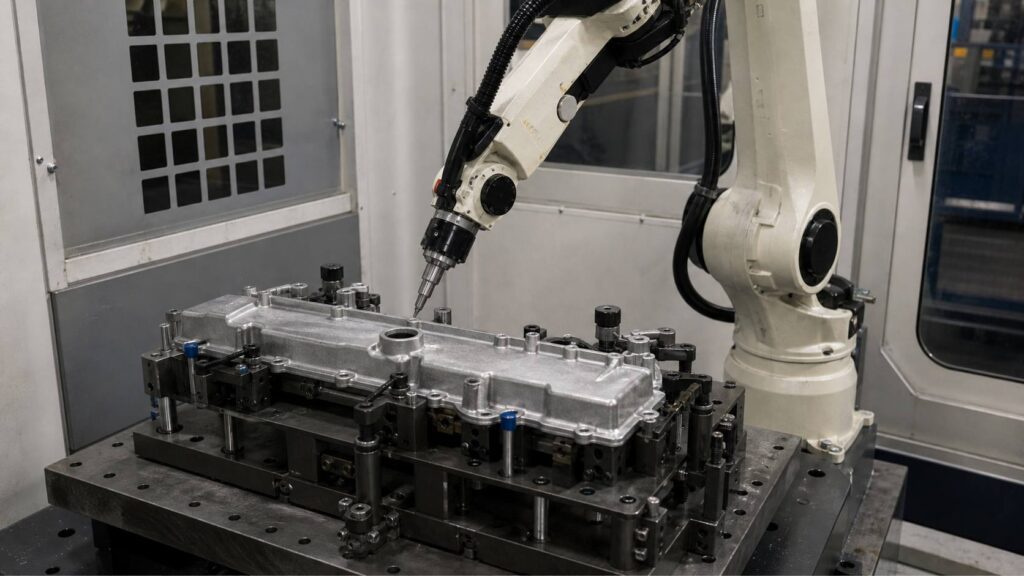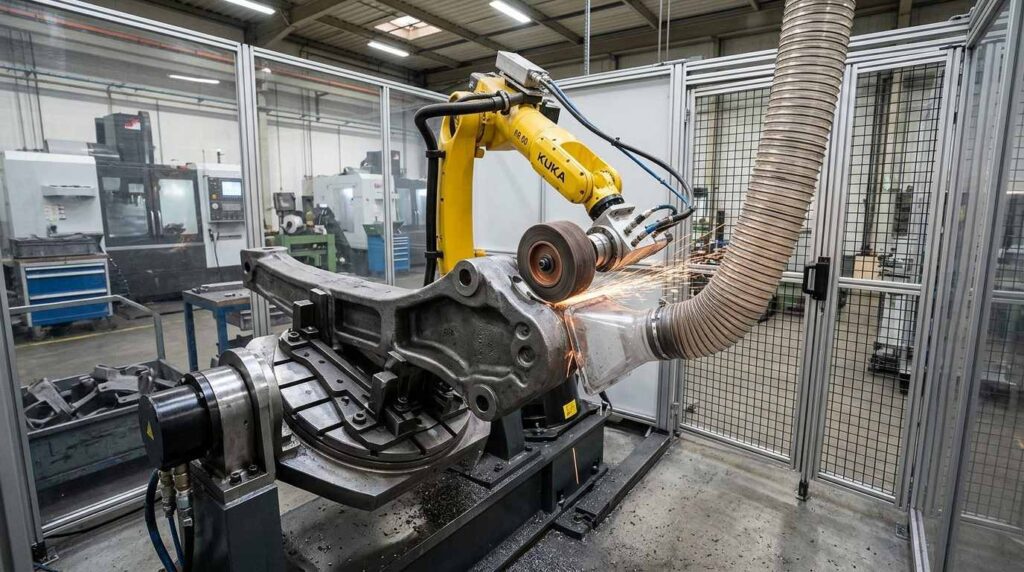
Dầm đúc hẫng là các bộ phận kết cấu đúc sẵn được sử dụng trong hệ thống khung gầm ô tô, các cụm liên quan đến hệ thống treo, xe thương mại, xe công trình và các kết cấu chịu lực khác của phương tiện. Là một chi tiết đúc bằng gang hoặc thép có kích thước trung bình, dầm đúc hẫng thường bao gồm các đường viền ngoài cong, các gờ lắp nổi, các khu vực lỗ, các gân gia cố và các vùng chuyển tiếp cục bộ đòi hỏi phải có quá trình hoàn thiện ổn định sau khi đúc.
During casting and rough machining, cantilever beams may develop casting flash, parting lines, burrs and sharp edges around the outer profile, mounting pads, bosses, hole edges and rib transitions. Manual grinding of these local features is repetitive and inconsistent, while robotic grinding provides a more stable method for contour finishing, boss deburring, hole edge treatment and surface preparation before coating or assembly.
What is a Cantilever Beam?
A cantilever beam is a structural support component designed to carry load from one side or support connected parts within a mechanical assembly. In automotive and vehicle applications, this type of cast beam may be used in chassis support areas, suspension-related structures, mounting assemblies or other load-bearing connection positions.
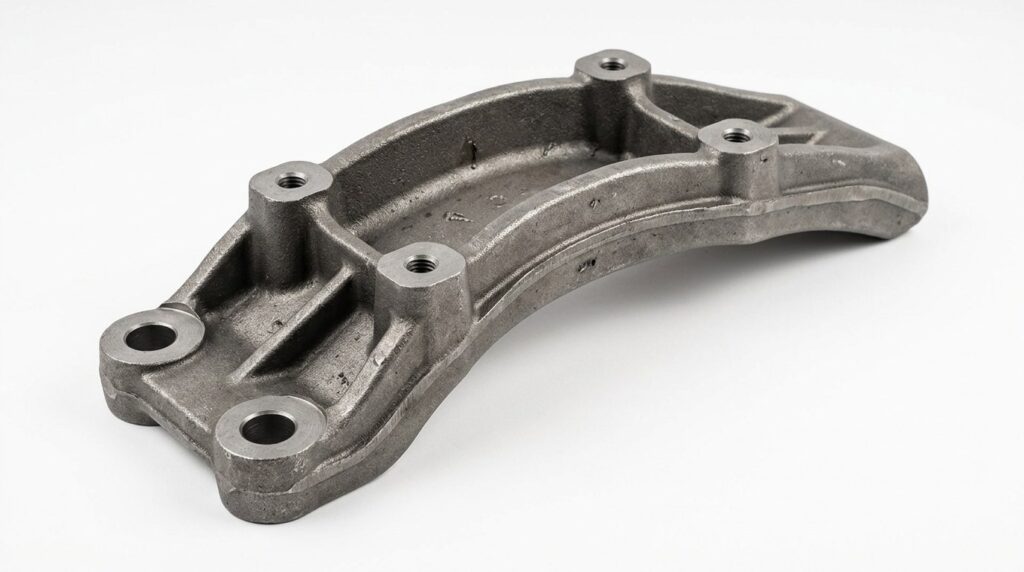
The sample workpiece has a compact cast structure with curved edges, raised mounting pads, circular boss areas and reinforced transitions. These features improve strength and rigidity, but they also create burr-prone zones after casting. Common finishing areas include outer contours, parting lines, boss edges, mounting pad transitions, rib edges and hole edges.
| Mặt hàng | Chi tiết |
|---|---|
| Tên chi tiết gia công | Cantilever Beam |
| Tên tiếng Trung | 悬臂横梁 |
| Kích thước tiêu chuẩn | 730 × 540 × 220 mm |
| Chất liệu | Cast Iron / Cast Steel |
| Quy trình chính | Mài bằng robot |
| Các quy trình được hỗ trợ | Loại bỏ gờ, bo tròn cạnh, hoàn thiện bề mặt |
| Các khu vực xử lý chính | Outer contours, mounting bosses, hole edges, ribs, parting lines |
| Ngành công nghiệp | Ô tô & Xe điện |
| Bàn thắng quyết định | Remove casting flash, burrs, sharp edges and local surface defects |
For this type of automotive cast structural part, the main goal is not decorative polishing. The key requirement is to remove casting defects, smooth sharp edges, protect mounting-related areas and prepare the part for coating or assembly.
Typical Applications of Cantilever Beams
Cantilever beams are functional cast structural parts used where strength, positioning stability and load support are required. Their exact shape may vary depending on the vehicle platform, but the finishing requirements are usually focused on burr removal, contour cleaning and edge safety.
| Lĩnh vực ứng dụng | Cách sử dụng thông thường |
|---|---|
| Automotive Chassis Systems | Cast support beam or structural connection component |
| Suspension Assemblies | Support or connection part near suspension structures |
| Xe thương mại | Medium-sized cast structural support component |
| Engineering Vehicles | Load-bearing cast bracket or beam component |
| Xe địa hình | Reinforced cast support part for chassis-related systems |
| Automotive Casting Production | Batch finishing of cast structural parts |
In these applications, burrs, sharp edges and casting flash may affect coating quality, assembly consistency, fixture positioning and handling safety. A stable robotic grinding process helps manufacturers improve finishing repeatability across batch production.
Pain Point Analysis of Cantilever Beam Finishing
Cantilever beam finishing is challenging because the part combines curved contours, raised bosses, mounting holes, ribs and reinforced transition areas. Burrs and casting flash may remain around the outer profile, raised pads and local rib structures. These areas require different tool angles, making manual grinding unstable and operator-dependent.
Another challenge is mounting-area protection. Some boss surfaces or hole-related areas may be used for positioning, fastening or assembly, so the process must remove burrs and flash without damaging important surfaces. Compared with manual processing, robotic grinding can define clear target zones and repeat the same finishing path for every part.
| Vấn đề thường gặp | Lĩnh vực cụ thể | Tác động |
|---|---|---|
| Ánh sáng chiếu sáng | Outer contour and parting line areas | Affects coating and appearance consistency |
| Burrs Around Bosses | Raised mounting pads and circular boss areas | May affect assembly and handling safety |
| Các góc nhọn | Curved edges, ribs and local transitions | Creates safety and coating risks |
| Hole Edge Burrs | Mounting holes and local openings | May affect installation or fastener assembly |
| Điều chỉnh thủ công | Complex contour and local feature areas | Gây ra chất lượng hoàn thiện không ổn định |
| Cast Iron Dust | Quá trình mài | Affects workshop cleanliness and operator comfort |
Compared with manual grinding, robotic grinding provides a more repeatable way to process curved contours, boss edges and hole edges. The robot can follow defined tool paths, maintain stable tool movement and reduce variation caused by operator fatigue or inconsistent hand grinding.
| Mục so sánh | Mài thủ công | Mài bằng robot |
|---|---|---|
| Contour Finishing | Depends on operator angle and force | Repeatable path and stable tool movement |
| Boss Edge Deburring | Easy to miss local burrs | Dedicated tool path for boss areas |
| Hole Edge Processing | Quality varies between workers | Controlled deburring around defined holes |
| Bảo vệ bề mặt | Khó điều khiển bằng tay | Defined target and protected zones |
| Sản xuất hàng loạt | Difficult to keep consistent | Các chương trình có thể được lưu lại và sử dụng lại |
| Dust Exposure | Operators work near grinding dust | Can be integrated with dust extraction |
For manufacturers producing automotive cast cantilever beams, robotic grinding helps reduce manual variation and improve consistency on repeated structural parts.
Robotic Grinding Process for Cantilever Beams
A robotic grinding cell for cantilever beams can be configured according to the casting structure, burr locations, production volume and finishing requirements. The system usually includes a six-axis industrial robot, dedicated fixture, abrasive grinding tool, flexible deburring tool, small grinding head, dust extraction system and safety enclosure.
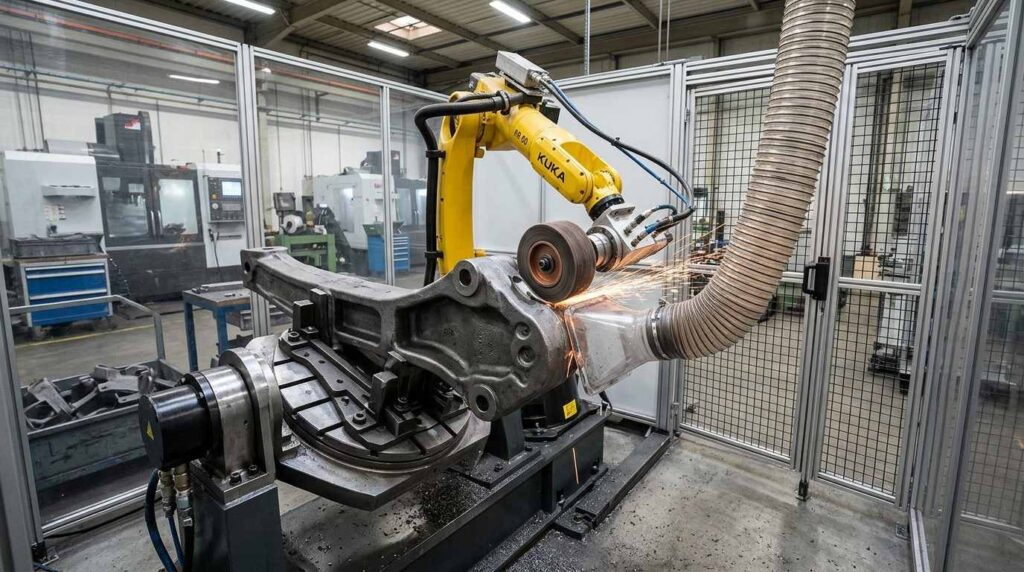
The process focuses on removing casting flash, smoothing curved contours, deburring boss edges, processing hole edges and preparing the workpiece for coating or assembly.
| Bước | Quy trình | Mục đích | Công cụ / Hệ thống |
|---|---|---|---|
| 1 | Tải và định vị | Secure the cast beam accurately | Giá đỡ chuyên dụng |
| 2 | Lựa chọn chương trình | Select the correct grinding path | Chương trình HMI / Robot |
| 3 | Mài viền ngoài | Remove flash from curved outer edges | Dụng cụ mài mòn |
| 4 | Boss Edge Deburring | Smooth raised mounting boss edges | Dụng cụ mài góc linh hoạt |
| 5 | Loại bỏ gờ cạnh lỗ | Remove burrs around mounting holes | Đầu mài nhỏ |
| 6 | Rib and Transition Finishing | Process reinforced ribs and local transitions | Compliant abrasive tool |
| 7 | Kiểm tra chất lượng | Check burr removal and protected areas | Kiểm tra thủ công hoặc kiểm tra bằng mắt thường |
| 8 | Dỡ hàng và vệ sinh | Lau bụi và chuyển bộ phận | Thổi khí / Hút bụi |
Bước 1: Tải và định vị
The cantilever beam is placed into a dedicated fixture. Accurate positioning is important because the robot must process curved edges, raised bosses, hole areas and local transitions without affecting protected surfaces.
The fixture should support the workpiece securely while keeping all target areas accessible to the robot. For repeated production, quick positioning features can be added to improve loading efficiency and positioning consistency.
Bước 2: Lựa chọn chương trình
The operator selects the correct robot program according to the cantilever beam model. If the manufacturer produces several similar structural castings, each part can have its own saved program.
For mixed production, barcode scanning, fixture recognition or recipe management can be used to reduce the risk of selecting the wrong process.
Step 3: Outer Contour Grinding
The robot first processes the curved outer contour and parting line areas. These sections often contain casting flash, raised edges or uneven local defects after casting.
An abrasive grinding tool follows the programmed contour path to remove flash and smooth the edge profile. Compared with manual grinding, the robot can maintain more stable tool movement along curved surfaces.
Step 4: Boss Edge Deburring
After the outer contour is finished, the robot processes the raised mounting bosses and pad edges. These areas are important because they are often close to assembly or positioning features.
A flexible deburring tool can remove local burrs around boss edges while reducing the risk of over-grinding mounting-related surfaces. The process path should clearly define target and protected zones.
Step 5: Hole Edge Deburring
Hole edges may contain burrs after casting, drilling or machining. If these burrs are not removed, they may affect fastener installation, handling safety or assembly quality.
The robot uses a small grinding head or deburring tool to process the hole edges with a defined circular or local path. This improves consistency and reduces manual rework.
Step 6: Rib and Transition Finishing
Reinforced ribs, curved transitions and local junctions often retain small burrs or flash after the main grinding steps. These areas are easy to miss during manual finishing.
The robot can process these local features with predefined approach angles and suitable abrasive tools. This helps improve finishing coverage across the whole workpiece.
Bước 7: Kiểm tra chất lượng
After grinding, the cantilever beam is inspected for flash removal, edge smoothness, boss deburring quality, hole edge finishing and surface protection. Key inspection areas include the curved outer contour, raised boss edges, mounting holes, ribs and parting line zones.
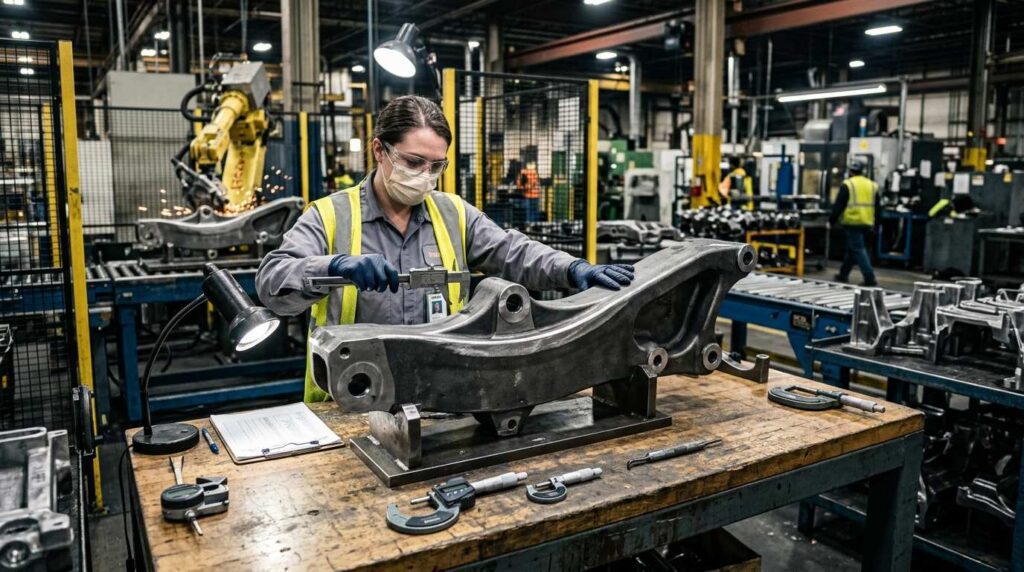
Inspection can be performed manually or with visual assistance depending on the production requirements.
Bước 8: Dỡ hàng và vệ sinh
The finished part is removed from the fixture. Dust and grinding residue can be cleaned by air blowing, brushing or vacuum suction. The part can then move to coating, machining, assembly or packaging.
Những khó khăn trong gia công và các giải pháp
Cantilever beams are challenging because they combine curved cast contours, raised mounting bosses, hole edges and reinforced local transitions. The robotic system must provide accurate positioning, controlled tool paths and stable finishing on different feature areas.
| Thử thách | Nguyên nhân | Giải pháp robot |
|---|---|---|
| Curved Outer Contours | Arc-shaped edges and profile transitions require changing tool angles | Programmed contour grinding path |
| Boss Edge Burrs | Raised mounting pads create local burr-prone areas | Flexible deburring tool for boss edges |
| Hole Edge Burrs | Holes may retain burrs after casting or machining | Small tool with defined circular path |
| Bảo vệ bề mặt | Mounting-related areas must not be over-ground | Accurate fixture and protected process zones |
| Casting Variation | Flash thickness may vary between batches | Compliant grinding or force control |
Difficulty 1: Curved Contours Require Stable Tool Angles
The cantilever beam has curved outer edges and local profile transitions. Manual workers need to constantly adjust the grinding angle, which can lead to inconsistent edge quality.
The solution is to use a programmed robotic contour path. The robot follows the same curve on each part and maintains more stable tool orientation, improving consistency across batches.
Difficulty 2: Raised Boss Areas Are Easy to Over-Grind
The sample part includes raised mounting pads and circular boss areas. These areas may require burr removal, but the functional surfaces must be protected.
The solution is to define clear grinding boundaries around the boss edges. A flexible deburring tool can remove local burrs while reducing the risk of damaging mounting-related surfaces.
Difficulty 3: Hole Edges Require Controlled Deburring
Hole edges and local openings may retain burrs after casting or machining. Manual deburring around holes may be inconsistent, especially in repeated production.
The solution is to use a small grinding head or deburring tool with a defined circular path. This allows the robot to process hole edges consistently without unnecessary surface removal.
Difficulty 4: Reinforced Ribs and Transitions Create Local Burrs
Rib transitions and curved junctions often retain small burrs or flash. These features are easy to miss during manual grinding.
The solution is to divide the part into feature zones and program local finishing paths for each area. This improves coverage and reduces missed burrs.
Difficulty 5: Casting Variation Requires Flexible Processing
Casting flash may vary slightly from one part to another. A rigid grinding path may not always provide stable contact.
The solution is to use compliant grinding tools or force-controlled processing. This helps the robot adapt to minor casting variation while maintaining consistent finishing quality.
Trường hợp sản xuất
Thông tin về khách hàng
An automotive casting manufacturer produces cast cantilever beam components for chassis or suspension-related assemblies. The parts include curved outer contours, raised mounting bosses, hole edges and reinforced transition areas that require finishing before coating and assembly.
Before automation, the customer relied on manual grinding to remove flash and burrs. As production volume increased, manual finishing became difficult to standardize, especially around curved profiles, boss edges and hole areas.
Những thách thức kỹ thuật
The workpiece had casting flash along the curved outer contour and burrs around boss edges, hole edges and local rib transitions. Manual grinding quality varied between operators, and some local areas were easy to miss.
The customer also needed to protect assembly-related surfaces while improving burr removal consistency. Dust from cast iron grinding was another concern in the finishing area.
Giải pháp
UBRIGHT SOLUTIONS designed a robotic grinding cell for automotive cast cantilever beams. The system used a six-axis industrial robot, dedicated fixture, abrasive grinding tool, flexible deburring tool, small grinding head and dust extraction system.
The robot first processed the curved outer contour and parting line areas, then moved to raised boss edges, mounting holes and local rib transitions. The fixture ensured repeatable positioning, while the robot path defined clear target and protected zones.
| Mặt hàng | Cấu hình |
|---|---|
| Chi tiết gia công | Cast Cantilever Beam |
| Kích thước tiêu chuẩn | 730 × 540 × 220 mm |
| Quy trình chính | Mài bằng robot |
| Quy trình có sự hỗ trợ | Deburring and Edge Rounding |
| Robot | Robot công nghiệp sáu trục |
| Dụng cụ | Abrasive Grinding Tool, Flexible Deburring Tool, Small Grinding Head |
| Lịch thi đấu | Dedicated Cantilever Beam Fixture |
| Kiểm soát bụi | Buồng kín có hệ thống thu bụi |
| Ứng dụng | Contour grinding, boss edge deburring, hole edge finishing |
Kết quả triển khai
After implementation, the customer achieved more stable finishing quality on curved contours, boss edges and mounting hole areas. The robotic system reduced repetitive manual grinding work and improved process consistency across repeated cast beam models.
The enclosed grinding cell also improved dust control and made the finishing process easier to manage in batch production.
| Khu vực kết quả | Sự cải thiện |
|---|---|
| Contour Finishing | More consistent grinding on curved outer edges |
| Boss Edge Quality | More stable burr removal around raised pads |
| Loại bỏ gờ cạnh lỗ | Reduced variation around mounting holes |
| Giảm nhân công | Giảm bớt khối lượng công việc mài thủ công lặp đi lặp lại |
| Bảo vệ bề mặt | Kiểm soát tốt hơn các khu vực mục tiêu và khu vực được bảo vệ |
| Kiểm soát bụi | Cleaner finishing environment with extraction system |
Phản hồi của khách hàng
“The robotic grinding system helped us improve contour finishing and local deburring consistency on cast cantilever beams while reducing manual grinding work in batch production.”
Câu hỏi thường gặp
Q1: Why is robotic grinding suitable for cantilever beams?
Robotic grinding is suitable because cast cantilever beams have curved contours, raised bosses, hole edges and local transitions that require repeatable finishing. The robot can process these areas with stable paths and reduce variation caused by manual grinding.
Q2: What areas of a cantilever beam are typically processed?
Common processing areas include curved outer contours, parting lines, mounting boss edges, hole edges, ribs and local transition zones. The exact processing scope depends on the part structure and finishing requirements.
Q3: Can robotic grinding remove burrs around mounting bosses?
Yes. With suitable flexible deburring tools and defined robot paths, the system can remove burrs around raised bosses and mounting pads while protecting important surfaces.
Q4: Can the robot deburr hole edges on cantilever beams?
Yes. The robot can use a small grinding head or deburring tool to process hole edges with a controlled path. This helps improve consistency around mounting holes and local openings.
Q5: Does the robot process the whole cantilever beam surface?
Not always. In most cases, the robot processes defined target areas such as contours, boss edges, hole edges, parting lines and local burr-prone transitions. Protected assembly surfaces can be avoided.
Q6: Can one robotic cell process different cantilever beam models?
Yes. Different models can be processed if suitable fixtures and robot programs are prepared. For similar cast structural parts, quick-change fixtures can help reduce changeover time.
Q7: Is polishing required for cantilever beams?
In most cases, no. Cantilever beams usually require grinding, deburring and surface preparation rather than decorative polishing. The focus is on removing flash, burrs and sharp edges before coating or assembly.
Câu hỏi 8: Hệ thống có thể được trang bị hệ thống hút bụi không?
Yes. Dust extraction is recommended for cast iron or cast steel grinding. The robotic cell can include an enclosure, local suction and filtration equipment to improve workshop cleanliness.
Kết luận
Cantilever beams are automotive cast structural components that require reliable finishing on curved contours, mounting bosses, hole edges and reinforced transition areas. Casting flash, burrs and sharp edges can affect coating quality, handling safety and assembly consistency if they are not removed properly.
A robotic grinding solution helps cantilever beam manufacturers improve contour finishing, boss edge deburring and hole edge consistency in batch production. With dedicated fixtures, controlled tool paths and integrated dust extraction, robotic finishing is well suited to repeated automotive casting production.
If your cantilever beam production still relies on manual contour grinding, boss deburring or hole edge finishing, Liên hệ với chúng tôi để có được một giải pháp robot được thiết kế riêng. Bạn cũng có thể khám phá Ô tô & Xe điện các ứng dụng và Thiết bị để tìm hiểu thêm về các hệ thống hoàn thiện bằng robot của chúng tôi.