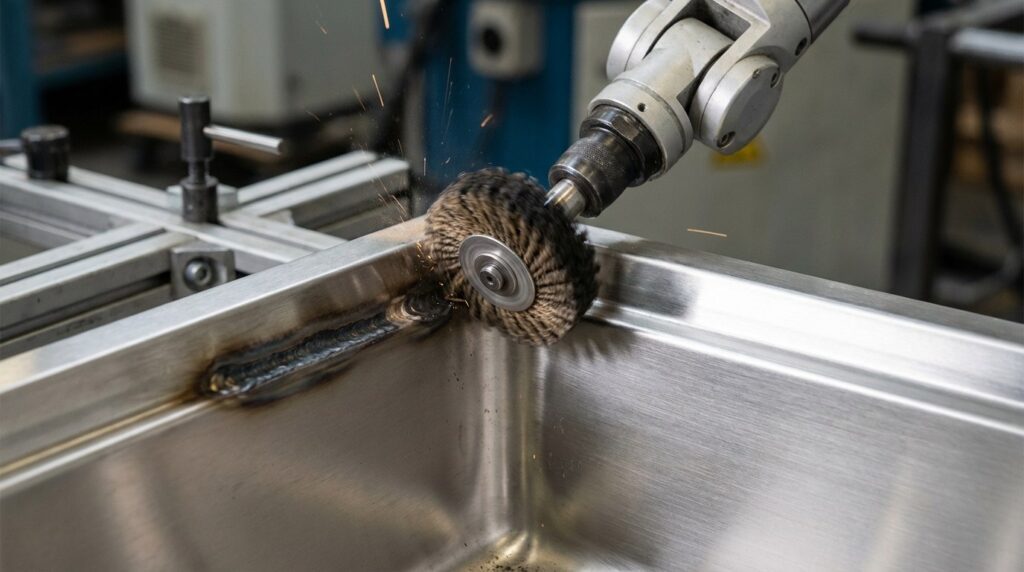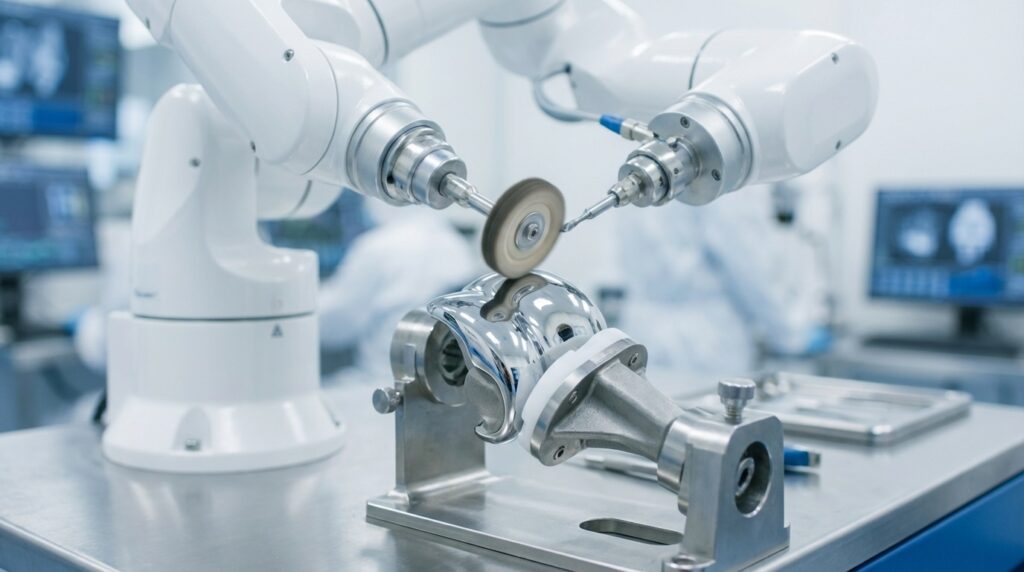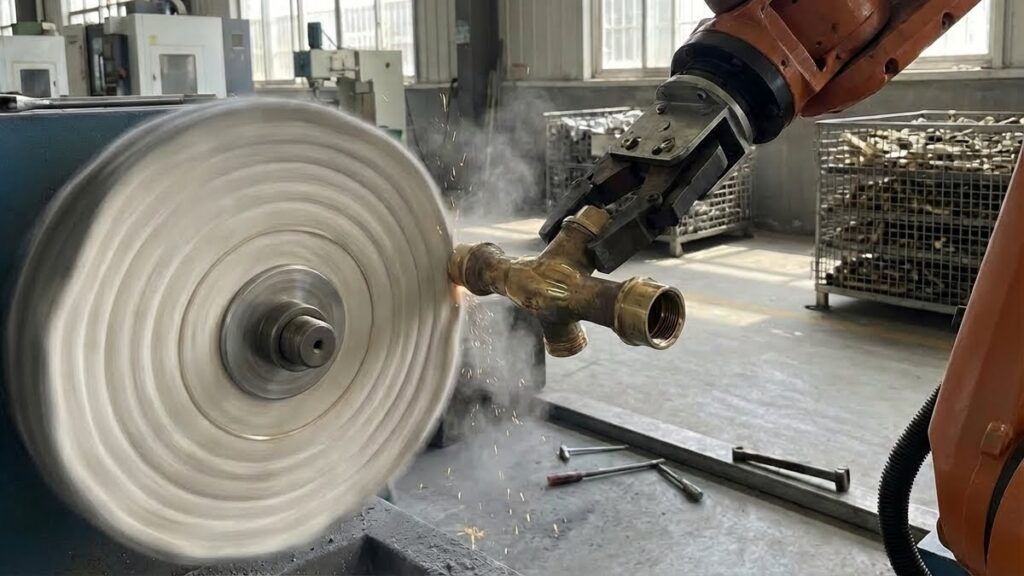
The quality of polishing directly determines the yield rate of the subsequent electroplating process and the final cosmetic appearance of plumbing hardware products. Built around the day-to-day pain points of sanitary hardware plants, this guide examines the technologies that make automated brass faucet polishing work. We cover process comparisons (manual vs. robotic), the application of Offline Programming (OLP) technology, the breakdown of multi-stage buffing processes, and consumable wear compensation strategies. Through detailed technical data and real-world production cases, we demonstrate how automated polishing breaks the “labor shortage” dilemma and achieves the optimal balance between plating substrate quality and production efficiency.
What is a Brass Faucet?
A brass faucet is a core component in high-end kitchen and bathroom facilities, primarily responsible for controlling and mixing water flow. To achieve corrosion resistance and excellent decorative effects, the brass body, after casting and machining, must undergo extremely rigorous surface polishing before final Chrome Plating or Nickel Plating.
Application Scenarios For Brass Faucet
Brass faucets are widely used in bathing systems for residential and commercial buildings. As they face the end consumer directly, they have extremely high “cosmetic attributes”.
- High-End Hotel & Residential Bathrooms: Requires perfect mirror reflection. The surface must have absolutely no water ripples, sand holes, or missed polishing spots.
- Kitchen Sink Mixer Taps: Designs often include large-arc gooseneck spouts, making it extremely difficult for polishing tools to conform perfectly to all curves.
All applications require zero-tolerance for the “pre-plating substrate quality”. The electroplating process does not hide flaws; rather, it magnifies microscopic scratches or unevenness left from the polishing stage tenfold.
Structural Characteristics For Brass Faucet
- Extremely Complex 3D Free-form Curves: Contains numerous continuous streamlined curves, sharp bends, and recesses, lacking standard geometric flat surfaces.
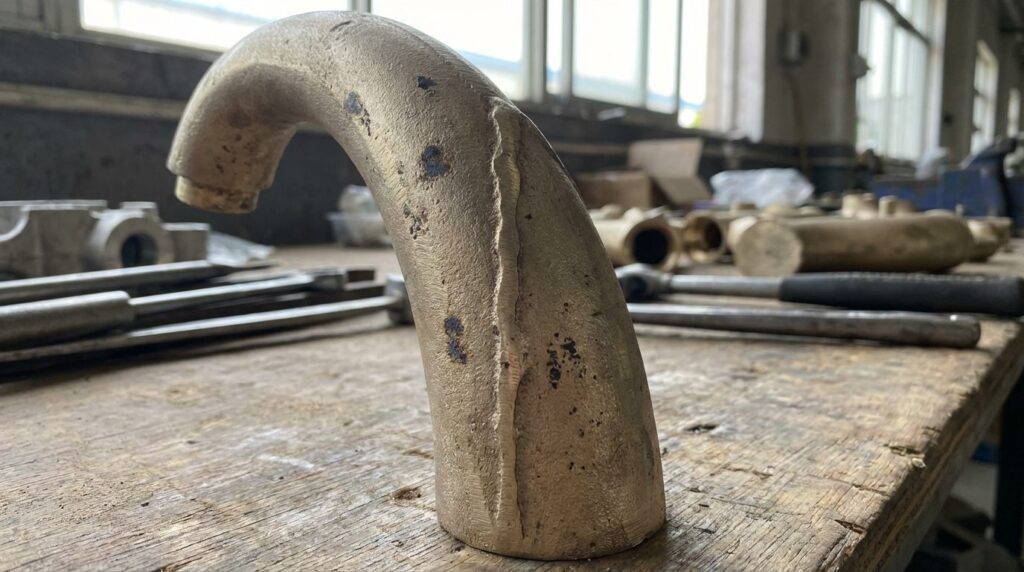
- Casting Porosity and Parting Lines: After sand casting or gravity die casting, micro-pores and stepped parting lines remain on the surface.
- Material Characteristics: Brass (typically Cu59) is relatively soft. Over-polishing can easily cause workpiece deformation or loss of design contours.
- Surface Quality: Must achieve a mirror-level roughness of Ra 0.05 – 0.1 to provide a flawless substrate for electroplating.
Key Characteristics of Faucet Polishing
Key Characteristics:
- High Gloss: Surface must be free of scratches, draw marks, and unpolished dead zones.
- Contour Fidelity: Post-polishing must retain the original industrial design streamlines; sharp edges cannot be lost due to over-grinding.
- Extremely High Yield: Reworking electroplated parts in the sanitary industry is highly expensive; the first-pass polishing yield must reach the high nineties.
Technical Parameters for Brass Faucet Polishing
| Item | Parameter Range | Notes |
| Sanding Belt Grit | P120 – P400 | Removes parting lines and deep pores |
| Sisal Wheel Speed | 1500 – 2500 rpm | Used with cutting compound for medium material removal |
| Cloth Wheel Speed | 1800 – 3000 rpm | Used for final mirror color buffing |
| Post-Polishing Roughness | Ra < 0.1 | Meets direct electroplating standards |
| Production Cycle Time | 3 – 5 Minutes | Depends on faucet size and curve complexity |
Why is Robotic Polishing Preferred for Brass Faucets?
Conventional Manual Polishing Pain Points
When manually operating in front of a polishing lathe, sanitary factories face severe challenges:
| Pain Point | Specific Issue | Impact |
| Severe Occupational Health Hazards | Polishing generates massive amounts of brass dust, cloth fibers, and compound fumes. | High risk of pneumoconiosis. It’s a high-hazard job that younger generations refuse to do. |
| Extreme Reliance on Skilled Labor | The angles of applied force and dwell time on complex curves rely entirely on a master’s “muscle memory”. | If personnel leave, production stops. Training novices takes many months. |
| Unstable Electroplating Yield | Worker fatigue leads to uneven polishing pressure, causing ripples or missed spots. | Defects are discovered post-plating, leading to high stripping/rework costs and soaring scrap rates. |
Advantages of Robotic Automation
Robotic polishing cells—typically a robot holding the workpiece against stationary polishing machines, a layout detailed in our robotic polishing machine guide—provide a systematic solution:
| Comparison Dimension | Manual Polishing | Robotic Polishing | Improvement |
| Machining Efficiency | Dependent on stamina | Continuous stable cycle | Steadily higher output |
| First-Pass Yield | Typically high eighties | High nineties, stable | Drastically reduces plating rework costs |
| Contour Consistency | Poor, prone to deformation | Repeatable contour fidelity | Preserves the industrial design |
| Consumable Utilization | High waste | Auto wear compensation | Longer wheel life |
Core Advantages:
- Offline Programming (OLP): Directly import the 3D CAD model of the faucet. The software automatically generates complex curved polishing paths, letting the robot reach the gooseneck dead corners humans struggle with.
- Auto Consumable Wear Compensation: As the buffing wheel shrinks from use, the system senses this via current torque or laser distance measurement, automatically adjusting the robot’s pushing force or TCP position to keep the polishing effect constant from start to finish.
- Turning “Craft” into “Data”: The master’s experience is solidified into robot programs, completely eliminating the enterprise’s reliance on specific skilled labor.
Automated Polishing Process Workflow
A brass faucet travels through eight stages inside the cell, from jig loading to final inspection. Polishing is a progressive refinement process, and the heart of it is the multi-stage grinding and buffing of steps 02-04, where different abrasive media progressively lower surface roughness.
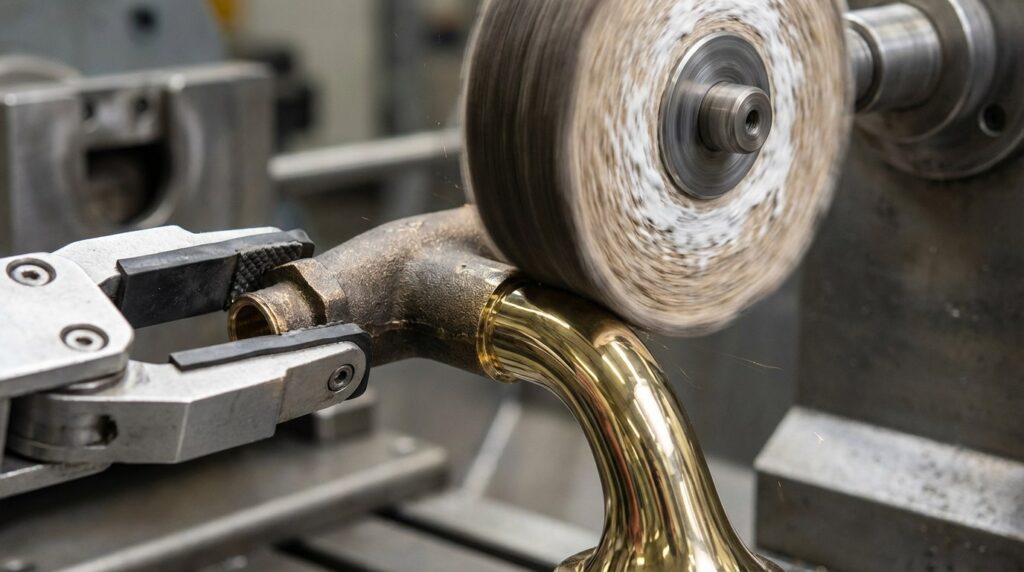
Complete Process Flow
| Process | Process Name | Equipment | Consumable | Time | Precision / Purpose |
| 01 | Jig Loading | Custom Quick-Change Jig + Robot | – | 10s | Gives repeatable positioning accuracy |
| 02 | Belt Sanding | Robot + Belt Sander | Alumina/SiC Belt | 60s | Removes casting lines and deep pores |
| 03 | Sisal Buffing | Robot + Polishing Spindle | Sisal Wheel + Cutting Compound | 90s | Removes sanding lines, flattens curves |
| 04 | Cloth Buffing | Robot + Polishing Spindle | Cotton Wheel + High-Gloss Compound | 80s | Achieves Ra<0.1 mirror gloss |
| 05 | Ultrasonic Cleaning | Auto Ultrasonic Line | Dewaxing Agent | 120s | Removes stubborn wax deep in pores |
| 06 | Pure Water Rinse | Spray Wash Cabin | DI Water | 40s | Removes chemical residue |
| 07 | Hot Air Drying | Tunnel Oven | – | 60s | Prevents oxidation and water spots |
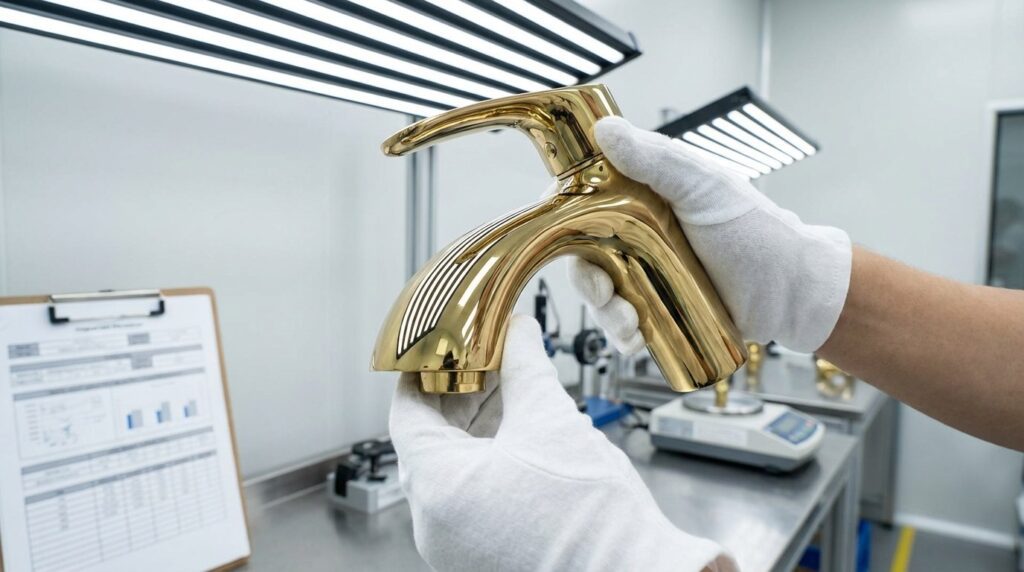
| 08 | Inspection | Zebra Strip Inspection Light | – | 30s | Visual check for consistency, move to plating |
Process Descriptions For Brass Faucets
Step 1: Jig Loading
Purpose: Secure the raw brass casting onto the robot’s gripper.
Key Points: Typically utilizes the internal water inlet threads as the expanding location datum, avoiding any fixture interference with the external surfaces that need polishing.
Step 2: Belt Sanding
Purpose: Quickly flatten prominent parting lines and deeper casting defects.
Key Points: The robot holds the faucet and presses it against a floating contact wheel on a belt sander, utilizing the flexibility of the belt to roughly conform to large curves.
Step 3: Sisal Buffing (Pre-polishing)
Purpose: Eliminate the linear scratches left by the sanding belt, further flattening the surface to prepare for coloring.
Key Points: Paired with an automatic compound spraying system that regularly applies coarse liquid compound to the high-speed sisal wheel. The robot executes complex 6-axis interpolated paths to ensure the wheel sweeps every dead corner.
Step 4: Cloth Buffing (Mirror Finish)
Purpose: The final surface “coloring” treatment to achieve a mirror standard ready directly for the electroplating bath.
Key Points: Uses extremely soft cotton cloth wheels and high-gloss compounds. The robot must control the contact force to prevent excessive temperature buildup that could scorch (yellow) the brass surface.
Step 5: Ultrasonic Dewaxing
Purpose: Polishing compounds (wax) penetrate tiny pores under high heat and are extremely difficult to clean once solidified. They must be completely stripped using high-temperature ultrasonic vibration.
Step 6: Pure Water Rinse
Purpose: Multi-stage rinsing with Deionized (DI) Water ensures the substrate surface is completely bare, with no media affecting electroplating adhesion.
Step 7: Hot Air Drying
Purpose: Rapidly dry the moisture to prevent the activated brass surface from quickly oxidizing and discoloring in the air.
Step 8: Inspection
Purpose: Inspect polishing quality under specific zebra lighting to ensure no dull areas, pores, or deformations exist.
Machining Challenges & Solutions
Challenge 1: Programming Complex Free-form Curves is Time-Consuming
Problem:
- Faucets feature avant-garde, ever-changing curves. Using a traditional teach pendant to manually record points for a new product might take 2-3 days.
- Manually taught paths are often not smooth enough, easily causing dwell marks (burning) at curve transitions.
Solution:
- Introduce Offline Programming (OLP) Software.
- Engineers import the 3D CAD model into a PC. The software automatically calculates surface normals and generates smooth toolpaths. After virtual interference checks, it is sent directly to the robot.
- Result: New product changeover time is slashed from days to hours, and path smoothness reaches perfection, completely eliminating dwell marks.
Challenge 2: Missed Spots Due to Shrinking Polishing Wheels
Problem:
- Cloth and sisal wheels are consumables; their diameters continuously decrease during polishing. If the robot maintains its original path, it will fail to reach the workpiece, leading to unpolished spots.
Solution:
- Implement Intelligent Consumable Wear Compensation Systems.
- Option A: Current Feedback. When the wheel shrinks and contact force drops, spindle motor current decreases; the robot automatically feeds forward toward the wheel to compensate.
- Option B: Laser Measurement. A laser sensor periodically measures the real-time diameter of the wheel, dynamically updating the robot’s Tool Center Point (TCP).
- Result: Guarantees that the first piece and the last piece (at the end of the wheel’s life) have 100% identical polishing quality.
Application Scenario
Project Profile
Project profile: a European sanitary hardware OEM specializing in geometric, minimalist brass faucets.
Technical Challenges
- Flat surfaces in minimalist designs highly test polishing skills; manual polishing easily rounds off sharp geometric corners (destroying the design intent).
- Extremely strict local environmental and labor regulations gave the workshop an ultimatum: shut down or fully automate.
- Required post-plating yield to stabilize in the high nineties.
The Solution
| Item | Configuration |
| Workpiece | Geometric Minimalist Brass Washbasin Faucet |
| Material | High-Purity Cast Brass |
| Equipment | 2 Coordinated 6-Axis Robots + 4-Station Pedestal Polishers |
| Core Tech | OLP + Laser Auto-Compensation + Auto Liquid Compound System |
| Process | Pick up -> Belt Sand -> Sisal Flat Polish -> Cloth Buff |
| Cycle Time | 3.5 Minutes / Piece (Two robots alternating) |
Implementation Results
- Labor: One robotic cell covers the output of several highly paid manual polishers.
- Quality: The sharp geometric edges designers demand are preserved piece after piece, and plating substrate yield climbs from the low eighties—typical of manual lines—into the high nineties and stays there.
- Compliant Operation: Fully enclosed cells combined with high-efficiency dust collection completely resolved workshop environmental compliance issues.
- Flexible Production: Using OLP software, the client now easily introduces several new product designs into automated mass production each month.
FAQ
Q1: Can robotic polishing completely replace human labor?
A: For over 95% of standard surfaces, robots not only replace human labor but do it better and more consistently. However, for extremely tricky, deep internal recesses, physical limitations of wheel sizes might prevent complete access. The industry standard practice is: the robot handles the vast majority of the polishing, while 1 operator performs a quick manual touch-up on microscopic dead corners, which already saves massive labor costs.
Q2: What is the advantage of an automatic compound system over manual application?
A: In manual polishing, workers press solid wax bars against the wheel by feel, leading to fluctuating cutting forces and compound buildup in workpiece crevices. Automatic liquid compound systems use programmable dosing pumps to spray exact amounts of polishing fluid onto the wheel at set intervals. This keeps abrasive distribution even, improves surface consistency, and makes ultrasonic dewaxing much easier.
Q3: How should fixtures be designed for differently shaped faucets?
A: The standard sanitary industry practice is “Zero-Interference Expansion Fixturing”. We utilize the hidden internal water inlet threads or mounting holes at the base of the faucet, using pneumatic expanding mandrels to grip the part from the inside. This exposes 100% of the external cosmetic surfaces to the polishing wheels, allowing full-coverage polishing in a single setup.
Q4: What is the typical Return on Investment (ROI) for this system?
A: Factoring in the savings from skilled worker salaries, drastically reduced plating rework costs, and approximately 20% longer consumable life, the ROI for a robotic faucet polishing cell running high-intensity two-shift production is typically between 12 to 18 months.
Conclusion
The surface treatment of brass faucets using a multi-stage robotic automated polishing system, combined with offline programming and intelligent wear compensation, can break the reliance on skilled manual polishers. With stable cycle times of 3-5 minutes per piece, it is the practical route for sanitary hardware enterprises to lift electroplating yields and meet environmental and labor requirements. The same architecture extends to other forged brass plumbing parts—our shower head robotic polishing solution covers the free-form curve case.
High plating rework, a shrinking pool of polishers and curves that defeat every trainee are exactly the problems a robotic faucet cell absorbs. Our engineering team can take your product from CAD model to proof-of-concept samples and on to automated deployment—see the case study library for reference projects.