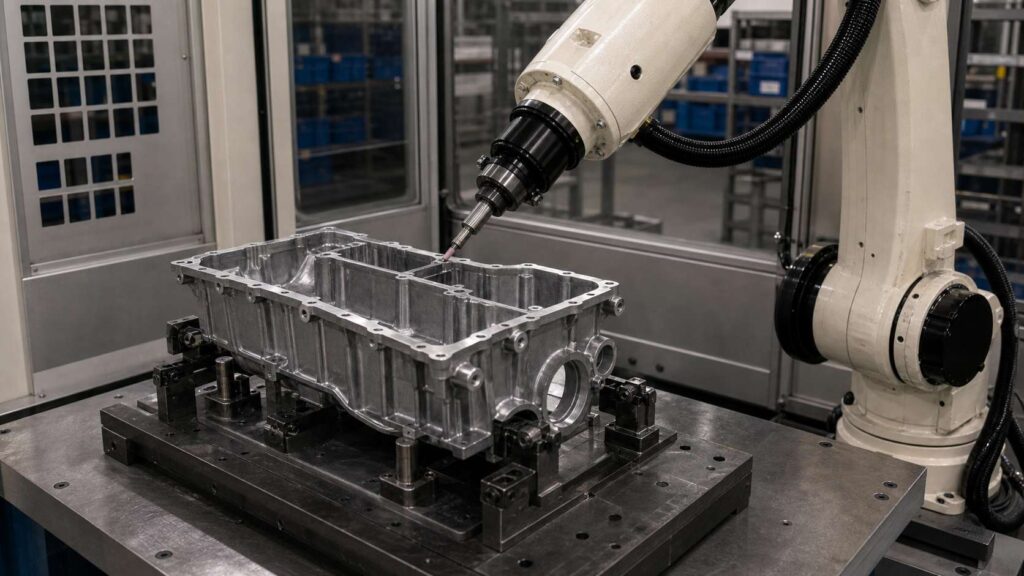
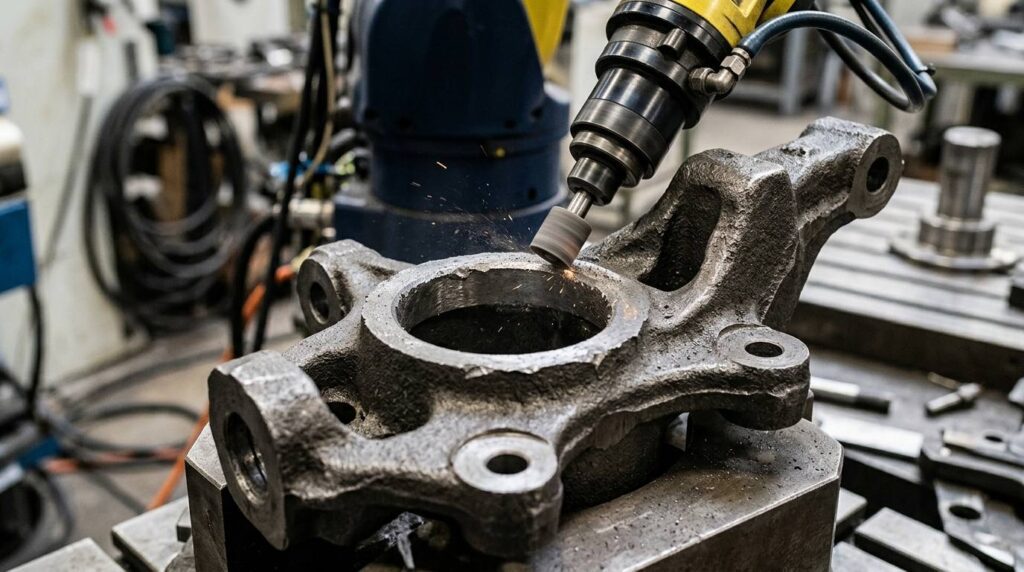
Aluminum alloy bearing ladder frames are structural casting components used in automotive engine lower-frame and crankshaft support systems. A typical part of this type has a ladder-like frame layout, multiple rectangular openings, cross beams, bearing support features, bolt holes, raised bosses and reinforced rib transitions, making post-casting deburring and local grinding more complex than on simple aluminum castings.
Giải pháp mài và loại bỏ gờ bằng robot này được thiết kế dành cho khung thang đỡ ổ trục bằng hợp kim nhôm, với kích thước tiêu biểu khoảng 400–650 mm chiều dài, tùy thuộc vào nền tảng động cơ. Giải pháp này giúp loại bỏ các gờ, vết thừa, cặn dọc đường phân chia, vết cắt cửa rót và các cạnh sắc nhọn trên các thanh khung, mép đỡ ổ trục, cửa sổ hình chữ nhật, lỗ bắt bu lông, các điểm chuyển tiếp của thanh ngang và các khu vực gân cục bộ, đồng thời cải thiện độ đồng đều của bề mặt hoàn thiện và giảm khối lượng công việc mài thủ công.
What Is an Aluminum Alloy Bearing Ladder Frame?
An aluminum alloy bearing ladder frame is a cast structural component used in the lower section of an engine assembly. It usually supports crankshaft-bearing-related areas, reinforces the lower engine structure and connects with the cylinder block, oil pan or other powertrain components through precise mounting and sealing interfaces. Neighboring parts in the same lower-engine assembly, such as the casting in our engine lower frame edge deburring solution, follow similar finishing logic.

Viewed as a whole, the workpiece shows a typical ladder-type structure with long side rails, cross beams, rectangular window openings, multiple circular holes, raised bosses and bearing support zones. After casting and trimming, burrs, flash, sharp edges and local gate residues may remain around the windows, rail edges, bolt holes, cross-beam intersections and boss boundaries. If the terminology is new to you, our primer on what robotic deburring covers explains the tools and process basics. Finishing for this casting centers on robotic deburring, controlled local grinding and edge cleanup; a polished appearance plays no part in the requirement.
| Mặt hàng | Chi tiết |
|---|---|
| Tên chi tiết gia công | Khung thang chịu lực bằng hợp kim nhôm |
| Kích thước tiêu chuẩn | Khoảng 400–650 × 250–400 × 80–180 mm, tùy theo mẫu |
| Chất liệu | Đúc hợp kim nhôm |
| Quy trình chính | Cắt gọt và mài bằng robot |
| Các quy trình được hỗ trợ | Làm tròn cạnh, Loại bỏ phần thừa, Làm sạch bề mặt cục bộ |
| Các lĩnh vực xử lý chính | Các thanh khung dài, các cạnh cửa sổ hình chữ nhật, các thanh ngang, các cạnh đỡ bản lề, các lỗ bu-lông, các ranh giới phần nhô ra, các điểm chuyển tiếp của gân, các khu vực cắt cửa |
| Các khu vực được bảo vệ | Bề mặt đỡ vòng bi, mặt lắp ghép, rãnh làm kín, lỗ chính xác, bề mặt ghép nối được gia công |
| Bàn thắng quyết định | Loại bỏ các gờ, phần thừa, các cạnh sắc nhọn và cặn bám cục bộ, đồng thời bảo vệ các bề mặt liên quan đến ổ trục và bề mặt làm kín |
Những thách thức điển hình trong quá trình hoàn thiện khung thang đỡ ổ trục bằng hợp kim nhôm
Khung thang dạng bậc thang làm từ hợp kim nhôm rất khó gia công hoàn thiện vì nó kết hợp các vùng chịu lực kết cấu và các bề mặt tiếp xúc đòi hỏi độ chính xác cao trong cùng một chi tiết đúc. Các thanh dọc và thanh ngang dài của khung tạo ra nhiều cạnh bên trong và bên ngoài, trong khi các cửa sổ hình chữ nhật và lỗ bắt bu-lông lại gây ra các vị trí gờ thừa lặp đi lặp lại trên toàn bộ chi tiết.
Việc gia công thủ công không ổn định vì người vận hành phải liên tục chuyển đổi giữa các công đoạn như mài góc cạnh đường ray dài, làm sạch mép cửa sổ, xử lý mép lỗ và mài cục bộ xung quanh các phần nhô ra. Các khu vực đỡ ổ trục và đường ray làm kín phải được bảo vệ cẩn thận; do đó, lực mài quá mạnh hoặc góc dao không chính xác có thể gây ra vết dao, mài quá mức cục bộ hoặc hư hỏng gần các giao diện chức năng.
| Vấn đề thường gặp | Lĩnh vực cụ thể | Tác động |
|---|---|---|
| Vết lóe khi đúc / Đường phân khuôn | Các thanh dọc khung dài, chu vi bên ngoài, các mép của thanh ngang | Ảnh hưởng đến tính nhất quán của mép và công tác chuẩn bị lắp ráp |
| Dư lượng cổng | Các phần cắt cửa cục bộ xung quanh thân khung hoặc đầu thanh ray | Yêu cầu phải loại bỏ vật liệu tại chỗ với khối lượng lớn hơn |
| Các góc nhọn | Cửa sổ hình chữ nhật, lỗ chốt, khe hở của dầm ngang | Gây ra các rủi ro trong quá trình xử lý và lắp ráp |
| Các gờ thừa | Gốc xương sườn, ranh giới khối, điểm giao nhau của thanh dọc | Gây ra chất lượng hoàn thiện không ổn định |
| Điều chỉnh thủ công | Các cạnh cửa sổ và nhóm lỗ lặp lại | Dẫn đến kết quả không nhất quán giữa các người vận hành |
| Các lĩnh vực chức năng nhạy cảm | Bề mặt đỡ vòng bi, thanh làm kín, mặt lắp đặt, lỗ chính xác | Nguy cơ hư hỏng trong quá trình mài thủ công |
Quy trình mài và loại bỏ gờ bằng robot cho khung thang đỡ ổ trục bằng hợp kim nhôm
A robotic deburring and grinding cell for aluminum alloy bearing ladder frames should be designed around frame rigidity, tool reach, force control and protected-zone management, and the machines in our 6-axis deburring equipment line are a common starting point for this class of workpiece. The process must remove burrs and flash from rails, windows, holes and cross beams while avoiding contact with bearing support surfaces, sealing rails and machined interfaces.

Đối với các khung thang có ổ trục có kích thước tiêu chuẩn khoảng 400–650 mm chiều dài, quy trình thường bao gồm các bước: xếp hàng, lựa chọn chương trình, xác nhận vùng bảo vệ, mài đường viền ray, loại bỏ gờ cạnh cửa sổ, làm sạch cạnh giá đỡ ổ trục, hoàn thiện phần chuyển tiếp của gân, kiểm tra và dỡ hàng. Có thể sử dụng các loại dụng cụ khác nhau tùy theo loại khuyết tật, bao gồm dụng cụ loại bỏ gờ linh hoạt, dụng cụ mài mòn, dụng cụ vát cạnh và đầu mài nhỏ.
| Bước | Quy trình | Mục đích | Công cụ / Hệ thống |
|---|---|---|---|
| 1 | Tải và định vị | Cố định khung thang để đảm bảo quá trình gia công diễn ra ổn định | Giá đỡ chuyên dụng |
| 2 | Lựa chọn chương trình | Chọn đúng mẫu khung và đường dẫn | Chương trình HMI / Robot |
| 3 | Xác nhận khu vực được bảo vệ | Xác định các vùng không được mài trên ổ trục, vòng đệm và bộ phận lắp đặt | Logic lịch thi đấu / Cài đặt chương trình |
| 4 | Mài thanh khung và đường viền ngoài | Loại bỏ cặn nhựa thừa và cặn dọc đường phân chia khỏi các thanh ray dài | Dụng cụ mài mòn |
| 5 | Loại bỏ gờ cạnh cửa sổ hình chữ nhật | Loại bỏ các gờ thừa ở các khe hở bên trong khung | Dụng cụ mài góc linh hoạt |
| 6 | Hỗ trợ ổ trục và xử lý mép trục | Xử lý các cạnh cục bộ xung quanh giá đỡ ổ trục và các gờ | Dụng cụ vát cạnh / Trục mài gờ |
| 7 | Hoàn thiện phần chuyển tiếp giữa dầm ngang và thanh giằng | Loại bỏ các gờ thừa tại các điểm giao nhau của dầm và gốc các thanh giằng | Đầu mài nhỏ / Dụng cụ tuân thủ |
| 8 | Xay nghiền tại chỗ cặn cổng | Loại bỏ các cặn đúc cục bộ dày hơn | Dụng cụ mài loại bỏ vật liệu dư |
| 9 | Kiểm tra chất lượng | Kiểm tra việc loại bỏ gờ và các khu vực chức năng được bảo vệ | Kiểm tra thủ công hoặc kiểm tra bằng mắt thường |
| 10 | Dỡ hàng và vệ sinh | Loại bỏ các hạt nhôm và chuyển chi tiết sang nơi khác | Thổi khí / Hút bụi |
Bước 1: Tải và định vị
Khung thang chịu lực bằng hợp kim nhôm được đặt vào một giá kẹp chuyên dụng, giúp đỡ chi tiết đúc từ các vị trí ổn định nhưng không tham gia vào quá trình gia công. Do phôi có các thanh dọc dài, thanh ngang và nhiều lỗ hở, độ cứng của giá kẹp là yếu tố quan trọng để ngăn chặn rung động trong quá trình mài góc và mài nhẵn.
Bộ kẹp phải giữ khung thang chịu lực ở vị trí ổn định, đồng thời cho phép tiếp cận các thanh ray ngoài, mép cửa sổ, lỗ bu-lông và các điểm nối dầm. Việc định vị chính xác cũng giúp robot duy trì khoảng cách an toàn với các bề mặt chịu lực và các điểm tiếp giáp làm kín.
Bước 2: Lựa chọn chương trình
Sau khi phôi được kẹp chặt, người vận hành sẽ chọn chương trình robot tương ứng thông qua giao diện người dùng (HMI). Tính năng này rất hữu ích khi một ô robot xử lý các mẫu khung thang tương tự nhưng có bố cục cửa sổ, mẫu lỗ bulông hoặc cấu trúc đỡ ổ trục khác nhau.
Chương trình đã chọn xác định trình tự gia công, tư thế của robot, loại dụng cụ, tốc độ tiến dao, lực tiếp xúc và các vùng được bảo vệ. Các chương trình đã lưu giúp quá trình gia công hàng loạt lặp lại diễn ra ổn định hơn và giảm sự phụ thuộc vào phán đoán thủ công của người vận hành.
Bước 3: Xác nhận khu vực được bảo vệ
Trước khi bắt đầu quá trình mài, hệ thống sẽ xác nhận các vùng không được mài. Đối với khung thang có ổ trục, các khu vực được bảo vệ thường bao gồm bề mặt đỡ ổ trục, thanh làm kín, mặt lắp đặt, miếng đệm đã qua gia công, lỗ chính xác và các bề mặt tiếp xúc lắp ghép.
Bước này quan trọng hơn đối với khung thang chịu lực so với các chi tiết đúc nhôm thông thường, bởi vì các mép dễ bị gờ có thể nằm gần các cấu trúc liên quan đến độ chính xác. Robot cần loại bỏ gờ khỏi rìa mép đồng thời đảm bảo các dụng cụ mài mòn không tiếp xúc với các bề mặt chịu lực và bề mặt làm kín có chức năng.
Bước 4: Mài thanh khung và đường viền ngoài
Robot xử lý các thanh dọc dài và đường viền ngoài – những vị trí thường xuất hiện các vết thừa sau khi đúc, vết cắt gọt và cặn dọc theo đường phân khuôn. Các khu vực này thường chạy dọc theo chiều dài của khung và có thể bao gồm các đoạn thẳng, các điểm chuyển tiếp ở góc và các phần nhô ra cục bộ.
Dụng cụ mài mòn có thể di chuyển theo đường viền ray đã được lập trình và loại bỏ các khuyết tật nhô cao. Đối với các chi tiết đúc từ hợp kim nhôm, cần kiểm soát độ sâu mài và áp lực tiếp xúc để tránh hiện tượng lem bề mặt, vết mài sâu hoặc việc loại bỏ vật liệu không cần thiết.
Bước 5: Loại bỏ gờ cạnh cửa sổ hình chữ nhật
Các lỗ hình chữ nhật là những khu vực gia công quan trọng trên khung thang của ổ trục. Các gờ và cạnh sắc có thể còn sót lại dọc theo viền của các lỗ này, đặc biệt là ở các góc và điểm giao nhau của các thanh ngang.
Dụng cụ mài góc linh hoạt rất phù hợp để xử lý mép cửa sổ vì nó có thể bám sát hình dạng mép bên trong đồng thời thích ứng với những sai lệch nhỏ trong quá trình đúc. Robot cần gia công từng tấm cửa sổ với góc tiếp cận ổn định để đảm bảo độ bo tròn mép đồng đều mà không làm thay đổi hình dạng của cửa sổ.
Bước 6: Giá đỡ ổ trục và xử lý mép trục
Các chi tiết hỗ trợ liên quan đến ổ trục và các phần nhô lên có thể có các gờ nhỏ xung quanh lỗ, các đường viền hình tròn và các điểm chuyển tiếp cục bộ. Các gờ này phải được loại bỏ, nhưng các bề mặt chức năng lân cận phải được bảo vệ.
Có thể sử dụng dụng cụ vát cạnh, trục mài gờ hoặc dụng cụ mài mòn nhỏ để thực hiện gia công cục bộ có kiểm soát. Robot gia công đường viền cạnh xung quanh từng phần nhô ra hoặc chi tiết chịu lực, đồng thời loại trừ các mặt ổ trục và các bề mặt tiếp xúc chính xác khỏi đường chạy dao.
Bước 7: Hoàn thiện phần chuyển tiếp giữa dầm ngang và thanh giằng
Các dầm ngang và gân gia cố tạo ra nhiều điểm giao nhau, nơi có thể còn sót lại các gờ sau khi đúc. Những khu vực này thường khó tiếp cận bằng tay do góc của dụng cụ thay đổi liên tục khi di chuyển giữa các thanh ray, dầm và các góc bên trong.

Một đầu mài nhỏ hoặc dụng cụ mài góc mềm dẻo có thể gia công các điểm gốc của thanh giằng, các điểm giao nhau của dầm và các vị trí chuyển tiếp lõm. Robot có thể chia khung thang thành nhiều vùng cục bộ và hoàn thiện từng vị trí chuyển tiếp với tư thế lặp lại chính xác.
Bước 8: Mài cục bộ cặn cửa khuôn
Một số vùng được cắt bằng khuôn có thể chứa vật liệu dày hơn so với các phần gờ thừa hoặc phần thừa thông thường. Những vùng này cần được mài cục bộ thay vì chỉ mài nhẹ các cạnh để loại bỏ gờ thừa.
Robot có thể sử dụng một dụng cụ loại bỏ phế liệu chuyên dụng với tốc độ tiến dao và áp lực được điều khiển. Việc tách riêng quá trình loại bỏ cặn cửa ra khỏi quá trình mài gọt chung giúp tránh việc mài không cần thiết trên các thanh khung đã sạch và các khu vực chức năng được bảo vệ.
Bước 9: Kiểm tra chất lượng
After robotic processing, operators inspect the long rails, rectangular windows, bolt holes, bearing support edges, boss boundaries, rib transitions and gate-cut areas. The check verifies that every window edge, rail and hole boundary is burr-free and that no functional surface has been touched.
Touch checks, go/no-go gauges and camera-based systems can supplement visual examination, depending on what the production line requires. Inspection feedback can also help optimize path compensation and tool replacement intervals.
Bước 10: Dỡ hàng và vệ sinh
Sau khi kiểm tra, khung thang có ổ trục được dỡ xuống và chuyển sang công đoạn tiếp theo. Cần loại bỏ các mảnh vụn nhôm, bụi mịn và các hạt cặn bám trên các khe hở, lỗ và các điểm giao nhau của các thanh giằng.
Nên sử dụng buồng robot kín có hệ thống thu gom bụi và mạt nhôm. Điều này giúp tạo ra môi trường gia công hoàn thiện sạch sẽ hơn và giảm thiểu việc người vận hành phải tiếp xúc trực tiếp với các công việc mài và loại bỏ gờ lặp đi lặp lại.
Những khó khăn trong gia công và các giải pháp
| Thử thách | Nguyên nhân | Giải pháp robot |
|---|---|---|
| Đèn chớp đường ray dài | Các thanh khung tạo ra đường phân chia dài và các vùng cần cắt gọt | Quỹ đạo mài đường viền ray được lập trình |
| Mũi khoan hình chữ nhật | Các khe hở bên trong tạo ra các đường viền có cạnh sắc lặp đi lặp lại | Loại bỏ gờ một cách linh hoạt dọc theo các thanh định hình cửa sổ |
| Bảo vệ khu vực ổ trục | Không được chạm vào các bề mặt đỡ và bề mặt làm kín của ổ trục | Các khu vực cấm mài và các lộ trình địa phương được kiểm soát |
| Các điểm giao nhau của dầm ngang | Các điểm giao nhau giữa dầm và thanh giằng tạo ra những vị trí có gờ hẹp | Sử dụng công cụ nhỏ kết hợp với các quy trình hoàn thiện tại chỗ |
| Loại bỏ cặn bám trên cổng | Các vùng cắt cổng chứa lớp vật liệu dư dày hơn | Đường mài chuyên dụng tại chỗ |
| Độ nhạy của bề mặt nhôm | Hợp kim nhôm có thể bị biến dạng do áp lực quá lớn | Lực tác động được kiểm soát, dụng cụ mài mòn phù hợp và sự tuân thủ |
Khó khăn 1: Hiện tượng lóe sáng trên đường ray dài và kiểm soát đường phân chia
Khung thang chịu lực có các thanh dọc dài và các đường viền ngoài, nơi có thể xuất hiện liên tục các vết thừa và cặn dọc theo đường phân chia. Việc mài thủ công dọc theo các mép dài này có thể dẫn đến hình dạng mép không đồng nhất và các vết trên bề mặt không đều.
Giải pháp là sử dụng đường chạy mài theo đường viền ray được lập trình sẵn. Điều này cho phép robot di chuyển theo hình dạng của ray với độ tiếp xúc của dụng cụ luôn ổn định, đồng thời loại bỏ các khuyết tật đúc nhô cao ở các vùng mép lặp lại.
Khó khăn 2: Các gờ thừa ở mép cửa sổ hình chữ nhật
Các cửa sổ hình chữ nhật xếp chồng lên nhau tạo ra các đường viền bên trong dài và các điểm chuyển tiếp ở góc. Các gờ sắc có thể còn sót lại dọc theo cả các cạnh thẳng của cửa sổ lẫn các góc bên trong, khiến việc mài gọt thủ công tốn nhiều thời gian và không đảm bảo độ chính xác.
Giải pháp là sử dụng hệ thống mài gọt bằng robot linh hoạt dọc theo từng thanh định hình cửa sổ. Robot có thể tiếp cận mép với lực ép được điều khiển và lặp lại cùng một đường đi cho mỗi khe hở, từ đó nâng cao tính nhất quán trên toàn bộ khung thang.
Mức độ khó 3: Bảo vệ mép đỡ ổ trục
Các khung thang chịu lực thường bao gồm các bề mặt và điểm tiếp xúc liên quan đến việc đỡ trục khuỷu hoặc cụm động cơ phía dưới. Các khu vực chức năng này tuyệt đối không được bị hư hỏng trong quá trình mài.
Giải pháp là xác định các bề mặt đỡ ổ trục, thanh làm kín và các giao diện chính xác là các vùng được bảo vệ. Robot sẽ loại bỏ các gờ thừa trên các cạnh liền kề nhưng giữ cho đường đi của dụng cụ nằm ngoài các khu vực quan trọng.
Mức độ khó 4: Các vết gờ ở điểm chuyển tiếp giữa thanh ngang và thanh dọc
Các thanh ngang và thanh dọc giúp tăng độ cứng kết cấu, nhưng chúng cũng tạo ra các điểm giao nhau hẹp và các vùng lõm nơi có thể còn sót lại các gờ thừa. Những vùng này rất khó làm sạch bằng tay nếu không liên tục điều chỉnh góc của dụng cụ.
Giải pháp là sử dụng đầu mài nhỏ hoặc dụng cụ mài góc mềm dẻo. Robot chia cấu trúc dầm và thanh giằng thành các khu vực hoàn thiện cục bộ và xử lý từng điểm chuyển tiếp với tư thế ổn định.
Mức độ khó 5: Loại bỏ cặn bám trên cổng cục bộ
Các vùng cắt cửa có thể chứa lớp vật liệu dư dày hơn so với các gờ thừa thông thường. Nếu các vùng này được gia công chỉ bằng dụng cụ mài gờ nhẹ, lớp vật liệu dư có thể vẫn còn sót lại; nếu mài quá mức bằng tay, các bề mặt lân cận có thể bị hư hại.
Giải pháp là sử dụng một quy trình mài cục bộ chuyên dụng dành riêng cho các tàn dư của cửa rót. Robot sẽ áp dụng dụng cụ, tốc độ tiến dao và lực tiếp xúc phù hợp chỉ vào khu vực bị ảnh hưởng, đồng thời bảo vệ các bề mặt xung quanh.
Application Scenario
Scenario Background
Consider a plant casting aluminum bearing ladder frames for engine lower-frame and crankshaft support applications. In a manual finishing loop, workers remove burrs, flash, gate residues and sharp edges from long rails, rectangular windows, bolt holes, bosses and cross-beam transitions by hand.
Once volumes climb, that handwork becomes hard to standardize: window edges and rib transitions end up under-processed on some shifts, while exposed rails get over-ground on others. This is the situation where a robotic deburring and grinding cell is typically introduced to stabilize consistency, cut manual workload and keep bearing-related interfaces safe.
Những thách thức kỹ thuật
The part presents long frame rails, multiple rectangular openings, cross beams, reinforced ribs, hole groups and bearing support features. Burrs sit across both long external edges and internal window edges, so several tool paths and tool angles are needed.
The core difficulty is balancing material removal against surface protection. Gate-cut areas call for stronger local grinding, while bearing support surfaces, sealing rails and precision holes must remain untouched.
Giải pháp
A cell built around this scenario combines a six-axis industrial robot, a dedicated ladder frame support fixture and a multi-tool finishing system: an abrasive grinding tool for long rail flash, a flexible deburring tool for window edges, a chamfering tool for bolt holes and bosses, and a small grinding head for beam intersections and rib roots.
Bearing support surfaces, sealing rails and machined interfaces are defined as protected zones in the robot program. The fixture holds the workpiece securely while leaving both external and internal edges reachable, and an enclosed cell with aluminum dust collection keeps chips and fine particles under control.
| Mặt hàng | Cấu hình |
|---|---|
| Chi tiết gia công | Khung thang chịu lực bằng hợp kim nhôm |
| Kích thước tiêu chuẩn | Khoảng 400–650 × 250–400 × 80–180 mm, tùy theo mẫu |
| Quy trình chính | Cắt gọt và mài bằng robot |
| Quy trình có sự hỗ trợ | Làm tròn cạnh, Loại bỏ phần thừa, Làm sạch bề mặt cục bộ |
| Robot | Robot công nghiệp sáu trục |
| Dụng cụ | Dụng cụ mài mòn, dụng cụ mài góc linh hoạt, dụng cụ vát cạnh, đầu mài nhỏ, dụng cụ gia công loại bỏ vật liệu |
| Lịch thi đấu | Dụng cụ cố định khung thang chuyên dụng cho ổ trục |
| Chiến lược bảo vệ | Các bề mặt đỡ ổ trục được bảo vệ, các thanh làm kín, các mặt lắp đặt và các lỗ chính xác |
| Kiểm soát bụi | Buồng kín có hệ thống thu gom bụi và mạt nhôm |
Kết quả triển khai
The robotic cell took over repetitive deburring and grinding work on long frame rails, rectangular windows, bolt holes, boss edges, beam intersections and gate-cut areas. The operator’s role shifts to loading, unloading, inspection and tool maintenance, so repetitive grinding intensity drops and batch-to-batch results stay consistent.
Buồng làm việc kín này cũng giúp cải thiện việc kiểm soát mạt kim loại và bụi trong quá trình hoàn thiện sản phẩm đúc nhôm. Thay vì phải mài thủ công ở khu vực mở xung quanh phôi, các hạt nhôm được thu gom bên trong buồng, góp phần tạo ra một khu vực sản xuất sạch sẽ và được kiểm soát tốt hơn.
| Khu vực kết quả | Sự cải thiện |
|---|---|
| Chất lượng Rail Edge | Việc làm sạch dọc theo các thanh khung dài diễn ra ổn định hơn |
| Loại bỏ gờ cạnh cửa sổ | Đảm bảo tính nhất quán cao hơn xung quanh các lỗ hình chữ nhật |
| Bảo vệ khu vực ổ trục | Giảm nguy cơ hư hỏng các bề mặt đỡ ổ trục và bề mặt làm kín |
| Xử lý lỗ và gờ | Làm sạch các cạnh có thể lặp lại xung quanh các lỗ và các phần nhô lên |
| Hoàn thiện phần chuyển tiếp của xương sườn | Giảm thiểu các vết gờ thừa tại các điểm giao nhau giữa dầm và thanh giằng |
| Vệ sinh cặn bã tại cổng | Các lối đi riêng dành cho cặn đúc dày hơn |
| Giảm nhân công | Giảm bớt khối lượng công việc lặp đi lặp lại liên quan đến việc mài và loại bỏ gờ bằng tay |
| Sự ổn định trong sản xuất | Các chương trình đã lưu để sản xuất lặp lại các lô khung thang |
| Môi trường hội thảo | Khu vực hoàn thiện sạch hơn với hệ thống thu gom bụi bằng nhôm kín |
Thông tin cần thiết cho đề xuất dự án mài bằng robot
Để đề xuất một tế bào gia công robot phù hợp cho việc loại bỏ gờ và mài khung thang chịu lực bằng hợp kim nhôm của quý khách, chúng tôi thường cần bản vẽ chi tiết, loại vật liệu, trọng lượng đúc, hình ảnh các gờ, phần thừa, đường phân chia hoặc cặn cửa rót, các khu vực cần gia công, các bề mặt ổ trục hoặc bề mặt làm kín cần bảo vệ, thời gian chu kỳ mài thủ công hiện tại và sản lượng hàng năm.
With this information, our engineers can judge fixture concept, robot reach, tool choice, extraction layout and overall process feasibility. For bearing ladder frame castings, it is especially important to identify which areas require material removal and which bearing support, sealing or precision interfaces must be protected during robotic finishing.
Câu hỏi thường gặp
Q1: Is this workpiece a bearing ladder frame?
Yes. The workpiece discussed here is an aluminum alloy bearing ladder frame, with long frame rails, cross beams, rectangular window openings, bolt holes, bosses and bearing-related support areas.
Q2: Why is robotic deburring and grinding suitable for this workpiece?
Việc sử dụng robot để mài và loại bỏ gờ là phù hợp vì chi tiết này có các đường ray, cửa sổ, lỗ và các điểm giao nhau của dầm lặp lại nhiều lần. Robot có thể di chuyển theo các đường dẫn đã được lập trình với độ tiếp xúc ổn định của dụng cụ, giúp nâng cao tính nhất quán so với thao tác thủ công.
Q3: What areas can the robot process on a bearing ladder frame?
Robot có thể xử lý các thanh khung dài, các cạnh cửa sổ hình chữ nhật, lỗ bắt bu-lông, ranh giới các phần nhô ra, gốc các đường gân, điểm giao nhau của các thanh ngang, các khu vực cắt khuôn và vị trí đường phân chia. Các khu vực cụ thể cần được xác nhận dựa trên bản vẽ và phân bố gờ thừa thực tế.
Q4: Does this aluminum alloy ladder frame require polishing?
Trong hầu hết các trường hợp, bộ phận này không cần phải đánh bóng trang trí. Yêu cầu chính là loại bỏ gờ, mài cục bộ, loại bỏ phần thừa và bo tròn các cạnh. Mục đích là loại bỏ các gờ và cạnh sắc nhọn đồng thời bảo vệ các bề mặt chức năng.
Q5: How are bearing support and sealing surfaces protected?
Các bề mặt cần bảo vệ được kiểm soát thông qua việc định vị giá kẹp, lập kế hoạch đường đi của robot và các vùng cấm mài trong chương trình. Các bề mặt đỡ ổ trục, thanh làm kín, lỗ chính xác và các bề mặt tiếp xúc đã được gia công đều được loại trừ khỏi đường đi mài.
Q6: Can one robotic cell handle similar ladder frame models?
Yes. One robotic cell can often handle similar aluminum alloy bearing ladder frame models if the fixture, robot reach and tooling are designed for part variation. Each frame number can keep its own stored program, so switching variants is a selection task rather than a reprogramming task.
Kết luận
Khung thang chịu lực bằng hợp kim nhôm có các thanh dọc dài, lỗ hình chữ nhật, thanh ngang, các bộ phận hỗ trợ chịu lực, lỗ khoan và các điểm nối được gia cố, khiến việc mài và loại bỏ gờ bằng tay khó đạt được tiêu chuẩn nhất quán. Giải pháp mài và loại bỏ gờ bằng robot giúp các nhà sản xuất loại bỏ gờ, phôi thừa, cặn cửa rót và các cạnh sắc nhọn, đồng thời nâng cao tính nhất quán và bảo vệ các khu vực chức năng liên quan đến ổ trục.
Nếu quy trình sản xuất khung thang chịu lực của quý vị vẫn còn phụ thuộc vào việc mài ray, loại bỏ ba via ở mép cửa sổ hoặc làm sạch cặn bám trên cửa bằng tay, Liên hệ với chúng tôi for a customized robotic solution. To see how this equipment family fits automotive casting lines, browse our Ô tô & Xe điện applications or the full Thiết bị range.